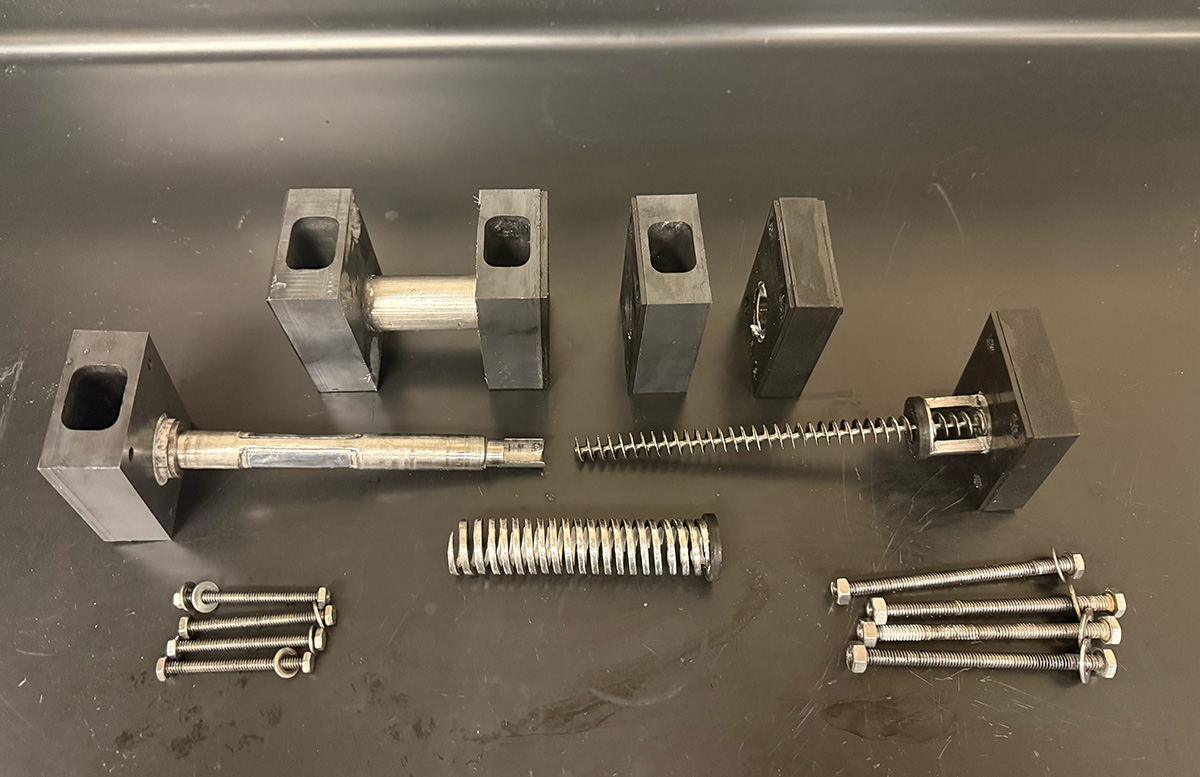
 The disassembled components of the NAS-EFC, including concentric stainless steel screws, current collectors, housings and bearings. The integrated screw-pump mechanism allows the device to handle thick electrode suspensions that clog conventional flow cell designs.
As solar and wind power become larger parts of the electrical grid, energy
storage systems have become essential for managing the intermittent nature
of renewable sources. These storage systems need to safely hold large
amounts of energy and release it quickly when demand spikes or generation
drops.
One promising approach uses flowable electrodes, suspensions of carbon
particles in liquid electrolyte that can be pumped through reactors to
charge and discharge. But there is a catch: packing more carbon particles
into the suspension increases energy capacity but also makes the material
thick and difficult to pump, whereas keeping it less concentrated reduces
storage potential.
A Drexel University engineering team has reported a flow cell design
inspired by the Archimedes screw, an ancient pumping device, that aims to
address this challenge. Led by
E. Caglan Kumbur, PhD
, professor of mechanical engineering and mechanics, researchers developed
the Nested Archimedes Screw-Electrochemical Flow Cell (NAS-EFC), which uses
concentric rotating screws within a cylindrical chamber to simultaneously
pump and charge dense carbon suspensions. The work appears in the February
issue of the Journal of Power Sourcesand demonstrates improvements
over conventional flat-plate cell designs used in electrochemical flow
capacitor devices.
Unlike conventional planar flow cells used in many electrochemical systems,
the tubular architecture offers an increased surface-to-volume ratio,
potentially enabling more effective utilization of the suspended carbon
particles. The concentric screws transport oppositely charged electrode
materials through separate channels divided by an ion-permeable membrane. As
the screws rotate, they continuously convey carbon suspensions while
generating shear forces that keep particles well mixed and reduce particle
settling or aggregation.
“These slurries are shear-thinning, meaning their apparent viscosity
decreases with increasing shear rate,” Kumbur said. “This becomes especially
beneficial at higher solid loadings, where pumping demands increase
significantly. By applying an active shearing mechanism throughout the
reactor volume, this concept may allow thick suspensions to be transported
more readily while preserving electronic conductivity.”
Working with Jonathan Ehring, PhD ’26, Engin Sever, PhD ’27 and Ali Mizrak,
PhD ’24, now a postdoctoral scholar at the University of Tennessee,
Knoxville, Kumbur’s team demonstrated that the system could continuously
transport suspensions at high solid concentrations, where planar cell
configurations can quickly become clogged or experience large pressure
drops. The device achieved high specific capacitance at low scan rates and
coulombic efficiency close to 95 percent in static mode.
In continuous flow tests, pumping energy requirements increased with solids
loading but remained within a manageable range across the conditions
studied. At the highest solid concentration tested, the pumping energy
increase relative to baseline was still lower than the several-fold pressure
increases reported for similar suspensions in planar flow cells. The team
also found that high concentrations of active material combined with small
amounts of conductive additive provided a desired balance between energy
capacity and electronic conductivity in the tested configurations.
“The NAS-EFC architecture enables simultaneous fluid propulsion and
electrochemical energy conversion, which is critical for practical
deployment,” Kumbur explained. “Beyond energy storage, this screw-driven
approach may also find applications in flow-electrode capacitive
deionization for water treatment, direct lithium extraction from brines, and
other applications where high-viscosity suspensions need to be transported
while maintaining electrochemical activity. The reliability and scalability
of screw-pump mechanisms make them well-suited for industrial energy storage
systems.”
The study was supported by the National Science Foundation. Future work will
focus on optimizing screw geometry and channel dimensions to further reduce
pumping energy while maximizing electrochemical performance across different
flowable electrode chemistries.
Read the paper online at
https://researchdiscovery.drexel.edu/esploro/outputs/journalArticle/A-novel-archimedes-screw-inspired-tubular-cell/991022147202404721