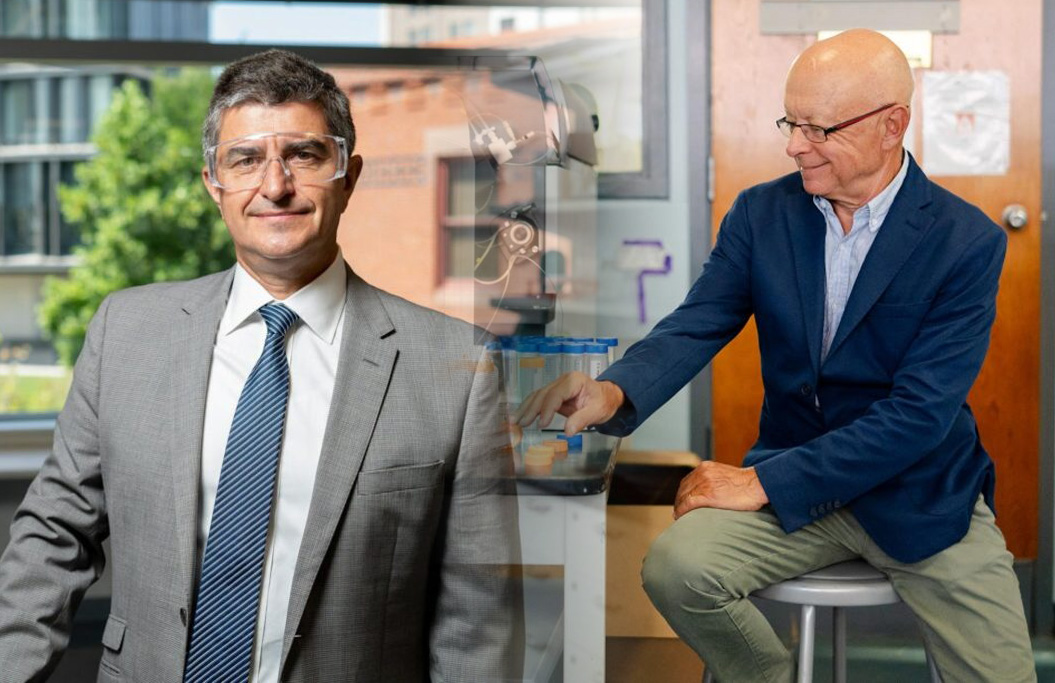
Yury Gogotsi, PhD, Charles T. and Ruth M. Bach Distinguished University Professor, and Michel W. Barsoum, PhD, Distinguished Professor, both in the Howley College's Department of Materials Science and Engineering, have been awarded the American Physical Society's (APS) 2027 James C. McGroddy Prize for New Materials. They share the prize with their former student Michael Naguib, PhD materials science and engineering '14, now a professor of physics and engineering physics at Tulane University.
The APS cited the three "for seminal work on MXenes, a broad family of 2D metal carbides and nitrides for optoelectronic and energy storage applications." The honor comes 15 years after the team, with Naguib then a doctoral student working under Barsoum and Gogotsi, reported the first MXene in the journal Advanced Materials.
Established in 1997 and endowed by IBM and the APS Division of Materials Physics, the McGroddy Prize recognizes outstanding achievement in the science and application of new materials, including the discovery of new classes of materials. The award will be presented at the APS Global Physics Summit, April 11-16, 2027, in Atlanta. Gogotsi said the source of the prize makes it particularly significant.
"It's important that this award comes from the physics community," he said. "MXenes have been widely appreciated and awarded by the chemistry and materials communities. Finally, the physics community has recognized the importance of MXenes, 15 years after they were first published."
That recognition reflects the materials' unusual physics. MXenes combine high metallic conductivity with ultra-low thermal conductivity, show chemically tunable superconductivity, highly nonlinear optical properties, and interact strongly with electromagnetic waves ranging across gamma rays and microwaves. Because their chemistry and structure can be controlled, those properties can be tuned, and recently discovered MXenes include semiconducting and 2D magnetic materials.
The discovery drew on both advisors' research. Barsoum and colleagues began revealing the properties of MAX phases, a large family of layered carbides and nitrides, in 1996. Gogotsi had spent years studying selective etching of carbides, including MAX phases, along with carbon nanomaterials such as graphene. Barsoum said the discovery depended on what each of the three brought to it.
"Scientific discoveries are rarely the work of a single person; they are built through collaboration, persistence, curiosity and the willingness to pursue ideas whose potential is not always immediately apparent," he said. "Sharing this award with them is a recognition of that collective effort and of a scientific journey we have shared."
According to Gogotsi, the discovery itself was serendipitous. The team was trying to make lithium-ion battery anodes from MAX phases as part of a U.S. Department of Energy project, and began selectively etching the material to give lithium ions easier access to its layered structure. After many attempts, Naguib removed a single atomic layer of aluminum from titanium aluminum carbide, leaving sheets just a few atoms thick that the team named MXenes.
Since that first report, MXenes have become one of the most active areas of materials research. Laboratories in more than 120 countries now study hundreds of MXene compositions for energy storage and conversion, electromagnetic interference shielding, thermal management, optoelectronics, water purification and other uses. With thousands of patents issued or pending and ton-scale manufacturing underway, MXenes are moving toward commercial impact.
Gogotsi places MXenes on a short list of entirely new material families discovered in the United States, alongside vulcanized rubber, Bakelite, Teflon and Kevlar, and the first since fullerenes in 1985. Among recent discoveries, he noted, MXenes are a rare case of a broadly applicable material family conceived, synthesized and initially developed at a single U.S. institution before spreading worldwide.
Drexel remains a center of that work through the A.J. Drexel Nanomaterials Institute, which Gogotsi directs, and Naguib has continued it at Tulane, which he joined in 2018 after serving as a Wigner Fellow at the U.S. Department of Energy's Oak Ridge National Laboratory. All three are Clarivate Highly Cited Researchers.
"When we first reported on MXenes, I did not anticipate the extraordinary breadth of research that would follow," Barsoum said. "I believe the story of MXenes is still being written, and I look forward to seeing where the next decade takes us."