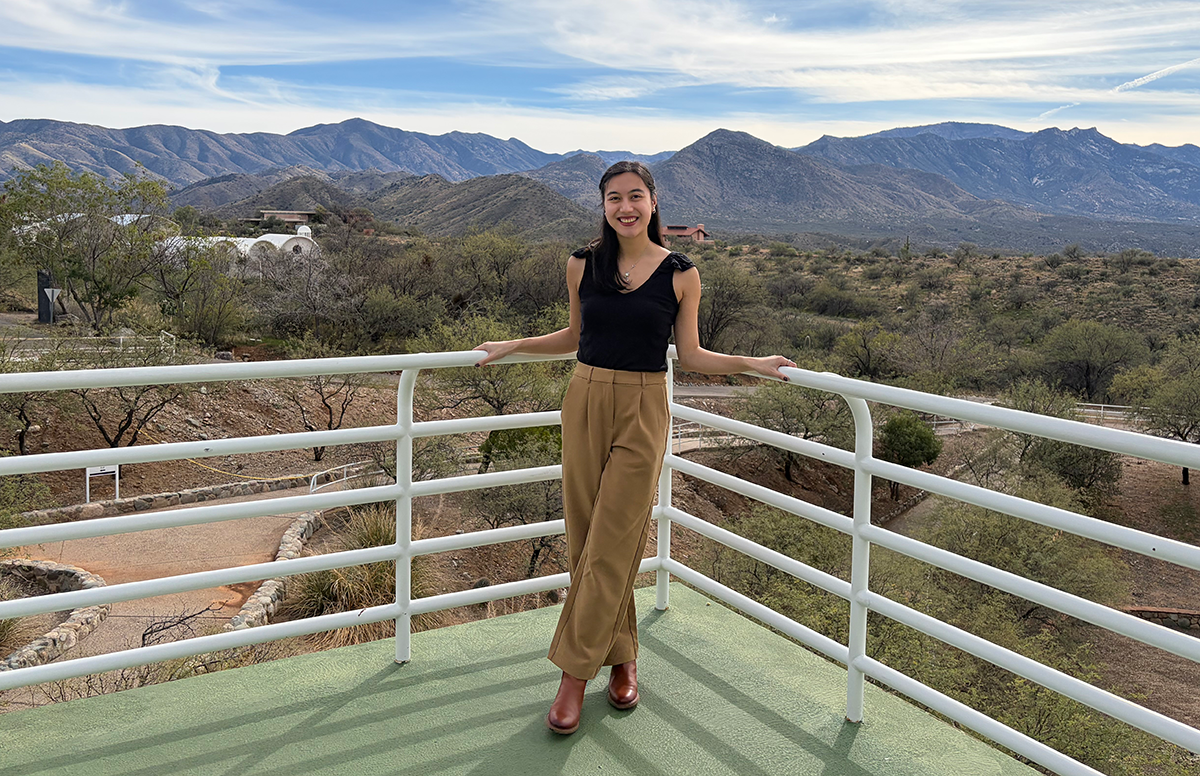
Alessandra Cabrera designs stage backdrops, hosts a podcast, runs a literary
journal, and has spent five years studying materials at the atomic level.
She is, in other words, not easy to categorize. That is entirely the point.
And on June 12, she’ll add another identity to her dossier: the
undergraduate commencement speaker for the Drexel University College of
Engineering's Class of 2026.
Cabrera, a fifth-year materials science and engineering student with a minor
in linguistics, arrived at Drexel in fall 2021, just as campus was coming
back to life after the pandemic. Research would become one of the defining
threads of her time at Drexel, woven through five years of labs, grants, and
mentoring relationships. But it nearly didn't happen at all.
When she filled out her application, she passed over a checkbox asking
whether she wanted to apply for the STAR (Students Tackling Advanced
Research) Scholars Program. She didn't know what it was. It wasn't until she
arrived on campus that a conversation with someone who did know changed the
trajectory of her next five years. She applied after the fact and was
accepted.
The program pairs first-year students with faculty mentors for a summer of
hands-on research. Cabrera was matched with
Caroline Schauer, PhD
, the Margaret C. Burns Chair in Engineering, whose lab was developing
natural polymer films infused with food waste, designed to line aluminum
cans and extend shelf life. Schauer remains a mentor figure today.
"She was a really good mentor," Cabrera said. "We still stay in touch, even
if I don't work in her lab."
A
Pennoni Honors College mini-grant
later opened the door to a second research experience. Cabrera's interest in
the polymer properties of MXenes, a class of two-dimensional nanomaterials,
gave her a through line she could carry forward from Schauer's lab into new
territory. She landed at the
A.J. Drexel Nanomaterials Institute
, where she has spent most of her undergraduate career developing
polymer-MXene composite films with applications in energy storage,
electromagnetic shielding, and water desalination.
Three co-ops carried that same curiosity into the working world, taking her
from bio-based seed coatings to gypsum in the construction industry to
adhesives. Each one landed her somewhere she hadn't expected to go, and she
made the most of all three.
Outside the lab and the classroom, Cabrera built a campus life that mirrored
the same instinct. She serves as president of Material Advantage, the
College of Engineering's materials science student organization, where she
has spent five years bringing together her community. She works at the
Drexel Writing Center as a Peer Reader and hosts the Drexel Writing Center
Podcast. And this year she participated in the Filipino Intercultural
Society at Drexel University (FISDU), where she designed more than 40
nine-foot stage backdrops for the annual cultural show while also dancing in
the production.
Perhaps no student organization captures her sensibility more fully than
Lit Lab
, a science and humanities journal she co-founded with friends across
disciplines. Its mission is to publish work that bridges those two worlds,
from personal essays on language and culture to analyses of engineering
crises around the world.
"Literally everyone who's approached me about it, they're like, ‘I want to
write, I never get a space to do that,’" she said. "When I talk to people
about Lit Lab, they realize, ‘oh, I feel like I had to give up being an
artist to be a scientist.’ And I think that the mission resonates with
them."
It is the same thing she tries to tell her mentees in Material Advantage.
“Engineering,” she says, “does not have to look one way.” And she has made a
point of showing up in spaces where that message carries weight, from
recruiting panels to orientation events, as a Filipina woman in a field
where that kind of visibility is still rare.
"I always try to volunteer at these events," she said, "because someone
might be able to look at me and say, she's approachable. Maybe I can ask her
about her experience."
What comes next is taking shape. Cabrera was recently awarded a Fulbright English Teaching Assistantship and will spend the coming year in Kazakhstan. Engineering will be part of her future, she says, but not right away. For now, she is following the same instinct that has guided her through five years at Drexel, staying curious, staying open, and trusting that the foundation holds.
"Material science, we're studying things with a microscope," she said. "You
need to get down to the bottom of it. The atoms of it. And I think that
brings a sense of curiosity to things. I think that's something that Drexel
engineering definitely offers."