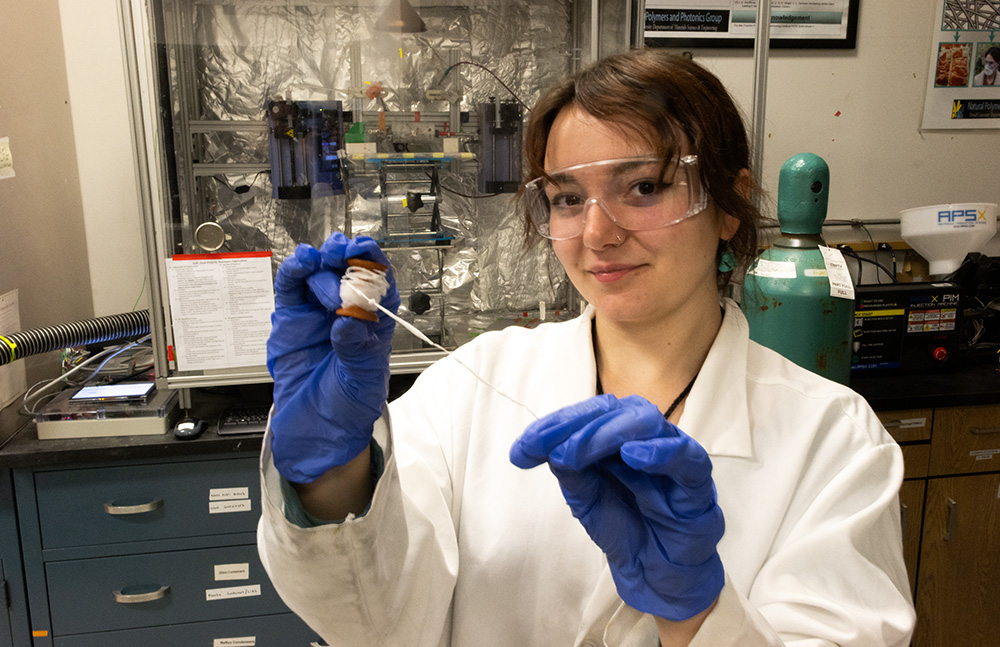
 Buscemi
As the fashion and materials fields look for more sustainable textile
solutions, researchers at Drexel University are developing novel biopolymer
nanoyarns. Working in the lab of
Caroline Schauer, PhD
, Margaret C. Burns Chair in Engineering and Materials Science and
Engineering’s department head, students prepare carefully measured polymer
solutions and use electrospinning, a process where electrical force
stretches and spins solutions into nanofibers. These nanofibers are then
collected and twisted into a larger nanoyarn using a motor-controlled
system.
One of these researchers is Saffron Buscemi, a fourth-year custom-designed
major studying the intersection of fashion with textile science and
technology. Drexel’s VIP Project initiative is a hands-on research
opportunity which allows Buscemi to explore how engineering principles can
shape the future of sustainable textiles.
Vertically Integrated Projects
(also called VIPs) are opportunities wherein undergraduate students work
with a group of other students in both undergrad and graduate programs,
research staff, and faculty members. These research projects can earn
students academic credit or inclusion on research papers.
“When I first read about the biopolymer nanoyarn VIP project, I noticed
right away that it aligned with my research and career interests,” Buscemi
said. “The idea that you can take a polymer and, through the process of
electrospinning, transform it into nanoyarn felt exciting and something I
had to be a part of.”
At the lab, each experiment begins by preparing a polymer solution a day in
advance. The polymer concentration, chosen by previous testing, is
documented and placed on a tube rotator for 24 hours. The next day, the
polymer solution is divided between various syringes, connected to tubing
and needles, tested and mounted onto the electrospinning apparatus. The
electrical force pulls the liquid out of the needles and stretches it into
thin fibers, while a small motor-controlled collector operated by a
Raspberry Pi spins these fibers into a nanoyarn.
Through the project, Buscemi has developed an appreciation for precision and
documentation in research. She emphasizes the importance of carefully
recording decisions, small adjustments and even unsuccessful trials,
recognizing that each detail can shape the outcome of an experiment. That
mindset has influenced her classroom approach as well, where she regularly
engages in experimentation and embraces curiosity, event when answers are
not immediate.
Working with teammates and mentors in different phases of their careers
has also enhanced her learning.
“Dr. Schauer is an amazing mentor to work with,” Buscemi said. “It is a very
welcoming and collaborative environment. I have also worked closely with
former PhD students of the lab, Emma Snelling and Divya Kamireddi, so being
able to see their dissertation process has also been incredibly rewarding.”
She credits the VIP program with furthering her research goals.
“Working within the intersection of materials science and engineering,
fashion design, and emerging technologies has positioned me with unique
skillsets and perspectives that reflect the value interdisciplinary learning
can have in any research or job setting,” Buscemi said. “Being able to find
ways to merge and apply them together might just create the next innovation
of tomorrow.”