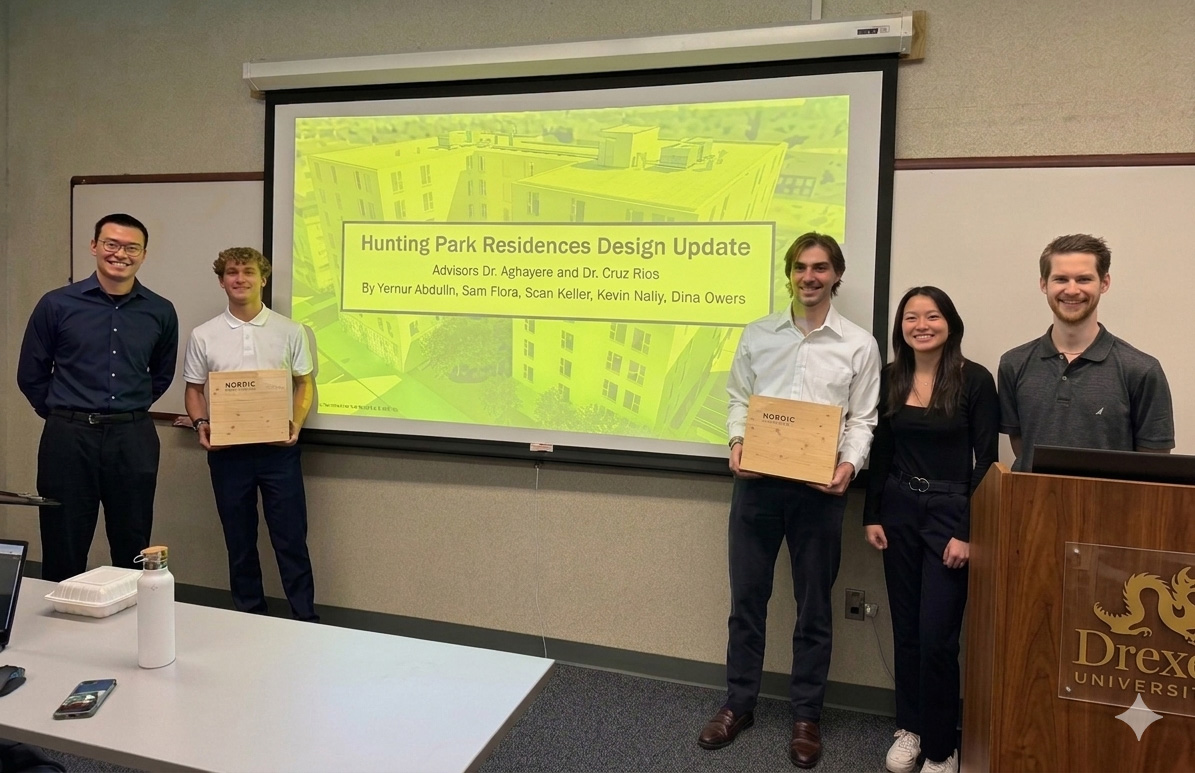
 The team, from left: Sean Keller, Dina Owers, Sam Flora, Kevin Nally, Yernur Abdulin
A team of five senior civil and architectural engineering students is
working to address Philadelphia's affordable housing shortage with a
mixed-use development proposal for a long-vacant site in the city's Hunting
Park neighborhood, and doing it with a construction material rarely seen on
the East Coast.
The project envisions a multistory building that uses mass timber as its
primary structural system. Mass timber, an engineered wood product made by
laminating or compressing lumber into large, load-bearing panels and
columns, has gained traction in Europe and on the West Coast for its
combination of structural performance and sustainability benefits. Unlike
steel and concrete, wood stores carbon rather than emitting it during
production, and mass timber construction tends to be faster and quieter than
conventional building methods, a meaningful consideration for an occupied
neighborhood. The material can also offer greater fire resistance than
traditional wood-frame construction.
"The choice of mass timber as a structural system led us to a design that
focused on helping the building's residents and the surrounding community,"
said team member Sam Flora. "The site we selected in Hunting Park has been
abandoned for years, and by developing this project we are trying to bring
new equitable development to the area and reduce demand for housing within
the city."
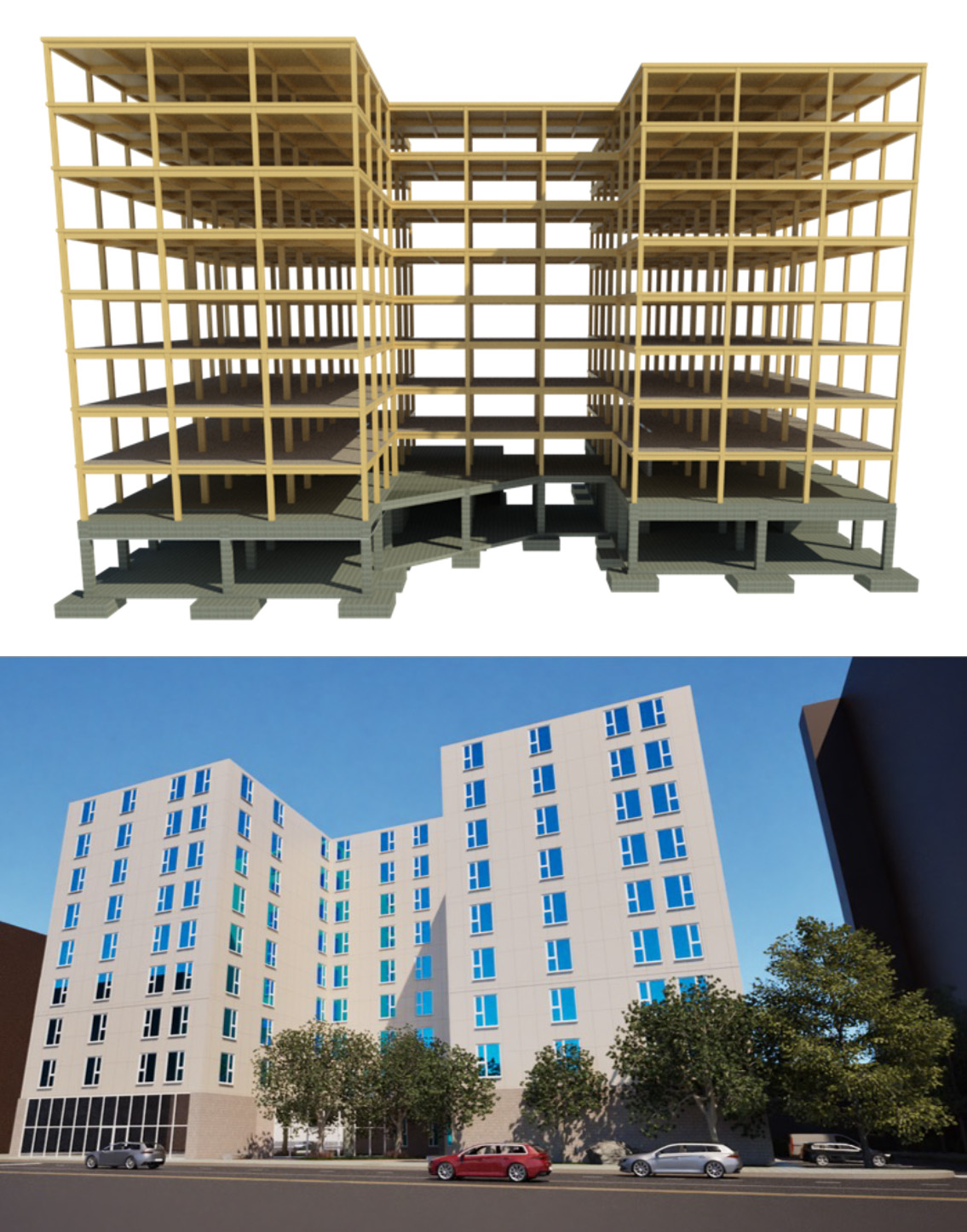 Renders of the team's concept, with the timber and concrete structure at top and the building as it would be seen from North Broad Street below
The team is composed of Flora, Yernur Abdulin, Kevin Nally, Sean Keller and
Dina Owers, all seniors in Drexel's Department of Civil, Architectural and
Environmental Engineering. Their project is part of the College of
Engineering's senior design program, a three-course sequence that asks
students to take ownership of an open-ended problem from the ground up,
build a team around it and see it through. Work was distributed based on
each student's area of expertise, with the diversity of their classroom and
co-op experiences shaping both how the team came together and how
responsibilities were divided. Site grading work was coordinated with
Stonefield Engineering, an industry partner that advised on soil extraction
analysis and preliminary grading using Civil3D software.
Over the fall and winter terms, the team developed the project's structural,
site and mechanical design. Now they are turning their focus to life cycle
assessment, energy modeling for LEED certification and construction clash
detection, the process of identifying conflicts between different building
systems. The team says that the structure of the senior design sequence,
allowing for a depth of iteration not possible in a standard course.
"Not everything has a clear answer, so you have to be able to adapt and make
decisions as you go," said Owers. "I've also learned how important it is to
take feedback and use it to improve both the project and my own ideas. It is
not just about coming up with solutions, but also about how you present
them, since communicating your work clearly is just as important as the work
itself."
The project is a design exercise rather than a development proposal, but
Flora sees it as a proof of concept with a longer reach. "The discussions
and feedback I have received from my team, peers, advisors and reviewers
have influenced and improved the design monumentally," he said. "As an
engineer you are always learning and improving, and I hope this project
brings attention to equitable and environmentally conscious design for
incoming seniors."