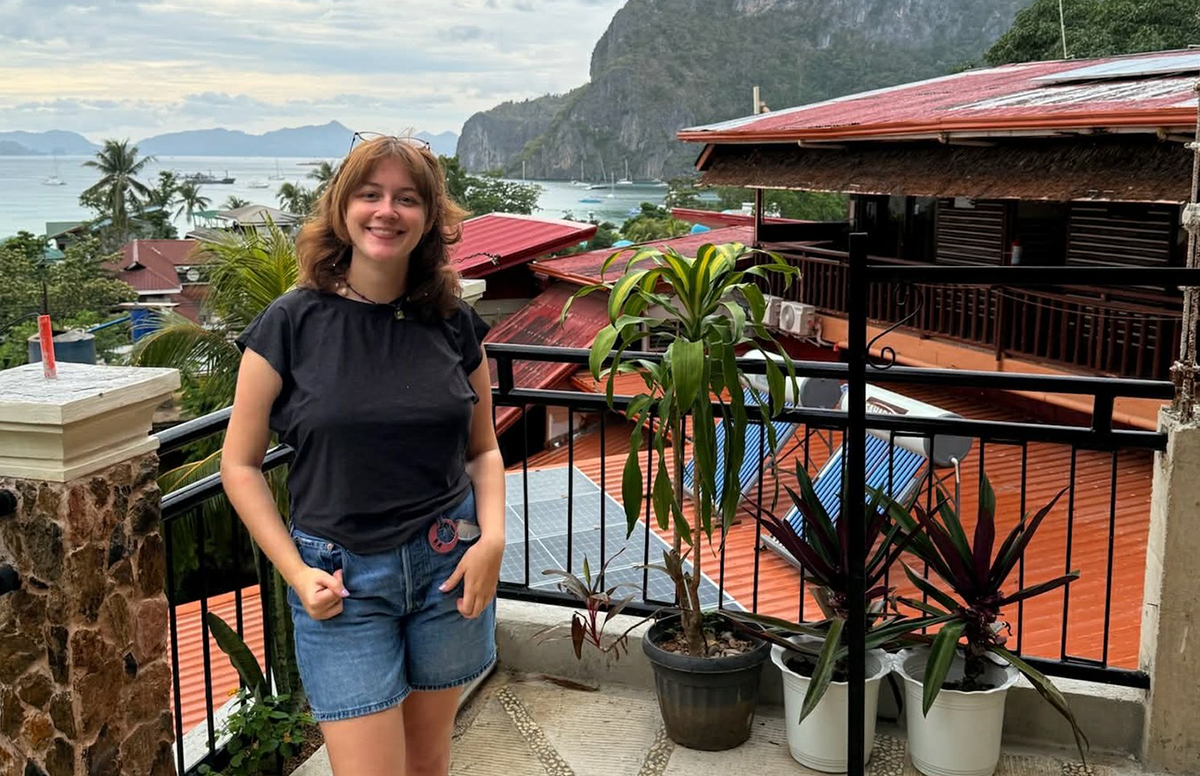
Alyssa Kemp's research days in the Philippines don't begin with a laptop.
They begin with a walk to the barangay hall.
As a
Fulbright researcher
working in Sablayan, a coastal municipality on the island of Mindoro, Kemp,
BS/MS
environmental engineering
'25, is conducting a community-informed assessment of coastal resilience
across three barangays, or small, tightly knit neighborhoods. Her fieldwork
looks nothing like it would in the U.S. In Sablayan's coastal fishing
communities, email isn't part of daily life, which means Kemp shows up in
person, prints whatever she needs to bring, and sits down with whomever she
needs to talk to. If she needs to follow up, she makes the trip back and
hopes they're available.
"Things are at a very personal level here," Kemp said, “It might annoy me in
America, where I’m used to emailing reports and expecting a quick reply, but
as a foreigner in the Philippines, I appreciate it because it has allowed me
to build more personal relationships through this work.”
Through stakeholder sessions with fisher folk, tourism workers, and women,
Kemp is documenting how residents experience disasters and coastal hazards,
including flooding, storm surges, and coastal erosion, and using
participatory mapping to let them identify hazard areas, safe zones, and
gaps in local preparedness. The ultimate goal is a presentation of findings
to government officials that centers the community's own priorities.
The need is real and urgent. The Philippines ranks first in the world in
disaster risk, facing a near-constant cycle of typhoons, earthquakes,
landslides, and volcanic eruptions. In Sablayan, only three of the
municipality's twenty-two barangays have official evacuation centers, and
those that exist fall short: inadequate bedding, insufficient food stores,
gaps in emergency response capacity.
"The biggest thing is the lack of funds to support disaster risk reduction
efforts," Kemp said. "Even the three barangays that have evacuation centers
aren't fully adequate."
Her project also touches marine protected areas, where she has found a
parallel problem: conservation regulations being shaped without meaningful
community input.
"The community members right now feel that they aren't involved enough, and
that their perspectives aren't fully incorporated," she said. "If they make
stricter laws, residents need to be part of that process."
It helps that she has seen those reefs up close. Sablayan sits near Apo
Reef, one of the largest coral reef systems in the world, and when Kemp
isn't running stakeholder sessions she is snorkeling its waters. "The waters
in the Philippines are crystal clear, so you can easily see the coral reefs
and schools of tropical fish beneath the surface," she said. "Snorkeling has
quickly become one of my favorite pastimes." Kayaking and swimming round out
her time off.
Kemp is candid about the scope of her work. She is covering three of ten
coastal barangays, conducting sessions in Tagalog while still learning the
language, and calls the result a baseline assessment. But she sees it as a
starting point for something larger, and a model for how this kind of
engagement can work.
"I just wanted to show an example of how a community of this size could
start incorporating more community knowledge, and also show pathways for
local residents to connect with their government about these issues," she
said. "Taking this one small step of telling the mayor about these people's
experiences, I hope opens the door to more of it."
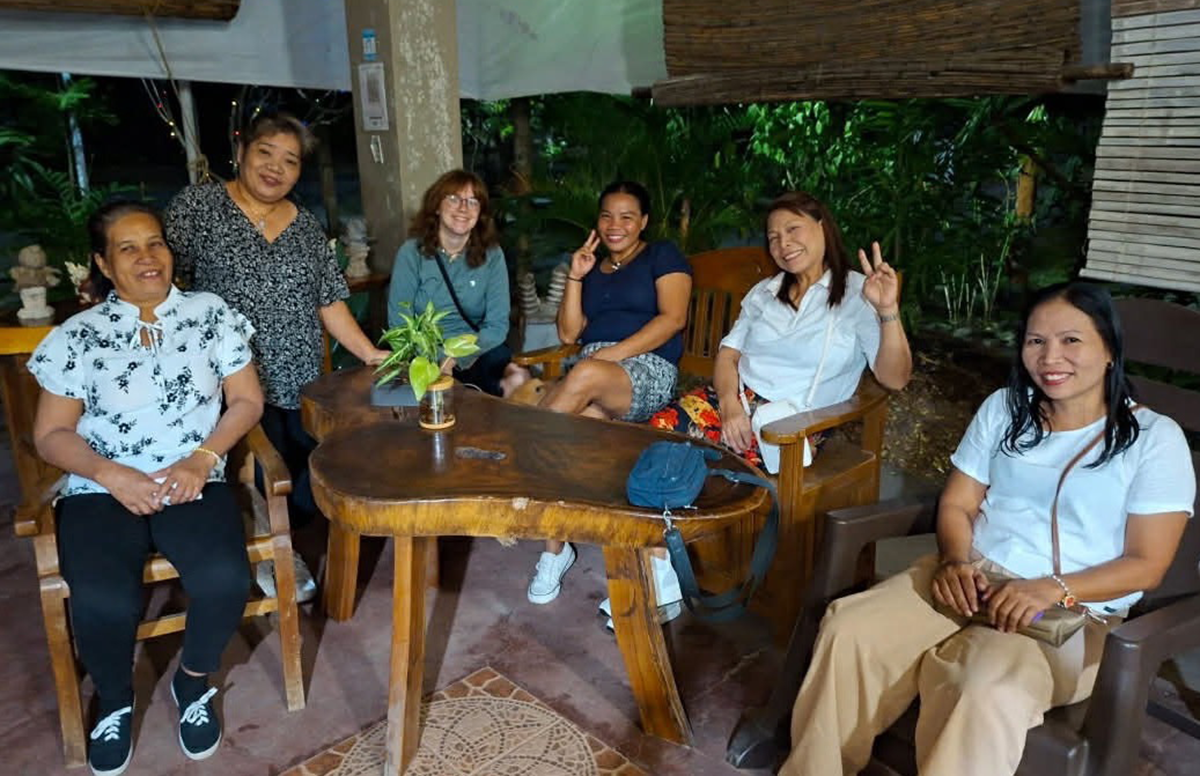
What has surprised her most about the Philippines is something harder to
measure. Before arriving, people told her how resilient Filipinos are.
Living here, she said, is another thing entirely.
"Saying it out loud is not the same as seeing it in person," Kemp said. "The
Philippines has a saying, bayanihan, which means communal unity and
helping each other. Even to a foreigner like me, I've been helped in any
situation I've needed. They have to live through so much, and they're very
resilient, very joyful."
The work builds on a foundation laid at Drexel, where Kemp spent years
developing her approach to community-centered environmental engineering.
Among the projects that shaped her was work with
Franco Montalto, PhD
, professor of civil, architectural and environmental engineering, on
climate resilience
in Philadelphia's Hunting Park neighborhood. It was one of several
experiences at Drexel that taught her to move between technical work and
community engagement, and she traces her current focus directly back to it.
"Engineers need to be able to work across sectors and really integrate
community knowledge and work with policymakers and residents," Kemp said.
"All of this is what I did in Hunting Park. That was really the start of my
passion."
Montalto, who completed his own Fulbright fellowship in Italy after college,
encouraged Kemp to apply for hers. She describes him as a core thread
running through her trajectory, from that first community project in
Philadelphia to the coastal barangays of Mindoro.
"Engineers who can incorporate local knowledge, work between sectors, work
with residents and policymakers, I think are better equipped to design
solutions that are more effective and more sustainable to this ever-changing
climate," Kemp said.