Office of Research & Innovation Newsletter - Spring 2026

In this issue:
General
- Welcoming ORI Team Members
- Novelution Implementation Update
- Powering Pennsylvania’s Future: Drexel and Partners Launch AI + Quantum Initiative
- News from the Undergraduate Research & Enrichment Programs (UREP) in the Pennoni Honors College
- New Library Catalog User Interface
- Wiley Open Access Publishing Agreements Now Available
- Drexel Libraries Testing New Reprints Feature in Drexel Research Discovery
Applied Innovation
Research Compliance & Regulatory Affairs
- ORI Guidance and Procedure Update
- Animal Compliance Spotlight
- New IBC Chemical Hazards Reference List
Sponsored Programs
- Federal Sponsor Updates
- Message from the Office of the Comptroller and Office of Research and Innovation
- Drexel Researchers Receive New Awards!
- Update on NSF Major Research Instrumentation Program
- Simons Foundation Now Accepting Applications for Next Class of Pivot Fellows
- Research Spotlight: Urban Health Collaborative
- CDMRP Announces New Research Outcomes Dashboard
- Student Research Achievements: Fall 2025
Did You Know?
- The Drexel Compliance Hotline
- Research Quality Assurance Program: Good Documentation Practices
- Resource Highlight: Drexel University Factbook
Other Research Training, Education, and Meeting Opportunities
- Keeping Up with Generative AI: Detecting Synthetic Images as AI Accelerates (May 22)
- The Future of Social Science Convening (June 4)
Stay Connected with the Office of Research & Innovation!
An Introduction from Sarah Archibald, Associate Vice Provost for Research Compliance and Regulatory Affairs
As the new Associate Vice Provost for Research Compliance and Regulatory Affairs, I want to extend my sincere appreciation to the Drexel University community for the incredibly warm welcome I’ve received. From my first days on campus, I’ve been struck by the strong sense of collaboration, connection, and shared purpose that defines Drexel. I am truly excited and grateful to join a community so deeply committed to innovation and impact. It is an energizing moment to be here, and I look forward to what we will build together.
In my role, I have the privilege of working alongside an exceptional team of research compliance professionals. Over the past few months, they have ensured seamless operations while giving me the opportunity to meet many of you across campus. Together, we are identifying new ways to support Drexel’s faculty, staff, and students engaged in the research enterprise. Below are several initiatives currently underway or recently implemented:
IRB
- Certificate of Confidentiality training (expected summer 2026)
- Rollout of Novelution’s IRB module later this summer
IACUC
- Reminder signage for checking expired medications during semi-annual inspections (April 2026)
- Rollout of Novelution’s IACUC and Animal Facility Management modules (expected late 2026/early 2027)
- New PI training that covers animal welfare regulations, the difference between the University Laboratory Animal Resources (ULAR) and the Institutional Animal Care and Use Committee, roles and services provided by ULAR, researcher responsibilities, tips for IACUC submissions, and resources to stay informed and in compliance
IBC
- Development of a Chemical Hazards Reference List to assist PIs in determining whether a chemical used in research requires IBC oversight and the completion of Form C: Hazardous Substance Addendum [DOC]
Research Security
- Multiple options now available for meeting research security training requirements (NSF 60-minute course or CITI course)
Research Integrity
- Planning for the next Responsible Conduct of Research (RCR) training during Welcome Week
Research Compliance Reminders
Research Quality Assurance Program
Drexel’s Research Quality Assurance Program continues to promote Good Clinical Practice (GCP) through guidelines, tools, training, and quality assurance reviews. Consistent application of GCP principles—such as proper informed consent, protocol adherence, and thorough documentation—reflects our shared commitment to high-quality, compliant research. Please visit the Clinical Research Guidelines and Tools page for resources, which are updated regularly. Research QA reviews, conducted in accordance with ORI-601 Research Quality Assurance Reviews Procedures [PDF], also support ongoing education and regulatory compliance across the research community.
Export Control & Research Security
If you are planning foreign travel for Drexel business or academic purposes, please submit a foreign travel registration at least six weeks prior to departure.
Reporting Misconduct
If you suspect research misconduct that may violate the law, University policy, or the University’s Code of Conduct, you may report concerns at 866.358.1010 or via the Drexel Compliance Hotline website.
I look forward to strengthening our partnerships across campus and continuing to enhance efficiency, transparency, and support within research compliance.
Best,
Sarah Archibald
Questions? Please email Sarah Archibald, Associate Vice Provost for Research Compliance and Regulatory Affairs at sarah.archibald@drexel.edu.
General
Welcoming ORI Team Members
Please join us in welcoming our new colleagues to the following teams:
Joining the Sponsored Programs Team
Jesse Szeto, Director of Contracts and Subawards. We are pleased to warmly welcome back Jesse Szeto in his new role as Director of Contracts and Subawards. Jesse previously served as a consultant with Drexel for over a year and a half, and many of you have already had the opportunity to work with him.
Jesse is a senior research administration leader with more than 20 years of experience spanning R1 universities, nonprofit organizations, and international research programs. He brings deep expertise in pre- and post-award operations, federal compliance, and institutional policy development, along with a strong track record of leading high-performing teams and managing complex research portfolios.
His career includes leadership roles at Georgetown University, the University of Wisconsin, the University of California, Davis, and The Geneva Foundation, as well as global program experience with the National Council of University Research Administrators (NCURA). He has also served as a gubernatorial appointee for the State of California and has played a key role in advancing international research partnerships.
We are delighted to have Jesse rejoin the team and look forward to the leadership and expertise he will bring in this role.
Joining the Research Compliance & Regulatory Affairs team
Shawn Gilmore, Animal Caretaker. We’re pleased to welcome Shawn Gilbert to the Drexel ULAR team as Animal Caretaker, effective February 23, 2026.
Shawn brings over a decade of local experience from the former Hahnemann Hospital and the New College Building loading dock, where he worked closely with Center City staff and assisted ULAR with animal receipt and delivery. That exposure familiarized him with our procedures before he officially joined Drexel.
In his role, Shawn will support daily husbandry and animal care operations at the New College Building, collaborating with veterinary and laboratory staff to uphold our high standards of animal welfare. His enthusiasm for the laboratory animal field, strong work ethic, and quick learning have allowed him to rapidly develop the skills needed to contribute effectively as a caretaker.
We have come to know Shawn for being reliable, team-oriented, and committed to continuous learning. We’re happy to have him on the team and look forward to supporting his career growth and endeavors.
Fun fact: Shawn also supervises for the Philadelphia Eagles Organization on some of his weekends!
Questions? Please email the Office of Research & Innovation's HR team at ori_hr@drexel.edu.
Novelution Implementation Update
Dear Colleagues,
A critical step in the implementation of our new Novelution research administration modules is User Acceptance Testing (UAT). Over the past month, we completed UAT on the first module to be launched, IRB. This UAT phase involved faculty and staff from across campus using the system in real world scenarios to confirm that it performs as expected. This type of user feedback is critical to ensuring the system is reliable, accurate, and supportive of the work we do every day from the day the system goes live.
During the testing period, several issues were identified that require additional time to resolve. These findings are addressable and not unexpected for a project of this scale; in fact, UAT is designed specifically to surface such issues before a system becomes part of daily operations.
To ensure a smooth transition from COEUS to Novelution and a high-quality experience for all users, we are adjusting the IRB module launch date to early summer. Our teams are actively analyzing and addressing the UAT findings with the vendor, and we will share the updated go-live date as soon as the process is completed.
We recognize that many individuals and units have been preparing for the original timeline, and we are committed to supporting you through this brief adjustment. Most ongoing activities—including training, readiness efforts, and transition planning—will continue, though some deadlines may shift. If you need to submit a protocol or other information for review in the interim, please use COEUS and the HRPP team will triage normally until Novelution is live.
As we move towards go live for the IRB module, we will continue offering additional resources, including training sessions and open office hours to maintain momentum and ensure everyone feels confident and prepared for launch. A list of FAQs to help answer questions about this change, training documentation, and more is available on the Novelution Hub, where continued updates will also be posted.
We look forward to building on this progress with the phased rollout of additional modules, which will further enhance functionality and support evolving institutional needs. Timelines for other upcoming modules, including Sponsored Research, may be adjusted to allow for the successful completion of the IRB module. We will share updates as planning progresses in the coming months.
Thank you for your continued partnership as we work to deliver a reliable and effective system for the Drexel research community.
With appreciation,
Doug Stay
AVP, Research Business Operations & Technology
Office of Research & Innovation
Questions? Please email the Novelution Implementation Team at novelution_info@drexel.edu.
Powering Pennsylvania’s Future: Drexel and Partners Launch AI + Quantum Initiative
Drexel University is proud to be part of the Keystone AI + Quantum Factory, a first-of-its-kind collaboration uniting Pennsylvania’s leading research institutions, including Carnegie Mellon University, Lehigh University, Pennsylvania State University, Temple University, University of Pennsylvania, and University of Pittsburgh, to advance AI and quantum innovation across the Commonwealth.
Through this initiative, Drexel University is contributing its research expertise and collaborative approach to help build shared, cutting-edge infrastructure that fosters true innovation. By working alongside partners across the state, Drexel is helping to create a unified innovation ecosystem that connects academia, industry, and government.
Aleister Saunders, PhD, Executive Vice Provost of the Drexel University Office of Research & Innovation notes, “Drexel is so excited to be collaborating with our fellow R1 institutions across the Commonwealth, the Pittsburgh Supercomputing Center, the Commonwealth of Pennsylvania, and Team Pennsylvania as we partner on efforts to accelerate discovery and real-world impact in artificial intelligence and quantum technologies. By aligning our talent, infrastructure, and research strengths, we can move faster, think bigger, and ensure that these transformative technologies advance economic growth, national competitiveness, and the public good.”
This effort positions Pennsylvania to compete at the highest level, unlocking new opportunities for research translation and workforce development, while ensuring that advances in AI and emerging technologies deliver meaningful benefits for communities across the state.
Questions? Please email Keystone AI + Quantum Factory at info@keystonefactory.org.
News from the Undergraduate Research & Enrichment Programs (UREP) in the Pennoni Honors College
Update on NSF Graduate Research Fellowship
In 2025, the National Science Foundation introduced major changes to eligibility for its Graduate Research Fellowship Program (NSF GRFP) that may affect your students and mentees in the upcoming application cycle:
- Second-year graduate students are no longer eligible; students can only apply in the first year of their first graduate program.
- BS-MS joint degree students are only eligible to apply in the final year of their joint degrees; they will not be eligible in the future as first-year PhD students.
- Rising seniors and alumni of undergraduate programs not yet enrolled in a graduate program are eligible to apply and have the highest odds of selection.
- Students who applied as prospective graduate students will still be permitted to re-apply in the first year of their graduate program; there is no penalty for re-application.
Drexel supports all students and alumni applying to the NSF GRFP with summer workshops, drop-in hours with successful applicants, a summer writing group, and expert feedback through our campus review process through Undergraduate Research & Enrichment Programs (UREP) in the Pennoni Honors College. Interested applicants should be directed to UREP's Applicant Resource Site for GRFP.
Faculty play a vital role in the success of our undergraduate and graduate students in pursuing this important source of graduate funding.
- Please talk with incoming Summer/Fall 2026 PhD students about whether they plan to apply, as the application deadline is expected to fall only a few weeks after the start of the fall term.
- Rising undergraduate seniors should also be strongly encouraged to apply, especially if they are in BS/MS programs; if a student tells you they are planning to apply to PhD programs in the upcoming cycle, encourage them to also apply to GRFP.
- Contact UREP's GRFP advisor Leah Gates at fellowships@drexel.edu with questions or if you would like to organize a departmental info session, class visit, or presentation to your lab group.
This summer, 105 first-year Drexel undergraduate students will be participating in the STAR Scholars Program, managed by UREP in the Pennoni Honors College. These students will engage in an immersive, full-time, faculty-mentored research, scholarly, or creative project over the summer term. These students are fully funded, receiving free on-campus housing and a stipend for the duration of the program, and are expected to complete 350 hours of faculty-mentored research or creative activity for the full ten-week summer term. Our students are currently looking for faculty mentors to guide their summer projects.
If you are interested in mentoring a STAR Scholar, we invite you to do the following:
- Post any available/existing research or creative projects or positions on ForagerOne. ForagerOne is an online platform intended to connect students and faculty in research, scholarship, and creative work. Faculty can claim their profiles on ForagerOne, post open research and creative positions, and manage applications through this platform. Check out our short video tutorial on navigating this platform or contact us urep@drexel.edu for assistance.
- Share your availability as a mentor with UREP staff by emailing us at urep@drexel.edu. If you have ideas for projects but are not sure if the project is appropriate for a STAR Scholar, or if there are students in the program with relevant/aligned interests, please reach out to us for more information. We can assist with direct recruitment of our STAR Scholars to ensure that students see your available projects.
Questions? Please email the Undergraduate Research & Enrichment Programs (UREP) in the Pennoni Honors College at urep@drexel.edu.
New Library Catalog User Interface
The Drexel Libraries is pleased to introduce a new version of DragonSearch, the online catalog used to find books, journal articles, newspapers, videos and other materials. The new user interface (UI) includes a modern, accessible, and user-friendly search and discovery tool that improves the library search experience. Other upgrades include:
- Natural language search: Click “Ask Anything” next to the search bar and type in your question in your own words. Primo will translate your sentences into Boolean search. You’ll see results immediately, and you can check the Boolean translation at any time.
- Related Entities: In a full resource record, you will now see Entity cards on the right of the screen. Quick links to related people, topics, and places. You may even see a map!
- Citation Trails: For records enriched by Web of Science and Scopus, you will see links for “references citing this” and “cited references” on the brief results page. Follow the links to see research the record cites, or more research that cites this record.
- Recommended Resources: Relevant databases and guides will appear at the top of certain searches. You can close this section for the rest of your session if it’s not useful to you.
- Improved “My Library Account:” Now you’ll see information on loans, requests and saved records/searches all in one place.
Questions? Please email libsystems@drexel.edu.
Wiley Open Access Publishing Agreements Now Available
Wiley OA Agreements are now working! There was previously an issue with publishing systems and researchers were not being offered the Open Access option. This issue has been resolved, and researchers should be able to publish their research as Open Access for free in Wiley journals. If you experience any issues, please contact libsystems@drexel.edu. Visit the Libraries’ Open Access Publishing guide for more details about the Libraries’ APC agreements.
Questions? Please email libsystems@drexel.edu.
Drexel Libraries Testing New Reprints Feature in Drexel Research Discovery
The Drexel Libraries is experimenting with a new feature of Drexel Research Discovery, the University’s research repository, to increase access to reprints of Drexel-authored research.
When articles are difficult to find online, the Libraries will request them via interlibrary loan (ILL) and then attach the PDF to the record in the repository. For example, this article has no DOI and the Drexel Libraries have no way to access it via subscription. The Libraries has attached a PDF reprint of the article to the record. Note that if you are not logged in, there is a key icon and the text “Request access.” Click the link to open a form asking the requester to identify themselves and provide a reason for the request. Once the request is received, the Libraries will send the requester a temporary link providing access (or decline the request if appropriate). Anyone with a Drexel login will be able to simply download the file.
Please share your feedback on this service, specifically, is this a service that you support and would like to see expanded? Send your feedback to libsystems@drexel.edu to help us continue to improve our services for researchers.
Questions? Please email libsystems@drexel.edu.

Applied Innovation
Protect your Ideas before a Public Disclosure
As a researcher, it is critical to disclose any potential invention made at Drexel or through your work to Applied Innovation BEFORE a public disclosure.
A public disclosure – even unintended – can significantly diminish the value and damage the potential for intellectual property protection of your innovation.
Nearly all foreign countries view public disclosures as a legal impediment to filing for patent protection and getting an issued patent. However, the United States grants a partial exception, allowing a 1-year grace period to file a patent application after a public disclosure has been made by you on your innovation.
What types of activities are considered public disclosures? Any of the following:
- Poster presentation
- Verbal or Visual presentation at a conference – in person or online
- Published journal article – in print or online
- Online postings – website, blog, or social media posts and updates about your innovation, or sharing your innovation on public platforms
- Grant applications or awards that are publicly accessible
- Theses / dissertations / public oral defense
- Discussions with a 3rd party without a confidentiality agreement in place
Outside companies often seek out faculty to talk about their research, expertise, and capabilities. When discussing your research, a potential collaboration, or an innovation with a third party, work with our team to get a Non-Disclosure Agreement in place first to protect any confidential information.
If discussions are already scheduled, let us know who you’ll be speaking to, and follow these guidelines:
- Talk about WHAT you can do, not HOW you do it.
- Industry is interested in WHAT you can do to meet their needs.
- HOW you do it is potential Drexel Intellectual Property that should stay confidential.
"Enabling" is the threshold. To negatively affect patentability, a public disclosure must be detailed enough that a person having ordinary skill in the art could reproduce the invention or method from the information you disclosed. When in doubt, don’t take the chance.
A downloadable Invention Disclosure Form can be found on our website. Submit your potential invention with details around upcoming publication or similar disclosure plans. Reach out to our team and we’ll answer any questions you may have.
Questions? Please email the Applied Innovation team at applied_innovation@drexel.edu.
Research Compliance & Regulatory Affairs
ORI Guidance and Procedure Update
As the Office of Research & Innovation (ORI) continues its efforts toward Drexel University’s strategic plan and CLARITY project we are excited to introduce a new and updated SOPs and guidelines through ORI’s established workgroup processes that will continue to provide best practices, enhance collaboration, and reinforce our commitment to Drexel University and our Research Community:
IACUC Procedure Updates
The ACU-209 Euthanasia Procedures [PDF] document has been updated (Version 004, Revision Date: March 11, 2026, Effective Date: March 23, 2026) and now includes several important revisions.
Please take a moment to review the key changes within the procedures document as these updates may affect your protocol requirements and daily practices. Key update summaries are outlined below.
Key Update Summaries
Section 5 – Secondary/Confirmation Methods
- Removed all references to “liver” in the description of acceptable secondary/confirmation methods involving removal of a major organ.
Section 5.1 – Rodent Euthanasia Methods
CO₂ Inhalation Updated
- Updated CO₂ flow rate from a fixed 50% to a range of 30–70% chamber volume per minute, allowing method flexibility while maintaining humane standards.
Anesthetic Overdose Addition
- Added detailed guidance for Desiccator jar / open-drop / bell jar methods anesthetic overdose, including:
- Requiring scientific justification
- Accurate dosing (5% isoflurane), formula to use, and duration
- Environmental controls required
- Specifics on types of bell jars to use and how to properly use them to ensure personnel and animal safety
Decapitation Guidance Expanded
- Added further clarification on decapitation, including:
- Restraint requirements (conscious decapitation)
- Blade sharpening frequency
- Expectations for maintaining and validating equipment
- Providing a guillotine usage and maintenance log template to support:
- Standardized documentation
- Verification of sharpening, cleaning, and performance checks
Sections 5.4 & 5.5 – Amphibians and Fish
- Expanded:
- Overdose dosing guidance for chemical agents
- Best practices for MS 222 usage (e.g., preparation, buffering, disposal)
- Field-use precautions, addressing transport, environmental considerations, and safe handling outside laboratory settings
Questions? Please email Liz Hann, Director of Animal Welfare, at iacuc@drexel.edu.
Animal Compliance Spotlight
Welcome to “Animal Compliance Spotlight” which serves as a reminder to help keep our animal care practices compliant and our research animals safe.
Drug and Medical Material Expiration Spotlight
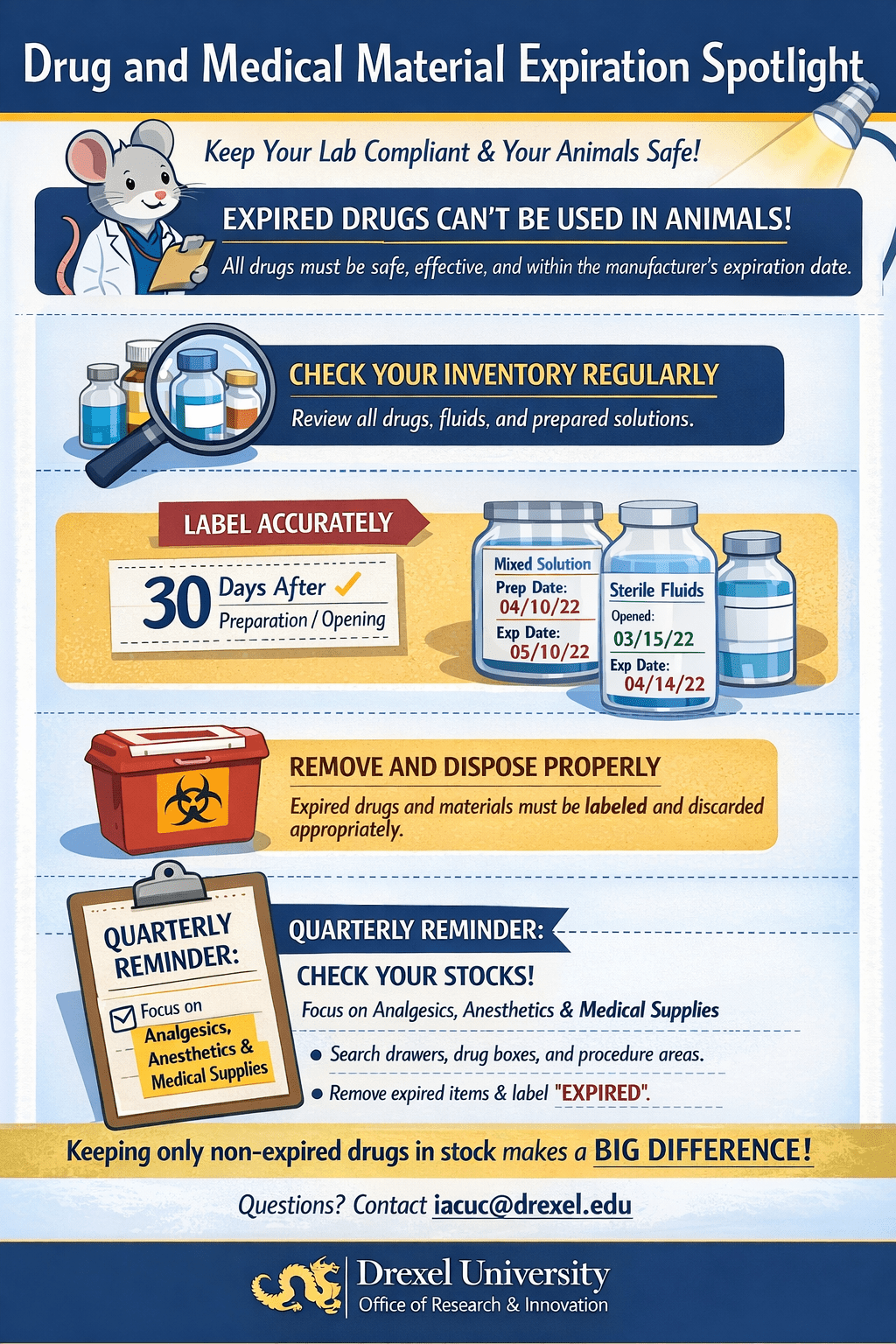
- Expired analgesic and anesthetic drugs can’t be used in animals under any circumstances. ACU-214: Expired Drugs and Medical Equipment Procedures [PDF] specify that all drugs used in animal research must be safe, effective, and within the manufacturer’s expiration date.
- Labs are responsible for regularly reviewing drug inventory, including mixed/prepared solutions and fluids, to ensure that everything in use is still in-date.
- Labels on mixed, diluted, or reconstituted drugs to reflect accurate preparation and expiration dates (30 days after preparation).
- Labels on bags of fluids and containers of sterile saline and sterile water to reflect accurate opened and expiration dates (30 days after opening). Additionally, single use containers of fluids should be discarded after the day of use.
- Expired drugs must be removed from active-use areas, labeled expired, and disposed of properly according to institutional procedures and DEA regulations, as applicable.
- Expired medical materials must be removed from use, separated, and discarded unless used exclusively for acute terminal procedures—where they must be stored separately, clearly labeled, Re sterilizable items may be re-dated after proper reprocessing.
So, this quarter’s helpful nudge:
Take a moment to check your drug stocks, with emphasis of analgesic and anesthetic, and medical material supplies.
Look through drawers, drug boxes, satellite areas, and procedure rooms.Take note of anything close to expiration and plan for a timely removal. If anything is expired, please remove it from use, label expired, and dispose of it. If you have any questions or need assistance with drug disposal, please let us know at iacuc@drexel.edu.
Keeping only non-expired drugs in stock is a small step that makes a big difference in animal welfare and regulatory compliance.
Thanks for doing your part to keep our program strong and our animals well cared for!
Questions? Please email Liz Hann, Director of Animal Welfare, at iacuc@drexel.edu.
New IBC Chemical Hazards Reference List
The Institutional Biosafety Committee (IBC) has developed a Chemical Hazards Reference List to assist Principal Investigators (PIs) in determining whether a chemical used in research requires completion of Form C: Hazardous Substance Addendum [DOC]. The Chemical Hazards Reference List is located on the Submitting a Biosafety Protocol page of the Biosafety website and is also referenced in Question 3 of Form A and within the instructions for Form C.
As a reminder, Form C must be completed for each chemical carcinogen, cytotoxic agent, mutagen, acute toxin, or teratogen used in research. The IBC Chemical Hazards Reference List identifies chemical agents that require Form C submission and IBC review, as well as commonly used chemicals that do not need to be documented on Form C.
The list is intended as a practical reference tool, not a comprehensive inventory of all hazardous chemicals. If a chemical hazard is not listed, or if there is uncertainty about whether Form C is required, PIs should contact the Biosafety Office at biosafety@drexel.edu for guidance.
Please note that the Chemical Hazards Reference List is updated periodically to include new chemical agents and revised information. PIs are encouraged to consult the current version when planning or modifying research activities.
Thank you for your continued attention to biosafety practices and compliance.
Questions? Please email the Drexel University Institutional Biosafety Committee (IBC) at biosafety@drexel.edu
Sponsored Programs
Federal Sponsor Updates
NOT-OD-26-069: Continuation of Modifications to Peer Review Practices
April 15, 2026 - This NIH notice extends temporary changes to peer review practices (initially implemented due to the 2025 funding lapse) through the October 2026 council round, including discussing fewer applications and introducing “competitive but not discussed” designations. It also simplifies review summaries by replacing narrative discussions with brief consensus statements and bullet-pointed key scoring factors.
NOT-OD-26-064: Update of NIH Late Application Submission Policy and End of Continuous Submission
March 31, 2026 - NIH Notice NOT-OD-26-064 updates the late application submission policy by ending the Continuous Submission option and tightening criteria for late submissions, including limiting acceptable reasons and prohibiting late submissions for certain programs (e.g., fellowships and small business awards).
NOT-OD-26-062: Prior Approval Requirement for Changes to Domestic Subawards
March 25, 2026 - This version of the NIHGPS includes policies and requirements that have been published via Guide Notices in effect as of March 17, 2026. The updates published in this version of the NIHGPS consolidate all such Guide Notices and supersede the April 2024 version of the NIHGPS.
NOT-OD-26-057: Publication of the Revised NIH Grants Policy Statement (Rev. March 2026) for Fiscal Year 2026
March 25, 2026 - This guide notice updates the NIH requirements for obtaining prior approval for changes to domestic subawards on all NIH grants and cooperative agreements.
NOT-OD-26-044: Ruth L. Kirschstein National Research Service Award (NRSA) Stipends, Tuition/Fees and Other Budgetary Levels Effective for Fiscal Year 2026
March 18, 2026 - The National Institutes of Health (NIH) has announced updated stipend levels for Ruth L. Kirschstein National Research Service Award (NRSA) trainees and fellows for FY 2026, effective for awards issued on or after October 1, 2025. While stipend amounts have been adjusted across undergraduate, predoctoral, and postdoctoral levels, tuition/fees and training-related support remain unchanged, and institutions must update applicable FY 2026 awards and appointments to reflect the new stipend levels. This applies to Fellowships with a due date of April 8, 2026.
NOT-OD-26-046: Updated Elements of an NIH Data Management and Sharing Plan
February 25, 2026 - The National Institutes of Health (NIH) has updated the required elements of its Data Management and Sharing (DMS) Plan to streamline submissions and reduce applicant burden. Effective for applications due on or after May 25, 2026, applicants must use a new, simplified DMS Plan format that focuses on clear yes/no responses regarding data sharing, timelines, repository use, protections for human participant data, and (when applicable) genomic data sharing requirements, with limited space for explanations of any restrictions.
NOT-OD-26-033: Adjusted Timeline for NIH’s Implementation of Common Forms
February 4, 2026 - NIH announced an adjusted timeline for implementing the new Common Forms for Biographical Sketch and Current and Pending (Other) Support, extending the leniency period through May 2026 to give applicants and institutions more time to adopt them. During this period, submissions not using the Common Forms will trigger warnings but will not be rejected, and NIH encourages use of the forms as soon as feasible. After the leniency period ends, system validations will be escalated to errors, and non-compliant submissions will be prevented.
NOT-OD-26-034: Guidance on Salary Limitation for Grants and Cooperative Agreements FY 2026
January 28, 2026 - NIH has issued updated guidance on the statutory salary limitation for grants, cooperative agreements, and related awards. Effective January 11, 2026, the salary cap is set at $228,000 (Executive Level II of the Federal Executive Pay Scale) and applies to both direct and indirect salaries; institutions may rebudget active FY 2026 awards to reflect the increase if funds are available and consistent with established salary policies.
Visit the Sponsor Updates Webpage
Questions? Please email Gia Boersema, Assistant Vice Provost, Sponsored Programs, at gia.d.boersema@drexel.edu.
Message from the Office of the Comptroller and Office of Research and Innovation
Dear Drexel Research Community,
NIH recently issued NOT-OD-26-072, which has generated questions about whether NIH indirect cost rules have changed again—and whether this creates an adverse impact for Drexel investigators.
To support the community in navigating these updates, we’ve developed an FAQ to help address common questions and offer further clarification.
The major changes to be noted:
- 15% NIH indirect cost cap is not in effect.
- The $50K threshold for NIH subawards has been rescinded. The $25K threshold for NIH subawards remains.
- Please refer to the NOA for all other sponsors regarding these issues. The NOA for each award will dictate the treatment of these issues.
Overall, for NIH grants, none of the recently announced “expanded” indirect cost flexibilities ultimately apply—NIH has reverted to the prior indirect cost framework, and Drexel should continue budgeting NIH awards accordingly.
Find the Announcement on the Comptroller's Website
Thank you,
Patricia J. Dalessandro, MBA, CPA, CFE
Vice President and Comptroller
Office of the Comptroller
Aleister J. Saunders, Ph.D.
Executive Vice Provost for Research & Innovation
Office of Research & Innovation
Questions? Please email Research Accounting Services at ras@drexel.edu.
Drexel Researchers Receive New Awards!
We’re proud to share that during Q3 of FY 2026, Drexel researchers have secured 75 new awards, totaling over $9.7 million in funding. These awards reflect a diverse range of support, including:
- 37% from federal sponsors
- 45% from private non-profit organizations
Congratulations to the investigators below on the following projects, which reflect a selection of the largest awards granted this quarter:
-
Cross-model investigation on the role of inflammasomes in the neurobehavioral and transcriptomic effects of cocaine exposure and HIV infection
Dr. Peter J. Gaskill – Pharmacology and Physiology, College of Medicine
Dr. Jacqueline M. Barker - Pharmacology and Physiology, College of Medicine
NIH National Institute on Drug Abuse
Drs. Peter Gaskill and Jacqueline Barker have received five years of funding from the NIH for their multi-principal investigator R01 award. This award establishes a collaborative, multi-modal research team led by Drs. Barker and Gaskill, combining research in in vitro, ex vivo and in vivo models to interrogate the mechanisms by which cocaine-mediated increases in dopamine dysregulate microglial inflammation and contribute to cognitive deficits and aberrant reward seeking in people living with HIV. Cocaine use disorder is highly comorbid with HIV, and people living with HIV who use cocaine can have distinct behavioral and neurobiological outcomes, necessitating novel treatment strategies. The Gaskill lab has shown exposure to the dopamine levels induced by cocaine use increases HIV replication and activates the NLRP3 inflammasome in myeloid cells such as macrophages and microglia. Using the EcoHIV model, the Barker lab has shown that EcoHIV infection increases cocaine relapse-related behavior and mesolimbic circuit activity. This project will expand on these findings, examining the how dopamine-mediated changes in mitochondrial activity alter microglial NLRP3 inflammasome activity in the context of HIV, and whether activation of NLRP3 modulates the impact of EcoHIV and/or cocaine on addiction-related behavior and cognition. The results of these studies will uncover specific substrates linking HIV infection, dopamine / cocaine associated inflammasome activity and cocaine-mediated behavior, providing leads for novel treatment strategies for people living with HIV who have comorbid substance use disorders.
-
Newborns & Neighbors: Community-Driven Perinatal Peer & Mental Health Support
Dr. Jesse Pintor – Dornsife School of Public Health
William Penn Foundation
Newborns and Neighbors is a community-driven perinatal peer support program housed in the Dornsife School of Public Health at Drexel University, in partnership with Blossom Health and Wellness. Newborns & Neighbors increases access to mental and behavioral health services for Black and Latine pregnant and birthing people through intentional connection grounded in shared lived experience, community-building, and culturally-responsive, intensive mental health support.
With Dr. Jessie Kemmick Pintor as PI and Dr. Irene Headen as Co-I, Newborns & Neighbors received $667,000 in William Penn Foundation funding to provide 1:1 perinatal peer support, co-facilitate group therapy, and provide direct access to 1:1 culturally-responsive therapy to 110 Black and Latine pregnant and birthing people in Philadelphia.
The impetus and program design of Newborns and Neighbors originated out of the Philadelphia Maternal & Infant Community Action Network (CAN)’s Holistic Mental Healthcare and Community workgroups and, in particular, from CAN lived-experience experts. The community-driven participatory research approach used to design and implement Newborns & Neighbors is an essential method for developing, implementing, and scaling community-driven solutions to eliminating racial health inequities. Since Newborns & Neighbors’ founding in the CAN, lived experience experts have been and continue to be full and active members of the team in co-leading design, training, implementation, evaluation, and dissemination.
A core element of the community-driven design of Newborns & Neighbors was to include long-term on-ramps to sustainable careers for the lived experience experts who are already supporting and lifting up new mothers and birthing people in their communities. Specifically, previous participants who have received Newborns & Neighbors perinatal peer support can then train to become perinatal peer support specialists in subsequent cycles.
-
Creating a community-partnered measure of broad communication skills in autistic adults
Dr. Ashley de Marchena – AJ Drexel Autism Institute
Dr. Diana Robins – AJ Drexel Autism Institute
Dr. Andrea Wieckowski – AJ Drexel Autism Institute
Dr. Giacomo Vivanti – AJ Drexel Autism Institute
Dr. Dora Raymaker – Portland State University
NIH National Institute on Deafness and Other Communication Disorders
Dr. Ashley de Marchena has been awarded a five-year grant totaling approximately $3.3 million from the NIH to develop and validate the C-SCAN (Communication Strengths, Challenges, and Nuances), a novel instrument designed to measure communication functioning in autistic adults. The project addresses a critical gap in autism research and clinical care: while difficulties with communication are a defining feature of the condition, existing measurement tools often fail to adequately capture the wide range of communication strengths, weakness, and experiences of adults. The C-SCAN will generate quantifiable profiles of everyday communication, systematically characterizing personal strengths alongside challenges. Researchers will develop two versions of the measure to capture communication functioning in adults who are able to report on their own experiences (self-report version), as well as those who are unable to (proxy-report version).
The study utilizes an iterative mixed-methods approach grounded in Community-Based Participatory Research (CBPR). To ensure the instruments are comprehensive and relevant, the team will employ a Delphi process to build consensus among a diverse panel of stakeholders, including autistic adults, caregivers, communication scientists, and clinicians. By integrating these multiple perspectives, the project systematically balances scientific rigor with lived expertise, ensuring the instruments capture communication experiences that have historically been overlooked by traditional observational approaches. This collaborative approach ensures the resulting instruments are accessible and inclusive of the entire autism spectrum.
This award follows the resolution APHA v. NIH, a legal settlement argued by the ACLU in which the NIH agreed to complete the review of scientific grant applications that had been stalled in 2025 for political reasons.
-
Design and development of Glutamate transporter activators for disease modifying and symptomatic treatment of Epilepsy
Dr. Sandhya Kortagere, Professor and Vice Dean of Research and Innovation
NIH - National Institute of Neurological Disorders and Stroke; Blueprint Neurotherapeutics Program
Dr. Kortagere was awarded the prestigious UG3 grant (UG3/UH3) from NIH to develop GTS467 a small molecule activator of the glutamate transporter EAAT2 to treat Epilepsy. Epilepsy is a complex neurological disorder characterized by recurrent, unprovoked seizures affecting around 70 million people worldwide. There are over 30 marketed drugs to treat the symptoms of epilepsy, however, these drugs do not work in nearly a third of the patients leading to drug resistant forms of epilepsy. In addition, there are various forms of genetic epilepsy and rare forms of epilepsy that do not respond to the existing drugs. Nearly 85 genes have been identified in genome wide association studies as causal for childhood and genetic epilepsy such as Dravet syndrome. Dr. Kortagere used the hybrid structure-based method a drug discovery platform technology to design GTS467 and tested it on various preclinical models of epilepsy. GTS467 and its analogs are part of the international patent 18/832,382. The design and early-stage development of GTS467 was supported by Drexel Coulter grants and NIH-Epilepsy screening and testing program. The UG3/UH3 grant will also be supported by significant in-kind resources from the blueprint neurotherapeutics program to advance the development of GTS467.
-
Temperature-Related Mortality in U.S. State Prisons
Jaquelyn Lorraine Jahn, Dornsife School of Public Health
National Institutes of Health
Dr. Jaquelyn Jahn was awarded an R01 from the NIH National Institute on Aging with Drexel co-investigators Leah Schinasi, Josiah Kephart, and Reneé Moore and researchers from Boston University, Rutgers School of Public Health, and Texas A&M University. The project, Temperature-Related Mortality in U.S. State Prisons, will assess extreme indoor prison temperatures in relation to mortality among incarcerated adults in the U.S. and identify prison conditions and policies that prevent these harms. Extreme weather events pose major risks for population health and mortality, particularly for incarcerated people who have limited control over their thermal environments. Several aspects of the prison-built environment (such as overcrowding, insufficient heating or air-conditioning, and heat-retaining building materials) likely worsen extreme temperature exposure, yet there has been no comprehensive investigation of the health consequences of extreme temperature exposure inside US prisons. This study will produce the first indoor temperature estimates for U.S. prison facilities, link these with comprehensive state prison mortality data, and evaluate prison conditions and policies that have the potential to reduce temperature-related mortality in prisons.
Seeking funding?
Search for funding opportunities using Pivot and Funding InstitutionalLet’s keep the momentum going!
Questions? Please email Rose Ann DiMaria-Ghalili, Interim Associate Vice Provost for Research & Innovation, at rose.a.dimaria-ghalili@drexel.edu.
Update on NSF Major Research Instrumentation Program
The NSF recently removed the MRI solicitation and submission dates and posted the following message:
The merit review process for MRI proposals submitted in Fiscal Year 2025 in response to solicitation NSF 23-519: Major Research Instrumentation (MRI) Program: Instrument Acquisition or Development is continuing and we expect that it will conclude before the end of FY 2026. NSF anticipates issuing an updated MRI solicitation later in FY 2026 for an opportunity to submit proposals in FY 2027. Please monitor this page and the NSF funding search for updates.
In response to this announcement, we are delaying the submission date for the internal MRI competition until the updated NSF solicitation is published. Based on this information, the new solicitation could be released at any time between now and September 30, 2026.
We encourage researchers to continue developing their proposals and to be prepared in the event of a tight turnaround for the internal competition. Updates to the internal competition will be posted in InfoReady, and an email with guidance aligned to the new solicitation will be sent to the research community once it is published. If you are interested in collaborating with one of Drexel’s research core facilities on your proposal, please contact Craig Johnson at craig.l.johnson@drexel.edu.
Questions? Please email Rose Ann DiMaria-Ghalili, Interim Associate Vice Provost for Research & Innovation, at rose.a.dimaria-ghalili@drexel.edu.
Simons Foundation Now Accepting Applications for Next Class of Pivot Fellows
The Simons Foundation is now accepting applications for its Pivot Fellowship program, a unique opportunity for faculty interested in applying their expertise to a new discipline within the natural sciences or mathematics. Designed to encourage bold, cross-disciplinary research, the program supports investigators as they transition into a new field through a year of mentored training embedded in a host lab.
Fellows receive salary support along with funding for research, travel, and professional development, while mentors are provided with a $50,000 research fund. Following the training year, fellows may be invited to apply for up to $1.5 million in research funding over five years in their new field.
Fellows must demonstrate that the fellowship will take place in a new discipline, distinct from their current field of study, within astronomy, biology, chemistry, earth sciences, neuroscience, physics or mathematics — and all subdisciplines therein. In order to receive the fellowship, fellows must be approved by their institution for a full year of leave. Fellows must not hold any other fellowship that will provide them with salary support during the training year of the Pivot Fellowship.
Application deadline: May 14, 2026 (12:00 p.m. ET)
Questions? Please email the Simons Foundation at pivotfellowship@simonsfoundation.org.
Research Spotlight: Urban Health Collaborative
At Drexel Urban Health Collaborative, researchers are advancing critical insights into how place, policy, and environment shape health outcomes in cities across the globe. Through data-driven, community-engaged research, the Collaborative works to uncover the root causes of health inequities and inform solutions that promote healthier, more equitable urban environments. Recent studies include:
- Faculty at the Urban Health Collaborative and Ubuntu Center, Gabe Schwartz and Jacquelyn Jahn, respectively, recently co-authored the first comprehensive national study on fatal police violence in and around American Indian/Alaska Native (AIAN) reservations. Published in PNAS, the study found that AIAN people experience higher rates of fatal police violence in and around these reservations.
- Researchers from the Urban Health Collaborative and SALURBAL recently published the first study to examine the temperature-homicide connection across a wide number of cities in Latin America. Published in Environmental Research, the study analyzed daily temperature data and homicide records from 307 cities across seven Latin American countries: Brazil, Chile, Colombia, Costa Rica, El Salvador, Mexico, and Panama – finding that high temperatures were associated with an increased risk of homicide deaths.
Questions? Please email Will Becker, Marketing & Communications Specialist, Urban Health Collaborative, at will.becker@drexel.edu.
CDMRP Announces New Research Outcomes Dashboard
The Congressionally Directed Medical Research Programs (CDMRP) has announced the launch of a new, interactive dashboard that allows users to explore impactful outcomes of CDMRP-funded research. The tool, available on the CDMRP website, features products, technologies and advancements that received regulatory approval, are commercially available, or are available for use by the military.
The dashboard shows how research investments can lead directly to breakthroughs that save and improve lives. The CDMRP designed this tool to offer patients, advocates, researchers and the public a transparent view of the progress made through CDMRP's efforts.
The CDMRP invites all interested parties to explore the dashboard and see the impact of these vital research investments.
Questions? Please email CDMRP Public Affairs at dha.detrick.cdmrp.mbx.public-affairs@health.mil.
Student Research Achievements: Fall 2025
We’re so proud to feature our Dragons, who continue to make incredible strides in research at Drexel University! Covering fieldwork and lab experiments plus design and AI, here’s a highlight of some of the outstanding student work last term:
- Kai Doron, Environmental Science ’28 – Presented at the Society of Vertebrate Paleontology in England, studying wing spur evolution in waterfowl with Drexel’s Ornithology Collection.
- Colin Cooper, Architecture ’28 – Won the John Stewardson Memorial Fellowship for reimagining ADUs to support affordable, sustainable housing.
- Tyler Creek ’26, Serena Zelezny ’26, and Matthew Richardson ’27, School of Education – Showcased research on generative AI at the 2025 CPED Convening.
- Madeline Plummer, Public Health ’26 – Published research linking education, health beliefs, and inflammation in cancer survivors.
- Breana Channer, MD/PhD student, College of Medicine – Awarded by the NIH for her research on immune responses in HIV infection, advancing understanding at the intersection of immunology and pharmacology.
From environmental science to public health, architecture, education, and medicine, Drexel students are tackling complex questions, designing innovative solutions, and creating meaningful impact across fields.
Did You Know?
"Did You Know?" is a recurring newsletter feature that shares helpful tips, tools, and guidance from Office of Research & Innovation teams to support the Drexel research community. An archive of previous "Did You Know?" sections can be found under the Resources section of the ORI website.
The Drexel Compliance Hotline
Drexel maintains a compliance hotline that helps Dragons do the right thing!
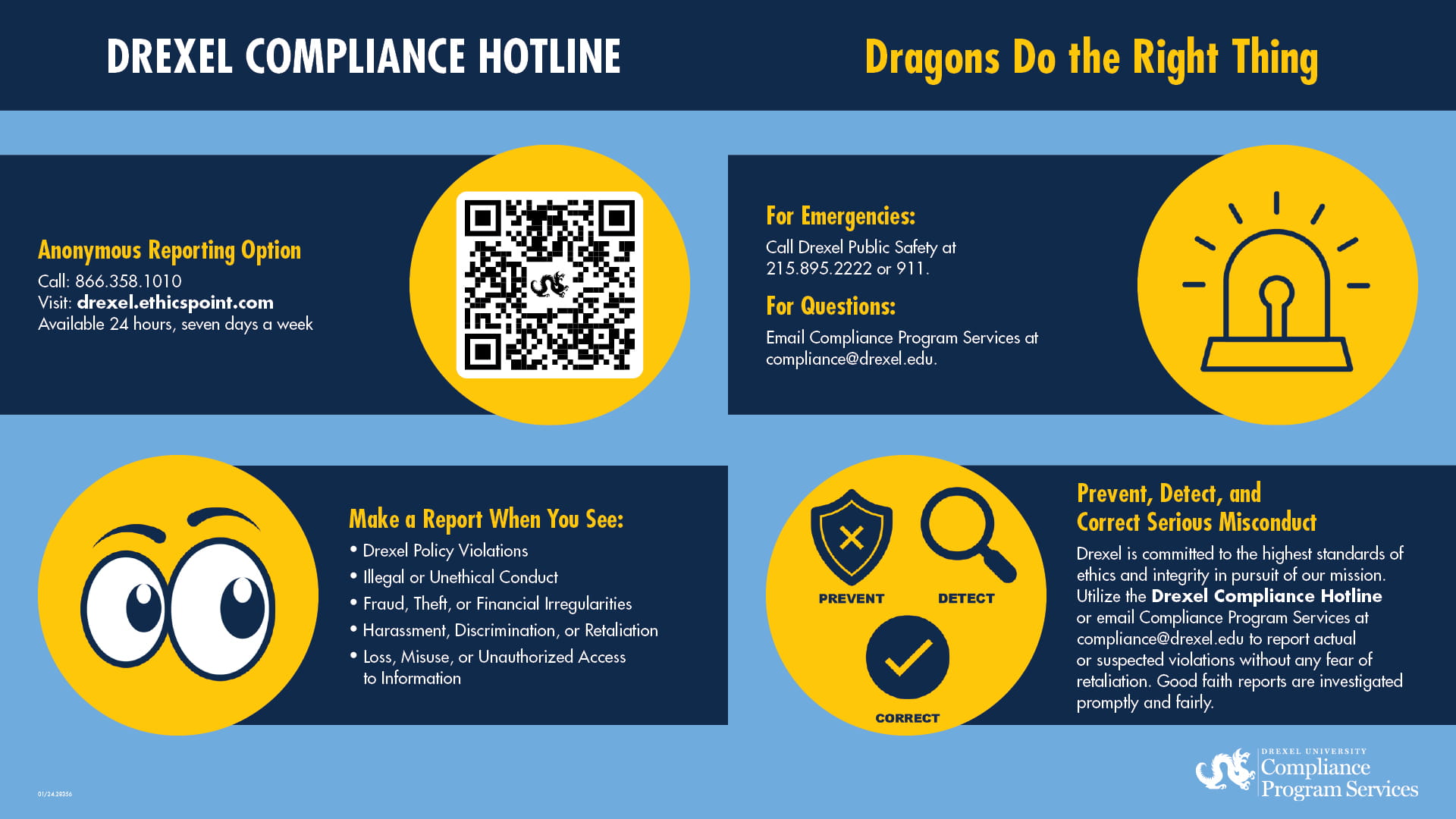
The University encourages all community members to report suspected misconduct through the Compliance Hotline, available 24/7 and anonymously. Reports can include policy violations, illegal or unethical behavior, fraud, harassment, and other forms of non-compliance. Drexel is committed to maintaining high ethical standards and ensures that all good faith reports are investigated promptly and without fear of retaliation. For emergencies, contact Public Safety at (215) 895-2222 or call 911. Anonymous reports can be made by calling (866) 358-1010 or visiting drexel.ethicspoint.com.
Thanks for doing your part!
Questions? Please email Compliance Program Services at compliance@drexel.edu.
Research Quality Assurance Program: Maintaining a Research Regulatory Binder/Files
A well-maintained regulatory binder or electronic regulatory file is often the first source reviewed during audits and inspections. Keeping required approvals, delegation logs, training records, and correspondence up to date helps demonstrate ongoing compliance and can significantly reduce inspection findings. An organized binder isn’t just paperwork—it’s evidence that the study is being conducted responsibly.
Helpful Tips & Best Practices:
- Organize the binder or electronic files using a logical structure (tabs or folders aligned with sponsor or institutional guidelines).
- Keep current IRB approvals, protocol versions, and consent forms readily accessible.
- Update delegation of authority logs, training records, and CVs as personnel or responsibilities change.
- File correspondence (IRB, sponsor, monitoring letters) promptly and chronologically.
- Ensure documents are version-controlled and obsolete documents are clearly marked or archived.
- Perform routine self-checks of the binder/files (e.g., quarterly or before monitoring visits).
- Maintain consistency between the regulatory binder and study conduct (e.g., approved personnel match who is performing study tasks).
- For electronic binders, ensure secure access, backup, and audit trails are in place.
Best practice reminder: A regulatory binder should tell the complete compliance story of the study, from initial approval through closeout.
Drexel’s Research Quality Assurance Program can assist with setting up systems and processes at the beginning of a study to validate all regulatory requirements and essential documents are in place (i.e., documentation of investigators qualifications, confirming Delegation logs are accurately completed, assisting with training documentation). Please email Marisa Corbett, Executive Director of Research Quality Assurance, at marisa.jo.corbett@drexel.edu for a study start-up regulatory file consultation.
Don’t forget to check out our Clinical Research Guidelines and Tools webpage for guidelines on the maintenance of regulatory files [PDF] and more!
Resource Highlight: Drexel University Factbook
Did you know about the Drexel University Factbook? This comprehensive resource serves as the official data source for institutional data, supporting Drexel users in grant writing and in completing surveys for external agencies.
Developed by the Office of Institutional Research, Assessment and Accreditation collaboration with Drexel Information Technology and Academic Information & Systems, the Factbook draws from the University’s centralized data systems to ensure accuracy and consistency.
The Factbook includes up to four years of historical data across key areas such as admissions, enrollment, faculty and staff, finance, and academic programs, with updates released as new data become available.
Questions? Please email the Office of Institutional Research, Assessment and Accreditation team at irae_requests@drexel.edu.
Other Research Training, Education, and Meeting Opportunities
Have an event you'd like to share with the Drexel research community? Email Becky Campbell, Senior Business Analyst, at becky.campbell@drexel.edu.
Keeping Up with Generative AI: Detecting Synthetic Images as AI Accelerates (May 22)
Can we still trust what we see? Detecting AI-generated imagery.
AI-generated images have become so realistic that they can be extremely difficult to detect with the human eye. This represents a growing challenge for researchers and industry professionals alike.
Join the IEEE Signal Processing Society (SPS) and Dr. Matthew C. Stamm of Drexel University for a deep dive into the forensic techniques to detect synthetic media while keeping pace with AI acceleration.
Topic: Keeping Up with Generative AI: Detecting Synthetic Images as AI Accelerates
When: May 22, 2026 | 12:00 PM – 1:00 PM ET
Speaker: Dr. Matthew Stamm (Drexel University)
Moderator: Dr. Amit Roy-Chowdhury (UC Riverside)
This session will explore the latest breakthroughs in detecting AI-generated images and media forensics. It is part of a series leading up to the International Symposium on Synthetic Media Attribution and Detection (ISSMAD) 2026.
Register for Free
Questions? Please email Dr. Matthew Stamm, Professor, Electrical & Computer Engineering at matthew.c.stamm@drexel.edu.
The Future of Social Science Convening (June 4)
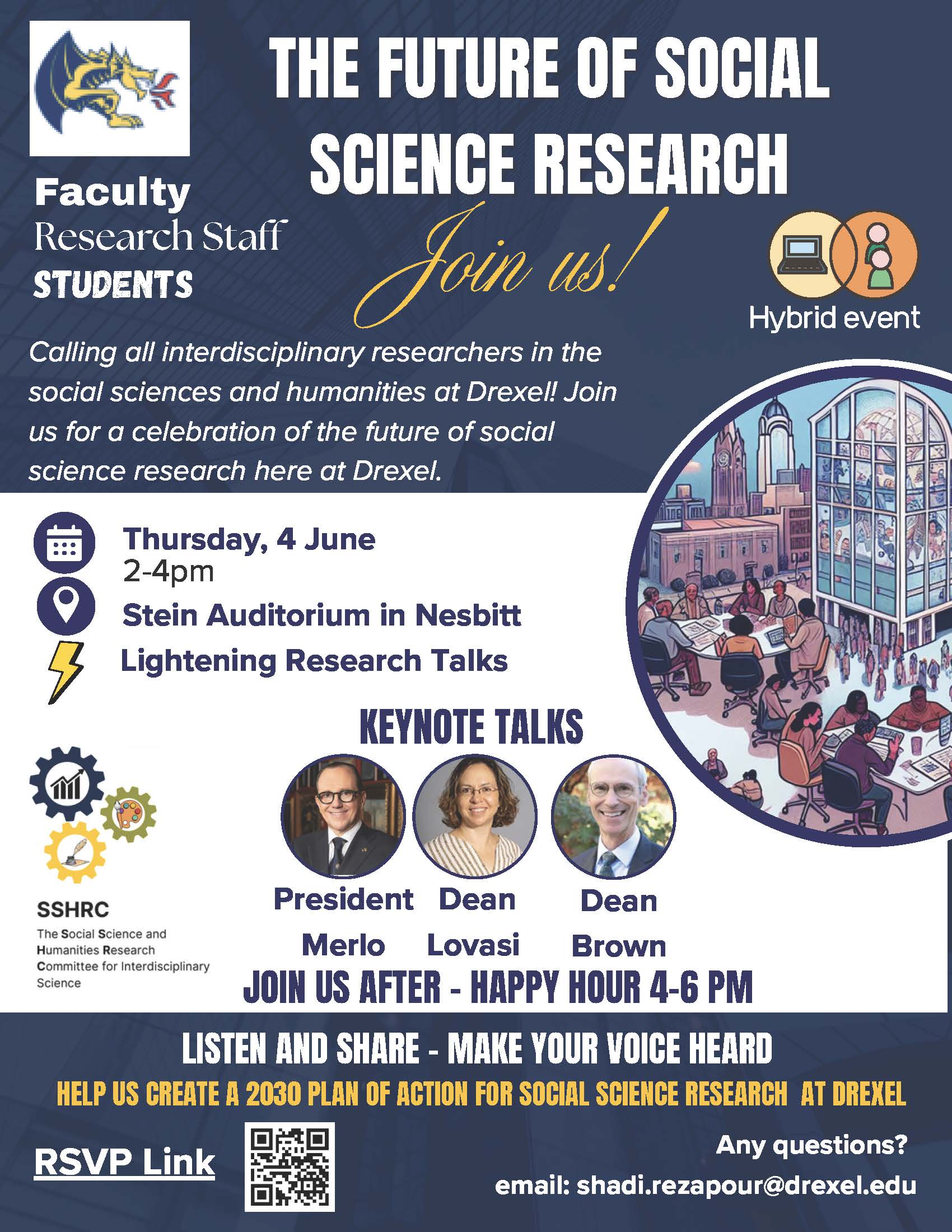
Interdisciplinary researchers across Drexel’s social sciences and humanities are invited to take part in a forward-looking conversation on the future of research at the University. Hosted by the Social Sciences and Humanities Research Committee (SSHRC), this hybrid convening will bring together faculty, students, and research staff to celebrate and help shape a 2030 plan of action for social science research at Drexel University.
The program will feature keynote remarks from President Merlo, Dean Lovasi, and Dean Brown, along with lightning talks showcasing research from across the community.
Date & Time: Thursday, June 4, 2026 | 2:00–4:30 PM
Location: Stein Auditorium, Nesbitt Hall (hybrid)
A networking happy hour will follow from 4:30–6:00 PM at Board and Brew.
RSVP or sign up to give a lightning talk
Questions? Please email Dr. Shadi Rezapour, Assistant Professor, Informatics, at shadi.rezapour@drexel.edu.
Stay Connected with the Office of Research & Innovation!
Ways to Engage with the ORI
- Quarterly Newsletter Archive: Read past issues of our newsletter for key announcements and updates
- Novelution Hub SharePoint: Engage with the COEUS Replacement Project via our new Novelution Hub
- ORI Training Library SharePoint: Access training resources and webinar recordings
- Email Announcements: View an archive of important ORI updates
- Upcoming Events: Explore a comprehensive list of research-related events
- LinkedIn: Follow us for the latest news about Drexel research
Questions? Please email Becky Campbell, Senior Business Analyst, at becky.campbell@drexel.edu.