Office of Engaged Humanities and Health Advocacy
Announcement
The Office of Community Engagement is now named the Office of Engaged Humanities and Health Advocacy (OEHHA), reflecting its ongoing core educational role.
Mission
Our mission is to advance the professional formation of excellent, compassionate and engaged physicians.
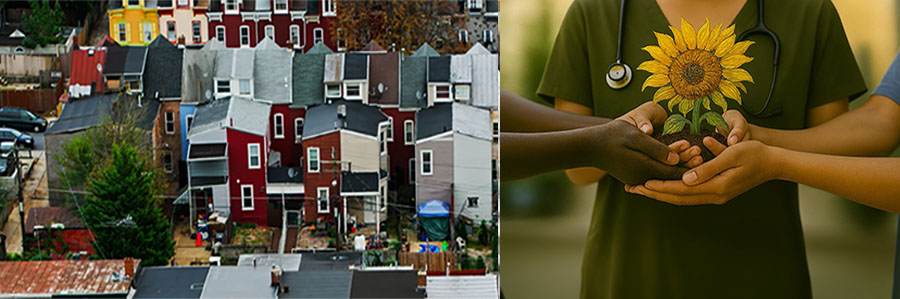
In medical school, we are called to be our best selves and develop the intellectual, emotional, social and ethical capacities to care for those who are ill and vulnerable. Engaged medical humanities apply humanistic knowledge to real-world issues affecting the health of people and communities. We learn from people’s lived experiences of illness, healing and doctoring. We also address intersecting health needs of individuals and their communities, and the social drivers of health.
Download the Office of Engaged Humanities and Health Advocacy (OEHHA) info sheet
Health Advocacy and Patient Allyship
Curriculum
Physicians are health advocates and patient allies who strive to overcome medical and social barriers to health. Through a comprehensive curriculum, we address social drivers of health and health inequities, and the foundations of the therapeutic alliance between doctors and underserved patients.
First-year students participate in a yearlong practicum in community or clinical settings that serve people experiencing homelessness, youth at risk, vulnerable elders, people with disabilities and other underserved or at-risk groups. Other educational opportunities include the Bridging the Gaps Community Health internship and our fourth-year elective, Providing Health Care for Vulnerable Populations.
Learn more:
The Health Advocacy Practicum
Bridging the Gaps
Student Engaged Free Clinics: Health Outreach Project
Our Health Outreach Project (HOP) works in partnership with the community to provide caring, nonjudgmental and interdisciplinary health services to individuals who have limited or no access to care. HOP students provide health services supervised by faculty at several different sites in the Philadelphia and West Reading areas. Sites include shelters; housing first, rehab and back-to-work residential programs; street outreach; and others.
Engaged Humanities
Medicine is about people caring for people and their communities. We apply the medical humanities to more deeply understand the individual and community dimensions of illness, healing and doctoring. We draw upon disciplines that include anthropology, contemplative studies, cultural studies, ethics, film, history and history of ideas, literature, philosophy, ethics, theater, visual arts, religious and spiritual thought, and sociology.
Campus enrichment program. Our Medical Humanities program offers over 10 elective courses each year, as well as many special events that are open to all medical students
Medical Humanities Scholars certificate program. Students may choose to complete a scholarly concentration in the medical humanities and graduate with distinction. This is a rich opportunity to thoroughly explore an area of personal interest.
Learn more:
Medical Humanities Courses and Events
Medical Humanities Scholars Certificate Program
Clinical and Professional Ethics
Our unique and leading-edge ethics curriculum emphasizes patient care in the real world. Students are challenged to critically analyze, tolerate ambiguity, and further develop themselves as moral agents. We emphasize virtue ethics—developing our moral capacities such as compassion and courage--to do the right thing even under duress.
Topics include medical student ethical challenges, informed decision-making, confidentiality, research ethics, bias and ethics of care, medical mistakes, public health emergencies and disaster ethics, end-of-life decision-making, dual loyalties, moral distress and moral courage, medical aid in dying, professional boundaries, and others.
Restorative Practices for Being In Community with One Another
Restorative practices are a set of social strategies for building inclusive and resilient communities. These practices draw from peace and justice teachings among traditional cultures.
OEHHA builds many of these practices into our courses and programs to foster connection, inclusion, respect, empathy and accountability among all.
Contact Us
Philadelphia:
Steven Rosenzweig, MD
Director, Office of Engaged Humanities and Health Advocacy; Professor, Department of Emergency Medicine
sr454@drexel.edu
Elissa Goldberg, MSS, LSW
Program Director, Office of Engaged Humanities and Health Advocacy
ejg32@drexel.edu
Laura Mullin, MS
Assistant Director, Medical Humanities Program
lam479@drexel.edu
Sammy Brink, MPP
OEHHA Project Coordinator, Health Outreach Project
sb4496@drexel.edu
West Reading:
Eugene York
Health Advocacy Course Co-Director, HOP Faculty
epy26@drexel.edu
Daniel Schidlow, MD
Campus Program Director, Medical Humanities
ds46@drexel.edu
Lisa Glenn, MS
Course Coordinator, HAP & HA2
lg868@drexel.edu
Andrea Bensusan, MS
Campus Program Coordinator, Medical Humanities
ajb489@drexel.edu
Back to Top