A Legacy of Global Service: Susan Carleton Benes, MD, MCP ’75
By Kate McCorkle
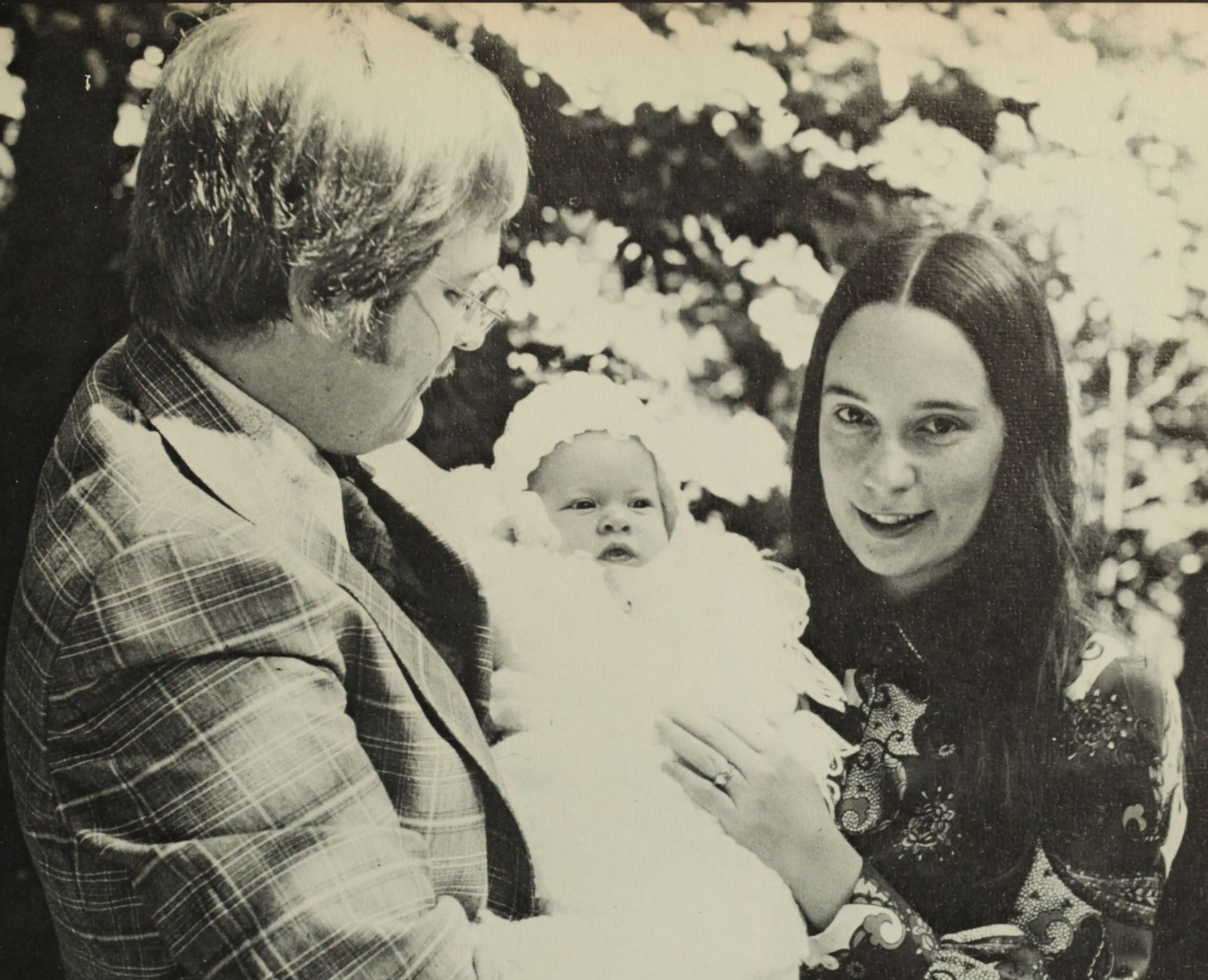
From the 1975 Iatrian, Benes (right) with husband Jim and their first child, Jennifer.
From a young age, Susan Carleton Benes, MD, MCP ’75, felt a
vocation to provide medical care in areas of critical need across
the world. For over 40 years, she has used her training as a
neuro-ophthalmologist to benefit people in remote and often
conflict-ridden areas. Her journey, however, revealed the earlier
presence of another Woman’s Medical College alumna — a “lady
doctor” from her own family. It is uncanny, although perhaps not
surprising, that Benes’ calling to use her medical expertise in the
service of others has such deep family roots and connections to
the College of Medicine.
As a child in Cleveland, Ohio, Benes loved listening to her
paternal grandparents’ stories of growing up overseas. Her
grandmother had been born and raised in Japan, since her parents
served as medical missionaries there. Her grandfather, born and
raised in India, was the third generation of medical missionaries
serving in that country. “I was always interested in missionary work
because of them,” Benes says.
After graduating from the University of Michigan, Benes spent
a year teaching in England while her soon-to-be husband, James
David Benes, completed the fifth year of his engineering degree.
They married right after the moon landing in 1969, an endeavor
toward which her engineer husband contributed. “We got married
after his graphite casket helped give the power for the lunar
module,” Benes says. “So that was a very exciting time.”
Benes always knew she wanted to become a doctor and
volunteer overseas, but she and James also wanted to live in the
same city. After they married, he sought an engineering position
and she applied to medical schools. “We matched in Philadelphia,”
she says. “He got an engineering job at Westinghouse in
Lester, Pennsylvania, and I got into Woman’s Med, even though
technically they were changing the name to MCP at the time.”
Walking into the medical college’s main building for her interview,
Benes came face to face with a brass plaque that had a familiar
name. The plaque read, “Dedicated in memory of Jessica Royce
Carleton, MD, Missionary to India.” Carleton was her great-great-aunt,
part of that second generation serving in India.
Benes recognized her name from having done a family tree, but
she didn’t know Carleton was a doctor, let alone an 1886 graduate
of Woman’s Medical, the school to which she was now applying.
Benes’ grandfather “always talked about his dad and his granddad,”
when speaking of medical missionary work, but he hadn’t
mentioned Jessica. He passed away before Benes applied to
medical school, so he couldn’t enlighten her about the family
connection to WMC when she was applying. When she saw the
plaque, though, she realized, “Holy cow. This is where I belong.”
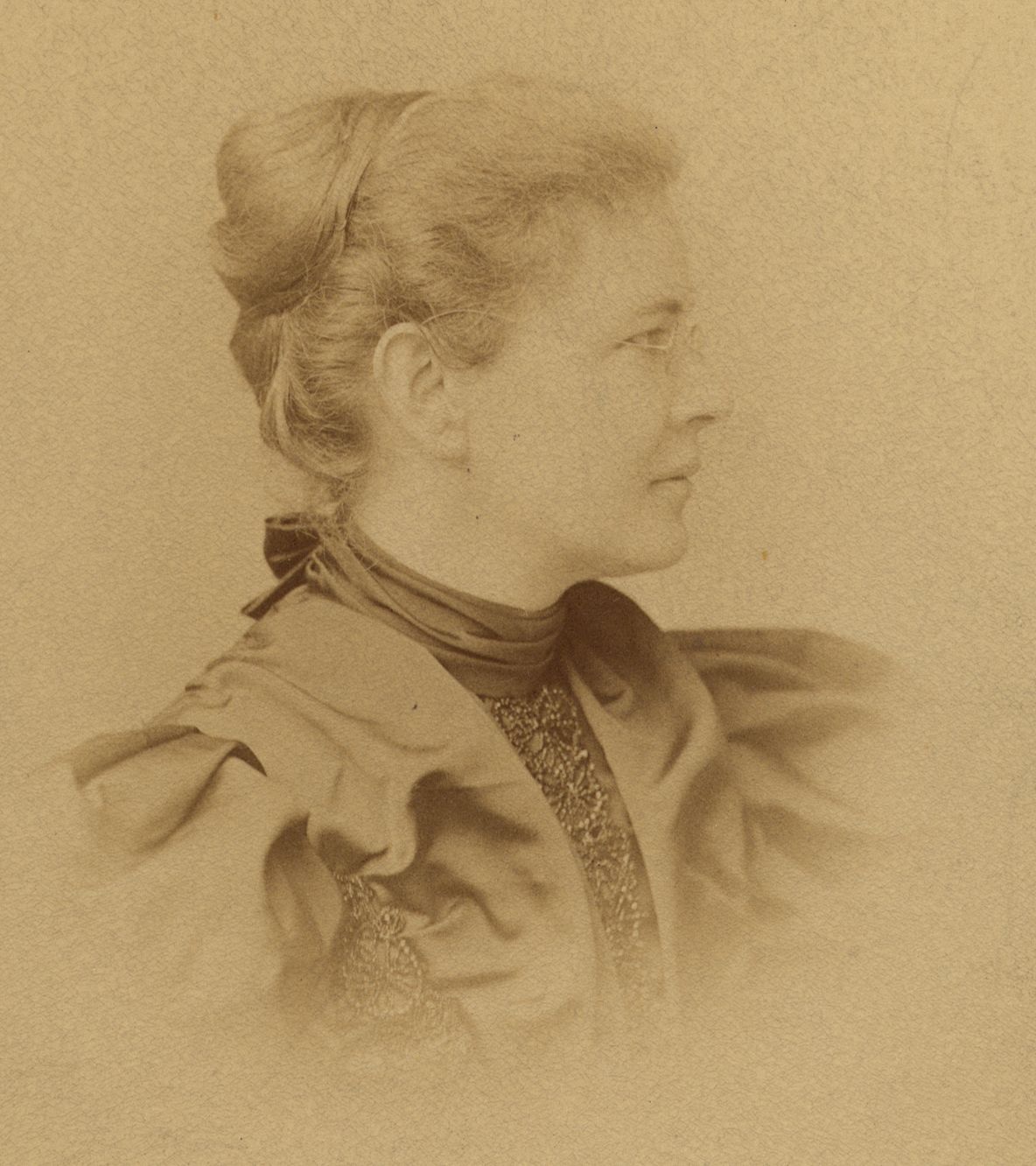
An archival image of Benes’ great-great-aunt Jessica Royce Carleton, WMC class of 1886.
In the ensuing years, Benes learned more about her great-great-aunt
from talking with members of her extended family. Born in
1862, Jessica was one of six children living in the northern Punjab
region of India with her Vermont schoolteacher mother (Celestina
Bradford) and medical missionary father (Marcus Maynard
Carleton). When the summers became too hot, the family removed
to the neighboring mountain region of Ambala, which was primarily
inhabited by Sikhs and Muslims. Benes explains that at that time,
the Muslims “wouldn’t allow women or children to be touched by a
man. So all the doctors in [Jessica’s] family couldn’t take care of the
sick people. It affirmed her decision to get back to America, go to
medical school, and come back to India and start a hospital for
women and children, which is what she did.”
Just one year after graduating from Woman’s Medical, Carleton
returned to Ambala and founded the Philadelphia Hospital for
Women in 1887. In the 1930s, the hospital opened to male
patients. Still in operation, it is now known as Philadelphia Hospital.
For her public service to India, which at the time was part of the
British Empire, Carleton received the Kaiser-i-Hind medal from King
George V in 1927.
With such a family legacy, and her own determination to serve
a broader community, Benes knew she was bound for medical service overseas. She recalls informing her husband before their
marriage, “I’m not going to be a stay-at-home mom driving a
station wagon and never leaving America. I’m going to be a doctor,
and I’m going to go overseas whenever there’s an opportunity.”
Following her graduation from MCP, internship at Lankenau
Hospital, and residency and fellowship at Wills Eye Hospital, she
was one of a couple hundred neuro-ophthalmologists in the county.
Benes’ first experience overseas was in 1980 teaching the
inaugural class of ophthalmology residents at Tumutumu Hospital
in Kenya. Realizing that this particular group of residents “did not
seem service-oriented,” Benes and her American colleague, Randy
Whitfield, MD, decided to teach locals “the easiest thing we could
teach them.” The pair then traveled to the 49 tribes in Kenya to
assess the prevalence of blindness and eye disease.
As they traveled from village to village, they recognized a
prevalence of blindness in people over 30. “They already had
cataracts,” she says. At this particular place and time, once people
lost their vision, they could not contribute to community life. “So we
would have a vote,” Benes explains. “The tribe would nominate
who they trusted for me to teach. Randy and I would teach that
clinical worker how to take cataracts out.” In this unconventional
way, the young adults with cataracts were able to contribute to
their tribes as they had in the past. Of this challenging experience,
Benes reveals, “Of course it was addictive. I wanted to do more.”
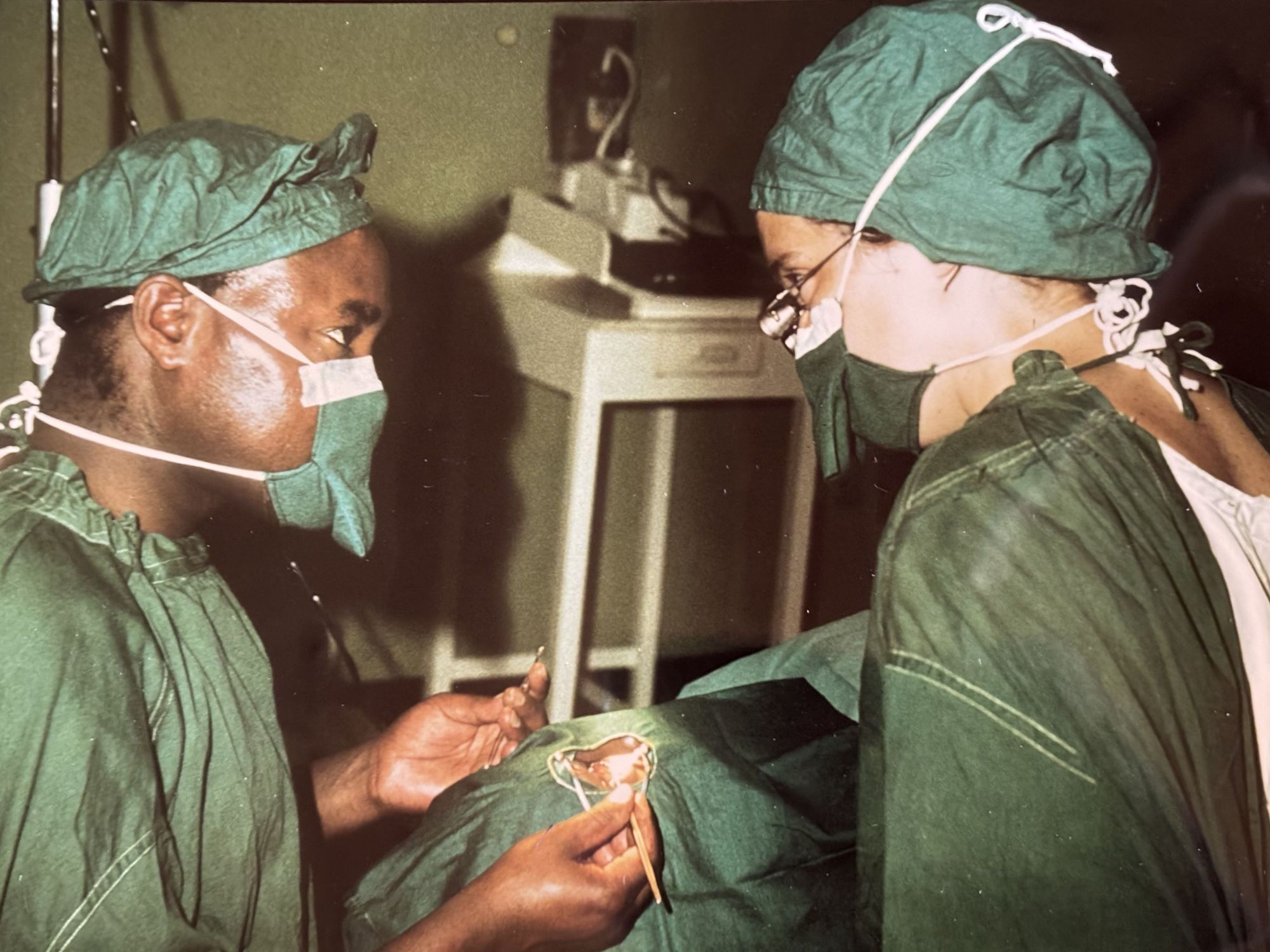
Benes teaching surgical technique at Tumutumu Hospital in Kenya in 1980.
Benes returned to the States, and for most of her professional
career was a professor at The Ohio State University. She’s a
national expert in neuro-ophthalmology, orbital diseases and
orbital surgery. A mother of three and grandmother to five, Benes
relocated to Colorado in 2017, where she practices with the Heart
of the Rockies Regional Medical Center.
Yet alongside the professional and family growth, Benes continued
to volunteer overseas. In the resulting decades of medical service,
she’s traveled to Ecuador, Peru, the Galapagos, the Marshall
Islands, Turkey, the Republic of Georgia, Mongolia and Ethiopia.
“All the places I went, I learned so much. And I loved working there
so much,” she says.
A few experiences stand out: The United States government
invited Benes to travel to the Marshall Islands to assess the
prevalence of disease in the aftermath of nuclear testing in that
area. Thyroid cancer was rampant. Benes and her colleagues
discerned a heartbreaking chain: Nuclear radiation had been
absorbed by the sand, which in turn was taken up by palm trees.
The inside of the palm fruits was radioactive, which was then
consumed by palm crabs. The crab’s iodine-rich exoskeleton
became radioactive as well, and when people consumed the
crabs, the radioactive iodine attacked their thyroid, leading to
the prevalence of thyroid cancer.
In 1995, Benes traveled to the Republic of Georgia, where
medical care was still crippled after the collapse and withdrawal
of the Soviet Union a few years prior. When the Russians left, they
took the fresh water, electricity, equipment, medicine — everything.
Hospital doors were locked since “the doctors in the Republic of
Georgia couldn’t take care of their patients. The Russians had even
taken the mattresses off the cots. It was stunning,” Benes recalls. She
and her colleagues arrived with medicine and surgical supplies,
with the goal of teaching refresher courses to the local physicians.
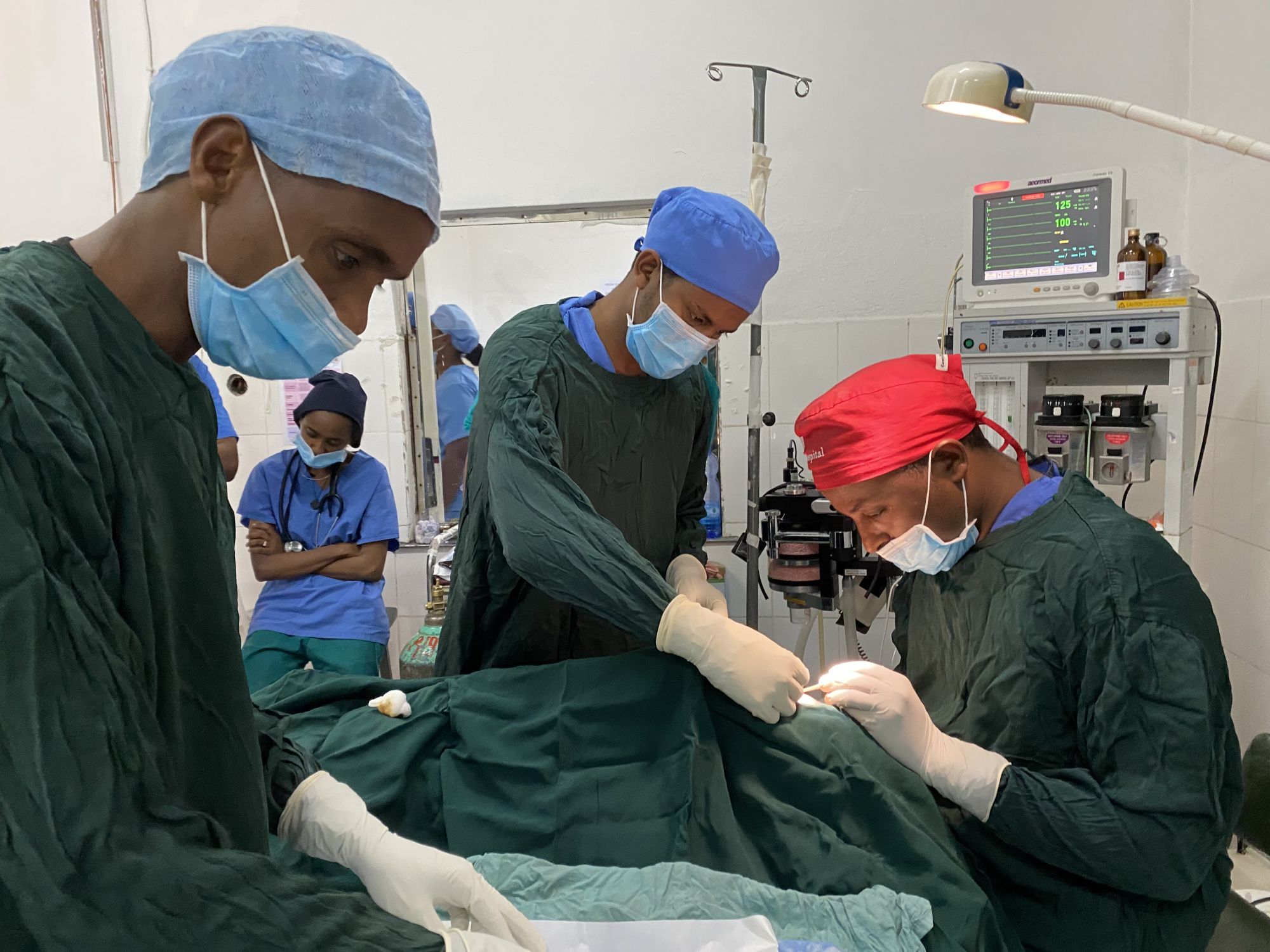
Residents at Addis Ababa University learning orbital surgery during Susan Carleton Benes’ 2020 trip to Ethiopia.
Most recently in 2019 and 2020, Benes traveled to both
Mongolia and Ethiopia with the Denver Lions Club. In Mongolia,
where there is a strong nomadic tradition, she was able to teach
students and perform much-needed surgeries in the capital city of
Ulaanbaatar. Then, in Ethiopia, she visited many villages, screening
hundreds of children and adults. In collaboration with the five
teaching hospitals and the Lions Club, Benes instructed residents in
ophthalmology and orbital surgery before her service was cut short
by the COVID-19 pandemic.
Since graduating from MCP in 1975, Benes has been a loyal and
supportive alumna. Yet her gratitude extends beyond herself. She
donates in honor of her great-great-aunt, the first woman physician
in her family, Jessica Royce Carleton. She has also contributed
to the College Archives — as well as the Presbyterian Historical
Society — donating funds and gifting items and photos from
Carleton’s life. Carleton’s actual diploma from Woman’s Medical,
however, resides with Benes.
Reflecting on a lifetime of global medical service, Benes is
currently weighing the pros and cons of retiring from that aspect
of her medical career. “It never occurred to me to quit,” she says.
“I hate the thought of giving up going overseas and serving. What
I loved about working overseas was just that everyone was not
working for themselves,” she says. “They were working for the good
of people. It was just completely different. I enjoy being with others
who want to be of service.”
Through the generosity of the Benes family and other alumni, the
Drexel University Legacy Center Archives & Special Collections
is curating exhibits depicting the rich history associated with the
pioneering faculty and students from our legacy institutions like
Carleton. Fundraising for this project is ongoing, with design underway
and the newest exhibit, planned for the second floor of the
Health Sciences Building, slated for completion in March 2026.