HTLV-1: Raising Awareness of a Deadly, Hidden Virus
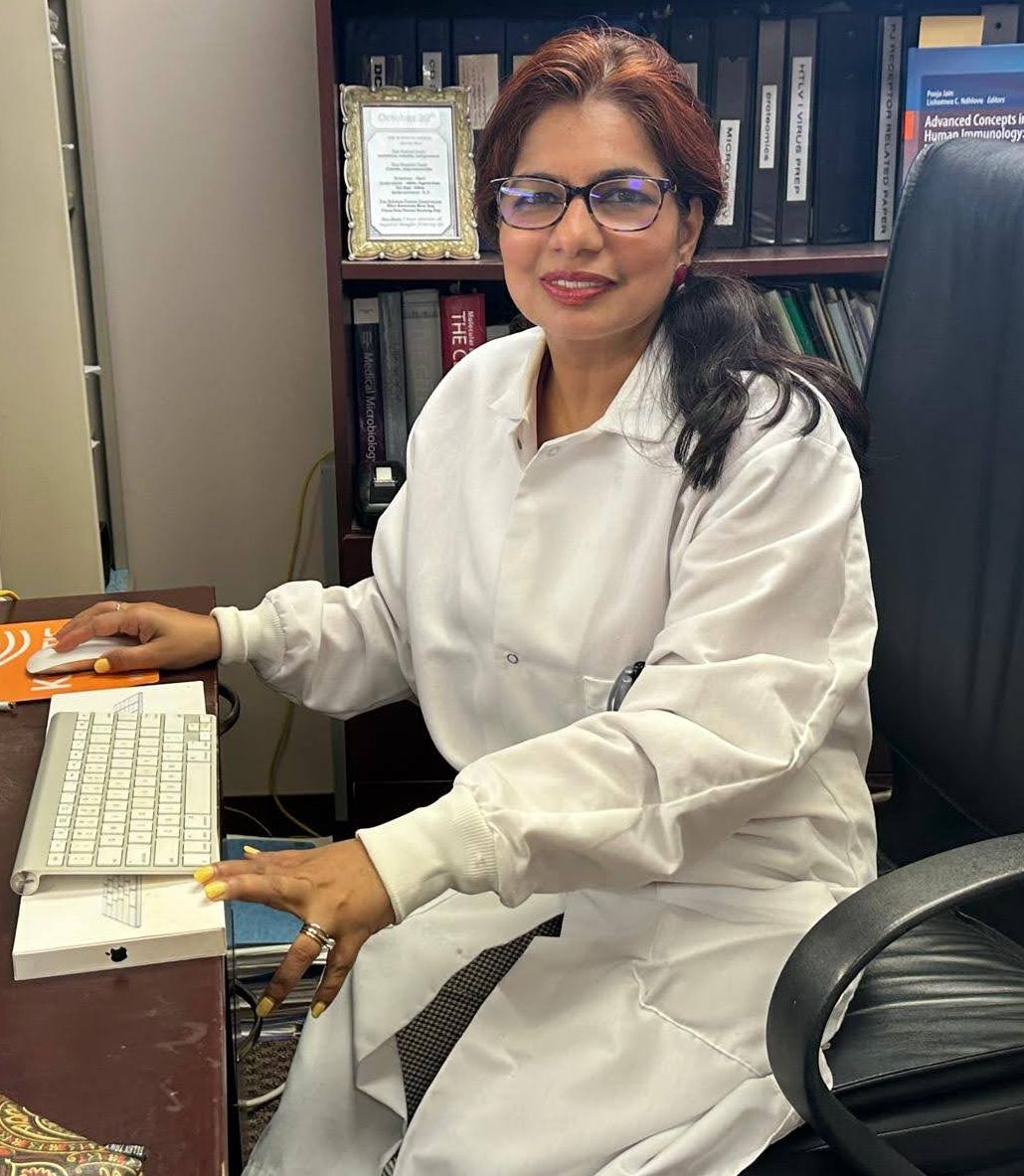
Pooja Jain, PhD, MS, professor, Department
of Microbiology & Immunology and
Department of Neurobiology & Anatomy
By Nancy West
If you’ve never heard of human T lymphotropic viruses
(HTLVs) or human T cell leukemia virus type 1 (HTLV-1), you
aren’t alone. This rare, cancer-causing retrovirus is an ancient
cousin of HIV with the ability to transform human T cells.
Because it is a retrovirus, it can integrate its genetic material
into a person’s DNA and live there forever. As a result, it
can cause a chronic, lifelong viral infection, usually without
any symptoms, that can lie dormant in the human body for
40 or more years.
During this time, it is estimated that 5% of people
with HTLV infection will develop adult T cell
leukemia or lymphoma (ATLL). By the time it
causes symptoms and is diagnosed, the cancer
is widespread and aggressive, and the infected
person may only have six months to two years to
live. That’s why Pooja Jain, PhD, MS, a professor
in the College of Medicine’s Department of
Microbiology & Immunology and Department of
Neurobiology & Anatomy, is on a mission to raise
awareness of this insidious virus.
“Compared to other cancer-causing viruses —
such as Epstein-Barr, herpes, and hepatitis B and
C — HTLV-1 has the highest potential of causing
cancer in the people it infects,” says Jain. “Most
oncoviruses have a 0.3 to 1% chance of causing
cancer, while HTLV-1 has a 5% chance.”
Experts estimate that 10 to 20 million people
worldwide have an HTLV-1 infection, but infection
rates vary widely. In North America, about
300,000 people are known to be infected. But in
other parts of the world, one-third or more of the
population is infected, including specific parts of
Brazil, Japan, Africa, South America, Australia and
the Caribbean.
HTLV-1 is transmitted most often through
breastfeeding. In endemic regions, around 20 to
30% of HTLV-1-infected mothers transmit the virus
to their infants in this way. The virus is also transmitted
through sexual contact, needle sharing and unsafe
blood transfusions.
In addition to cancer, HTLV-1 can also cause a
progressive inflammatory disease of the nervous
system called HTLV-associated myelopathy and
tropical spastic paraparesis (HAM/TSP).
“This virus is able to cross the blood-brain barrier
and enter the central nervous system,” explains Jain,
who has been conducting HTLV research for 23
years. “When it enters the nervous system, it attacks
the myelin sheath of neurons, causing a disease that
is very similar to multiple sclerosis. So the same virus
in the blood that can cause lymphoma can also
cause myelopathy in the brain.”
The Phenomenon of Immune Exhaustion
Jain was intrigued by the extensive immune
response she saw in patients who have HAM
disease. “These patients develop a very strong
immune response that is incapable of killing
the virally infected cells,” she notes. “This leads
to the phenomenon of immune exhaustion.
Our immune system is constantly under attack
by the virus antigen, but the dose of antigen
is not powerful enough for our immune system
to kill the infected cell. As a result, there is a
low-grade inflammation that goes on and on.
Eventually, the time comes when the immune
system becomes so crippled that the patient
will develop ATLL or HAM.” She adds, “My
lab was able to establish very early that this
phenomenon of immune exhaustion does not
only work in cancer, but also in
neuroinflammation.”

Sharrón (Ronni) Manuel, MD, PhD ’13
Key to this research was Sharrón (Ronni)
Manuel, MD, PhD ’13, one of the first Drexel
Woman One Scholarship recipients, who
worked in Jain’s lab from 2006 to 2011.
“Ronni was sampling patients with a high level
of neuroinflammation,” Jain notes. “We found
that they had very high levels of the PD-1
molecule that acts like a brake on the immune
system and can cause immune exhaustion.”
“We saw that there were various immune
cell markers, especially on dendritic cells, that
were either up- or down-regulated depending
on their role in the immune system,” explains
Manuel. “A lot of inflammatory markers were
up-regulated in those patients with disease
compared to the asymptomatic carriers, which
told us that there was a heightened immune
or inflammatory response in those patients.”
She continues, “PD-1 is one of the most
effective receptor targets to block in cancer
therapy. When PD-1 binds to PDL-1 or PDL-2,
it tells the T cells to slow down or stop their
attack. If certain cancer cells up-regulate that,
then the T cells are not going to attack, and
those cancer cells continue to grow and attack
the body. By therapeutically blocking the
PD-1/PDL-1/2 interactions, the brakes from
the immune system are removed, restoring
normal T cell function, leading to antitumor
responses. We saw that PDL-1 was up-regulated
in the cells of the HTLV disease
population compared to the asymptomatic
carriers. If we could somehow block that
response in a vaccine, we could control
the disease progression, which was our
ultimate goal.”
A Dual Vaccine Approach
Based upon Manuel’s thesis observations,
the Jain Lab proceeded to test a dual vaccine
approach — blocking the PD-1 molecule but
also combining with new epitopes for vaccine
purposes.
Manuel Continues Immunology Research
Inspired by her mentor, Pooja
Jain, PhD, MS, Sharrón (Ronni)
Manuel, MD, PhD ’13, has
continued her immunology
research.
“Pooja was a terrific mentor,”
emphasizes Manuel. “Seeing her
drive and enthusiasm really
encouraged me to continue doing
research. She provided me with a
truly diverse, hands-on experience
where I was able to learn the ins
and outs of conducting research
projects. I also traveled and
presented at international
conferences. It was an honor to
receive the Young Investigators
Award for my presentation at an
HTLV conference in Japan. All
these experiences were invaluable
to me.”
Now a reproductive
endocrinology and infertility
physician at HRC Fertility, and
an assistant professor at the
University of Southern California,
she focuses on how the immune
system affects reproduction, with
interests in PCOS, endometriosis,
ovarian aging, pregnancy loss
and miscarriage.
“This combination acts like a
double-edged sword — when you take the
brake off, the existing immune system works,
and then when you put new epitopes on the
T cell, you bring in fresh immunity, and the
combination of the two helps to eradicate
neuroinflammation in virus-infected cells,”
Jain explains.
“This is what I consider to be the major
contribution from our lab — studying and
establishing this phenomenon in
neuroinflammation caused by HTLV-1 and
also testing a new idea for immunotherapy
or vaccine against HTLV-1,” she says.
Manuel adds, “Through our research, we
hoped to find a way to keep HTLV-1-infected
patients asymptomatic as much as possible
instead of progressing to disease.”
At the same time, other researchers in Jain’s
lab were studying the HTLV-1 mechanism
for oncogenesis, which involves T cell
transformation. HTLV-1 has a very powerful
oncoprotein capable of triggering the
leukemia genesis process. Jain’s lab
discovered a new target called MEF-2 —
myocyte enhancer factor 2.
“We found that MEF-2 cooperates with
the viral factor and aids the process of T cell
transformation,” says Jain. “So, our lab was
able to decipher immune mechanisms as well
as devise a novel target for chemotherapy.”
Currently, Jain’s lab is testing a small
molecule inhibitor that belongs to a proven
group of anticancer molecules. She is hoping
to take this to clinical trials, depending upon
the availability of funding.
Raising Awareness: June 2026 IRVA Conference
Outside the lab, Jain is working tirelessly
to increase awareness of HTLV-1 to
fulfill her role as the secretary of the
International Retrovirology Association
(IRVA) since 2023. Now she is
also serving as chair of the 22nd BiennialInternational Conference on HumanRetrovirology: HTLV and Related Viruses,
to be held in Philadelphia on June 3-6,
2026.
“People from around the world who are
experts in HTLV-1 diagnosis, translation,
clinical trials and basic science research
will be invited to speak at this conference,”
says Jain. “We will also invite patients to
share their experiences of living with
HTLV-1.”
She adds, “This conference will cover
some of the most important advances in
discovery research, molecular and
immunological pathogenesis, pre-clinical
models, epidemiology, diagnostics,
prevention, vaccinology and therapeutics.”
Engaging With the Community
In the Philadelphia area, Jain has been
engaged in various community outreach
activities. “We are finding many high-risk
communities within Philadelphia and
nearby areas where viral-infected patients
could exist, but no one knows about
them,” she states. “I think there are many
more cases of HTLV-1 in the U.S. than
we’re aware of. It’s all about surveillance
— and there is no real surveillance of
HTLV-1 in this country. If we do more, I’m
sure we’re going to find a lot more cases
that we can treat before the patients are in
the advanced stages of ATLL. Because this
cancer is considered a rare disease in the
U.S., we haven’t been making the progress
we should be making,” she emphasizes.
“My hope is that this conference will help
to change that.”
Jain is also very engaged in working
with African American communities living
in Philadelphia who are represented by
the African Cultural Alliance of North
America (ACANA). “They are willing to
work with us to educate their communities
about the risk of the viruses being
transmitted primarily through breastfeeding,
but also by sexual intercourse
and intravenous drug use,” she says.
Jain notes that in some countries, such
as Brazil, where the incidence of HTLV-1
is much higher, there is a government
mandate to screen every pregnant patient
for this virus. Those who are found to be
infected are prohibited from breastfeeding
and are given baby formula by the
government.
“Brazil has become a superstar county
in taking very strong measures to prevent
the transmission of HTLV-1, and our hope
is that this will spread to other places
where the virus is present,” says Jain.
She also notes that Japan has many
immunotherapy vaccine trials in progress
because they have more HTLV-1 patients,
as well as government support.
Drexel Initiates
HTLV-1 Screening in Philadelphia
In Philadelphia, Drexel University
College of Medicine has recently begun
collaborating with the Sidney Kimmel
Comprehensive Cancer Center at Thomas
Jefferson University and ACANA. More
importantly, Jain’s lab — in collaboration
with the Jefferson community outreach unit,
clinicians and ACANA — have earned a
$100,000 pilot grant to conduct mobile
screening in high-risk communities. Jain
intends to expand this initiative to other
cities within the U.S.
“If someone tests positive for HTLV-1
in the Philadelphia area, we refer them
to our collaborators at Jefferson who have
been treating HTLV-1 patients,” says Jain.
“If a patient is diagnosed with an HTLV-1-
related myelopathy, we refer them to the
University of Pennsylvania Neuroscience
Unit.”
She adds, “We need to educate health
systems about who could potentially be at
risk. Then it will be up to the health care
professionals to educate these patients and
ask them to undergo screening. This will be
critical to our success in reaching more
patients before it’s too late to help them.”
Internationally, interest in HTLV-1 and
related viruses has increased significantly
in the last six years, according to Jain.
Researchers are making progress in
vaccine development, and they are seeing
the potential to repurpose some existing
antiretroviral therapies.
“More — much more — needs to be
done,” says Jain. “There remains an urgent
need to expedite research and its funding;
spread awareness; engage patients,
communities, policymakers, the World
Health Organization and pharmaceutical
industries; and make sure that the voice of
people living with HTLV is heard.”