The Entrepreneurial Law Clinic
Sections:
Build Companies. Solve Legal Problems. Learn Transactional Practice.
At the Entrepreneurial Law Clinic (ELC), Drexel Kline Law students work directly with startup founders building early-stage companies.
Students help entrepreneurs form businesses, draft agreements and navigate legal issues related to ownership, governance and risk. Working under faculty supervision, they gain hands-on experience with transactional law while engaging directly with Philadelphia’s innovation community.
The clinic works with companies at very early stages of development. Many clients do not yet have a product, employees or even a legal entity.
^Top
Work with Founders Building Early-stage Companies
Students work closely with startup founders throughout the semester, often helping guide a company from the idea stage through the creation of foundational legal documents.
Each student typically works with two clients. Some matters are handled individually, while others involve two law students working together. Students participate in client interviews, draft agreements and maintain regular communication with founders throughout the semester.
Client requests often reveal broader legal and business issues beneath the surface.
It’s hands on, tangible and students actually get to see those documents being used and those companies benefiting from that work.
Eamon Gallagher, clinic director
^Top
Startup Clients and Legal Matters
As a student in the ELC, you can:
- Conduct startup client interviews
- Draft agreements and governance documents
- Participate in startup office hours
- Research transactional legal issues
- Work directly with founders and entrepreneurs
- Present legal topics to startup audiences
- Engage with Philadelphia’s startup ecosystem
Clinic matters may involve entity formation, founders’ agreements, employment agreements, licensing agreements, terms of use and privacy policies, software agreements and other customized business contracts.
^Top
How Transactional Lawyers Approach Problems
The clinic introduces students to the practical demands of transactional law practice.
Rather than drafting documents from scratch, students learn how transactional lawyers evaluate risk, research comparable agreements and tailor contracts to a client’s specific business needs.
Operating agreements may be reviewed, governance structures evaluated or contracts revised as a client’s business model changes.
Students also learn how legal structures affect ownership, governance and risk as companies evolve, and how transactional lawyers adapt agreements to address changing business needs.
It was interesting to see a company grow from a mere idea into a legal entity.
Ethan A. Jagielski, JD ’26
^Top
Philadelphia’s Startup Ecosystem
Throughout the semester, students engage with Philadelphia’s broader startup and innovation community through networking events, startup office hours and one-on-one meetings with founders, attorneys, investors and other professionals.
Startup office hours are open to Drexel affiliates and entrepreneurs throughout the Philadelphia community. During these sessions, students observe a wide range of legal and business issues while learning how lawyers identify problems in real time.
The clinic also requires students to engage intentionally with Philadelphia’s startup community through events and one-on-one meetings with founders, attorneys, investors and other professionals. These conversations help students practice outreach, build professional relationships and understand how lawyers participate in the business communities they serve.
If you get off campus and start going to those events, you’ll start to see a lot of familiar faces.
Eamon Gallagher, clinic director
^Top
Legal Services for Early-stage Startups
The ELC works with early-stage startups and entrepreneurs across Philadelphia, particularly companies that may not yet have a product, employees or even a legal entity.
The clinic provides foundational transactional legal services to qualifying startups at a stage when legal guidance may otherwise be difficult to access.
Under close faculty supervision, students assist clients with matters such as:
- Entity formation
- Founders’ agreements
- Employment and consulting agreements
- Terms of use and privacy policies
- Licensing and software agreements
- Other customized business contracts
The clinic generally works with startups preparing to launch products, test business models or position themselves for future growth and investment.
Apply to be an ELC client
^Top
When Client Work Becomes Tangible
One of the defining features of the clinic is that students see their work used by clients. Students help founders draft agreements and business structures that companies continue to use after the semester ends. Some clinic clients eventually raise investment capital or expand into larger operations. Others pivot or evolve as their businesses develop.
Former clinic clients represent startups across healthcare, technology, sustainability and community-based services, including:
^Top
Communication, Judgment and Professional Growth
The clinic emphasizes communication, judgment and client interaction alongside legal drafting.
A major focus of the clinic is learning how to explain complex legal concepts in ways that startup founders can understand and apply.
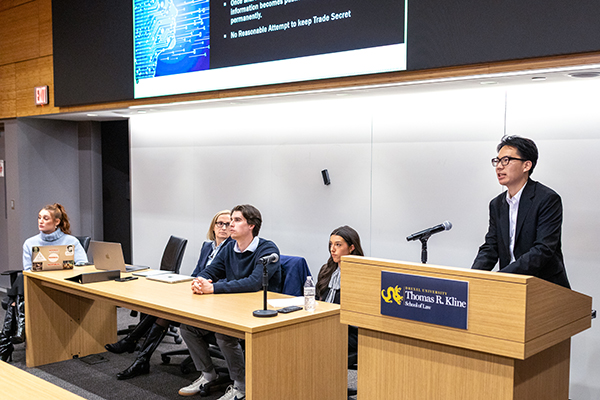
Public presentations are also part of the ELC experience. Topics have included the legal implications of artificial intelligence tools, startup governance and operational risk.
The goal is to help students build confidence communicating with clients, presenting legal concepts publicly and navigating professional relationships within the startup community.
There was a lot of redlining, but the collaboration helped our clients form their businesses in a way that best fit their goals.
Mary Katherine O. Mastaler, JD ’26
^Top
Why It Matters
The ELC gives students the opportunity to experience the full lifecycle of transactional legal work, from identifying a legal issue and counseling a client to drafting agreements and seeing those documents used in practice.
Students leave the clinic with experience working directly with founders, navigating ambiguity and understanding how legal decisions affect growing companies.
The clinic also helps students understand how professional relationships, communication and judgment shape long-term careers in transactional practice.
^Top