Child Advocacy Field Clinic
Sections:
Advocate for Children in a Team-based Practice
The Child Advocacy Clinic places Drexel Kline Law students inside the Child Advocacy Unit (CAU) of the Defender Association of Philadelphia. The clinic is yearlong and open to 3L students (or accelerated students entering their final year of law school). Participants represent children in dependency proceedings in Philadelphia Family Court as part of an interdisciplinary practice that integrates legal advocacy and social work.
Unlike many courtroom experiences, this work isn’t limited to a single hearing. Cases often unfold over months or years, and students see how decisions about placement, services and family relationships shape a child’s life over time.
^Top
Work Inside an Active Child Advocacy Office
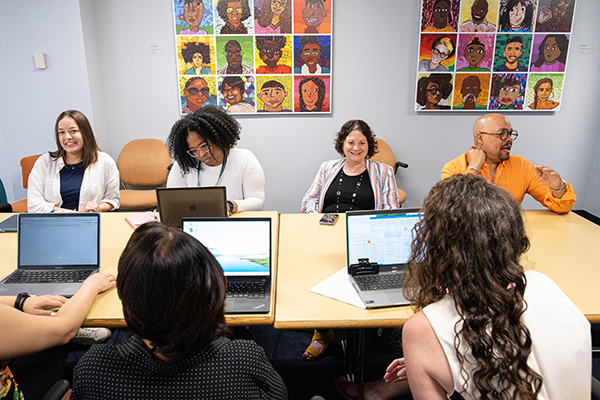
From the start, participants are integrated into ongoing case teams within the Child Advocacy Unit. Each student is paired with mentor attorneys and works closely with the attorneys and social workers assigned to that client.
The clinic combines office work with a weekly seminar. Early sessions deliver a structured overview of the dependency system and the issues that commonly arise. As students take on cases, class time becomes a space to analyze hearings, discuss strategy and explore substantive topics in child welfare law.
They’re stepping into an existing team with an assigned attorney and an assigned social worker, and they’re fully part of that team, working together to problem solve what’s practical and what we can do for our clients.
Emily Blumenstein, clinic co-director
^Top
Represent Children in Dependency Proceedings
Clinic participants work on matters, such as:
- Shelter care hearings following emergency removals
- Adjudicatory hearings
- Permanency review hearings
- Adoption-related review hearings
Dependency proceedings involve multiple parties, including the child, parents and the state. Positions can shift as circumstances change in a child’s life and within the family. That framework changes how advocacy unfolds.
Clinic students prepare not just for individual hearings, but for cases that develop over time.
Our area of law is really one of the only ones where there are at least three parties, not just a defendant and a plaintiff.
Mimi Laver, clinic co-director
^Top
Children as Clients
In this clinic, children are the clients. That reality shapes how students listen, counsel and advocate. Some clients clearly articulate what they want. Others communicate through posture, tone or hesitation. Students navigate their role as both advocate and guardian ad litem, weighing a child’s expressed wishes alongside the child’s best interests.
Representing children requires recalibrating how lawyers listen.
It takes a level of respect for even a very young child and their expression of their interest.
Sambhavi Cheemalapati, JD ’26
The work exposes students to the responsibility of serving as guardians ad litem, a role that calls for careful decision-making and attention to cultural context, family dynamics, as well as developmental needs.
^Top
Professional Judgment in Practice
The clinic emphasizes preparation, supervision and reflection. Students anticipate how hearings may unfold, outline questions in advance and observe courtrooms before taking the lead. They and their mentors talk through different scenarios before stepping into court. Preparation includes reviewing records, speaking with case managers and understanding how different judges manage proceedings.
We work through all the ways that a hearing could go in advance.
Emily Blumenstein, clinic co-director
Flexibility matters. A parent who has not appeared in months may unexpectedly walk into court. A witness may say something no one anticipated. Preparation is constant, but judgment is tested in real time.
Law school makes you feel like this is such an individualized practice. Working with social workers and other professionals makes you realize how this must be a collaborative experience.
Cameron Chisolm, JD ’26
The aim is to give students real responsibility without compromising representation and to help them understand the long-term weight of the work.
Once you meet clients and care about them and have names and faces to go with these issues, you take that with you.
Emily Blumenstein, clinic co-director
^Top
Holistic Representation
The Child Advocacy Unit’s model of representation pairs every child with both a lawyer and a social worker. That structure also requires humility.
As individual people, we shouldn’t always be making decisions about what’s best for somebody else’s child.
Mimi Laver, clinic co-director
The model shapes how cases are approached from the start. Students see how advocacy goes beyond courtroom walls into school meetings, medical care and service planning—and that representation can span years.
I’ve had the same client from 12 who’s now 19.
Emily Blumenstein, clinic co-director
^Top
Why It Matters
Because dependency proceedings are confidential and often unfold outside public view, students gain insight into a system most people rarely see. The clinic helps build professional judgment that carries into many areas of practice.
I hope that they walk out of here with some humility about the world… and about our role as guardians ad litem.
Mimi Laver, clinic co-director
^Top