Biostatistics Scientific Collaboration Center (BSC)
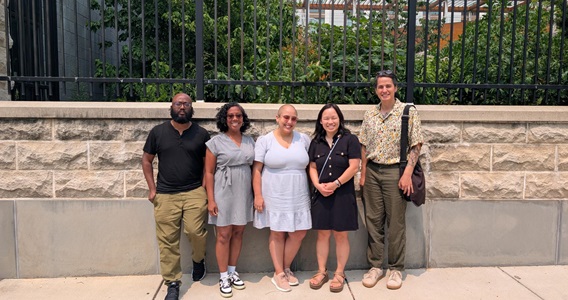 Biostatistics Scientific Collaboration Center team members
What is the Biostatistics Scientific Collaboration Center (BSC)?
Welcome to the Biostatistics Scientific Collaboration Center (BSC). The BSC is based in the Department of Epidemiology and Biostatistics at Drexel University's Dornsife School of Public Health.
Staffed with highly capable biostatisticians and qualitative experts, the BSC is a fee-for-service center.
Have a project in mind? Let us know by completing our request form:
BSC Collaboration Request form
The BSC team can support you at any point in your research journey—from study design and data collection to statistical and qualitative analysis, interpretation, and dissemination of results.
We can get involved as you begin to plan your study by engaging in conversations about refining study design and aims with a biostatistics and data management lens.
If you are looking for experienced collaborators to strengthen your research, then you have come to the right place.
Mission of the Drexel Dornsife BSC
The Biostatistics Scientific Collaboration Center (BSC) engages in team science to provide expertise in study design and conduct, data management, qualitative and statistical analysis, and translation of qualitative and statistical findings to inform content specific scientific inquiries.
We strive to help build research programs and stand in the gap for researchers, departments, centers, colleges, and teams who do not have sufficient biostatistics resources to contribute to all their research endeavors. Our goal is to facilitate research with strong scientific premise informed by sound statistical design and methodology, while fostering a spirit of inclusive interdisciplinary team science.
Fill out a request form
How Does the BSC Work?
Based on your project needs, the BSC assembles a team of biostatisticians, qualitative experts, and data collection specialists to join in collaboration with your study team.
The BSC is deliverable-based, and together we create and implement a scope of work (SOW) for a set of clearly defined deliverables for each stage of the study design, data management, analysis, and dissemination process.
Projects are priced by tier depending on the time, personnel needed, project complexity, and Drexel affiliation. Most projects require several tiers. Please see below for examples of BSC deliverables.
Examples of BSC Services
The BSC team can contribute to your project in the following ways, and more:
- Study Design: Power Analysis & Statistical Review of Grant Proposal
- Quantitative/Qualitative Aims
- Aims, Rigor & Reproducibility, Stat Methods Section
- Creation of Analytic Dataset
- Data Cleaning
- Merging Multiple Sources of Data
- Creation of Derived Variables and Scoring Constructs
- Quantitative & Qualitative Analysis
- REDCap Database Development, Implementation, Maintenance
- Honest Broker (unblinded team for data management and analysis)
- Collaboration on Reports Required for Regulatory and Funding Agencies (e.g. DSMB, NIH)
- Collaboration on Manuscripts
- Response to Reviewers for Grants and Manuscripts
- Data Mining and Analysis of Large, Administrative, or Publicly Available Datasets (e.g. NHATS)
Schedule a Consultation With Our Biostatistics Team
Is BSC a good fit to join your team? Submit the BSC request form to help us learn more about your project and research. Please reach out to us at least 4-6 weeks prior to your targetprovided deadline. We cannot guarantee our full scope of services with less notice
After you complete the form a member of our team will respond to your request within two business days to set up a time to meet.
Please also feel free to contact us via email at bsc@drexel.edu. We are excited about the possibility of collaborating with you!
BSC Personnel and Research Expertise
- Reneé H. Moore, PhD, Director
- Daniel Vader, PhD, Statistician
- Jordan Wilson, MPH, Statistician & Qualitative Researcher
- Karlin Taylor (nee’ Moore), MS, Data Analyst
- Natalie Rodrigues, Program Manager & Data Analyst
- Research Interests of BSC Members
The research interests and expertise of BSC personnel include:
- Clinical trials
- Community participatory research
- Data collection tools (Qualtrics, REDCap)
- Data management, security, and sharing
- Data mining
- DEI and trauma-informed principles
- Education and training (interactive hands-on learning)
- Electronic health record (EHR) data
- Geospatial analysis
- Health equity
- Hierarchical, nested, clustered data analysis
- Longitudinal data analysis
- Measurement error
- Missing data
- Mixed-methods analysis
- Observational data analysis
- Propensity score weighting
- Qualitative analysis
- Rigor and reproducibility
- Study design
- Survival analysis
How Can Biostatistics Students Join Drexel Dornsife's Biostatistics Scientific Collaboration Center?
There are various ways that students can become involved in the BSC. BSC faculty and staff teach the following courses:
BST 567/867 Statistical Collaboration: This course introduces the fundamental aspects of statistical consulting and provides students with training on being an effective statistical consultant and collaborator.
BST 675/875 Statistical Collaboration Lab: Students learn the practical aspects of statistical collaboration through hands-on experiences that facilitate understanding of the roles and responsibilities of biostatisticians.
BST 698/898 Statistical Collaboration in Practice: For their master's project, MS in Biostatistics students can work in close collaboration with BSC investigators on an actual BSC project.
Additional opportunities include research assistantships, APEs, data analysis projects, and work study positions. Also, BSC faculty and staff can serve as members of thesis and dissertation committees.
Acknowledgement
The BSC follows the guidelines for authorship set by the International Committee of Medical Journal Editors. In many cases, support via the fee-for-service model qualifies BSC faculty and staff as authors. Otherwise, manuscripts or grants presenting work supported by the core should include the following statement: “This work was supported by the Biostatistics Collaboration Center at Drexel University."
Contact the BSC via email at bsc@drexel.edu if you have any questions.