The Academy of Natural Sciences’ Living Legacy of Research and Discovery

For nearly two centuries, most visitors encountered the Academy of Natural Sciences through its museum. But beyond the public galleries, a scientific enterprise has been — and continues to be — at work.
The Academy is home to one of the world’s most globally significant natural history collections. It holds about 19 million biological specimens, fossils and minerals, along with archives, books and other records documenting centuries of scientific discovery. Its scientists study freshwater ecosystems and record environmental change across the planet at the same time they advance research in taxonomy and systematics, ecology, evolutionary biology and paleontology. Researchers worldwide use its collections to advance their own work. And Drexel University students learn alongside Academy scientists and experts through courses, co-ops and fieldwork.
That work continues even as the Academy enters a new chapter. The museum, which first opened in 1828, closed to visitors on Sept. 30 as part of ongoing efforts to secure a sustainable future for the institution. The Academy was founded in 1812 “for the encouragement and cultivation of the sciences, and the advancement of useful learning,” and its research, collections and scientific education remain rooted in that founding mission.
Since 2011, the Academy has been formally affiliated with Drexel, and its mission has become intertwined with the University’s research and education. The affiliation brought Academy experts into faculty roles and led to the establishment of the Department of Biodiversity, Earth and Environmental Science (BEES) within Drexel’s College of Arts and Sciences, creating new connections between the Academy’s research and Drexel’s classrooms and students.
Those connections extend through the Center for Systematic Biology and Evolution, Academy Library and Archives and the Patrick Center for Environmental Research, where students work alongside scientists and professional staff and develop in their fields. BEES itself has grown from 25 undergraduates in 2012 to over 100 today.
Fifteen years after the affiliation, the result is a scientific partnership built around an institution whose mission predates its museum — and continues beyond it.
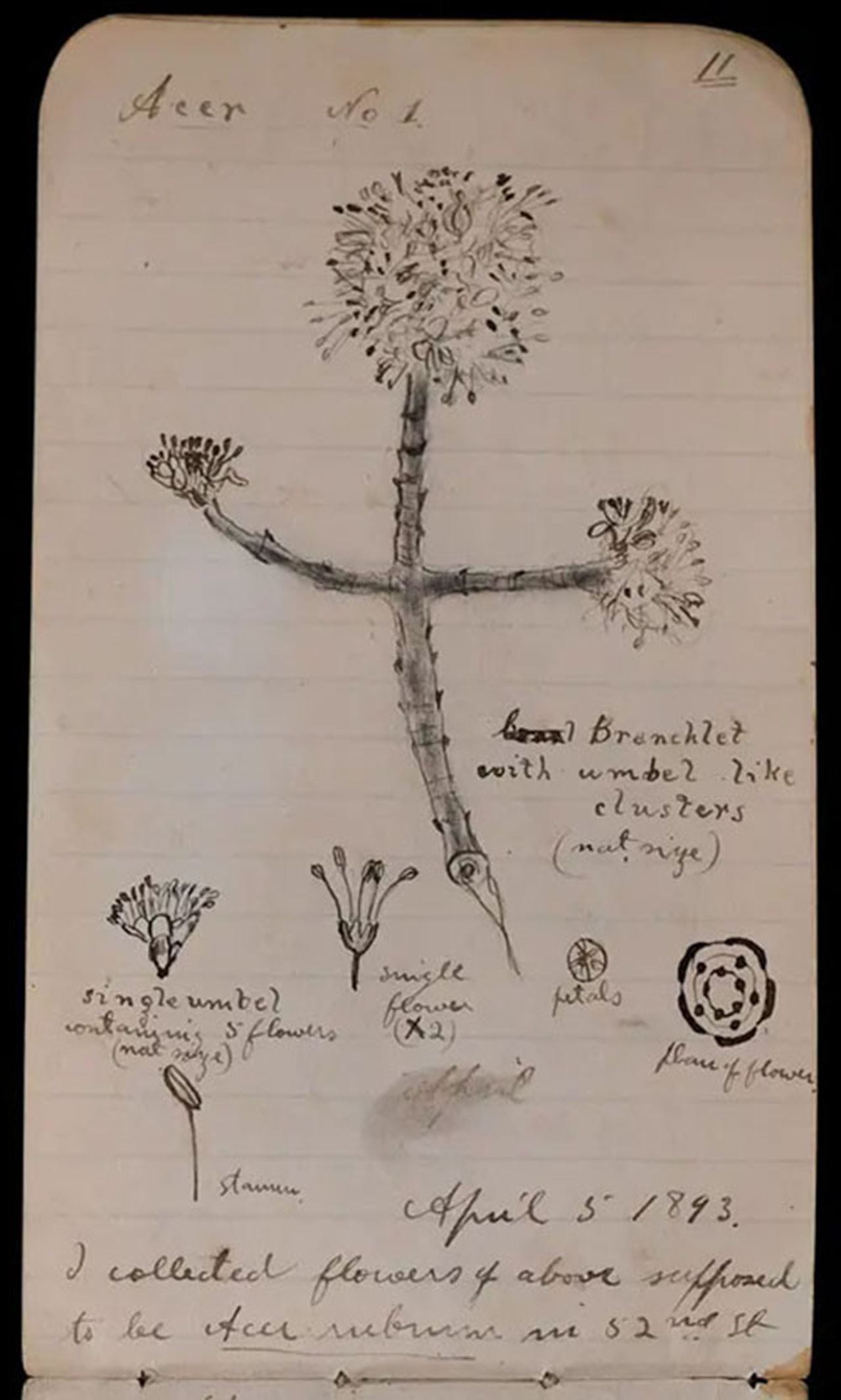
Alexander MacElwee was the founding curator (and, later, president) of the Philadelphia Botanical Club, which has contributed to Academy’s collection of local plants and the Academy’s herbarium since its 1891 founding. In the mid-1880s, he worked on the grounds of the West Philadelphia estate of Drexel University’s founder, Anthony J. Drexel. Today, the Academy holds more than 4,600 specimens he collected. This is a digitized scan of an entry from one of his field notebooks held in the Academy’s Archives: “April 5, 1893. I collected flowers of above supposed to be Acer rubrum [red maple tree] in 52nd St.” Image courtesy of the Academy Library and Archives.
Experiential Education from the Start
When the Academy of Natural Sciences of Philadelphia was founded in 1812, the natural sciences had not yet been formalized as an educational or professional field in the country. The Academy helped change that.
The Academy’s founders and generations of staff and scientists advanced the natural sciences fields through discovery, collaboration and education. As one of the first institutions in America to formally collect and study specimens, publish research, conduct fieldwork, and — with the creation of the museum in 1828 — share its discoveries with the public, the Academy helped set standards still followed today. Many of the specimens and archival materials collected throughout that history are preserved within Academy collections.
In the 20th century, the Academy added another key component: the Patrick Center, founded in 1947 by its later namesake, Ruth Patrick, PhD. During her eight decades at the Academy, Patrick led pioneering research and scientific collaboration focused on freshwater ecosystems, diatoms and environmental health — work that continues today.
Even before the Academy-Drexel affiliation, some Drexel faculty and students came to the Academy for research, said David Velinsky, PhD, a senior staff scientist at the Patrick Center and professor in Drexel’s BEES Department who began working at the Academy in 1995. But the connections deepened considerably after the 2011 affiliation.
“Before Drexel, we were doing research, but it was always very quiet,” he said. “After we combined, now we have students working in the collections and Library and Archives, working in the Patrick Center, going out in the field and coming in for classes. It adds vibrancy to the place.”
Velinsky had a central role in building those relationships. He served as director of the Patrick Center from 2007 to 2017, as founding chair of the BEES department from 2012 to 2023 and as vice president for the Academy’s Center of Academy Science from 2012 to 2020.
Antonio Merlo, PhD, who became Drexel’s president last year, said that the University’s affiliation with the Academy has helped “preserve and strengthen one of the nation’s great scientific collections.”
“We remain firmly committed to their long-term stewardship and to ensuring they continue to serve researchers, educators, students and the public for generations to come,” he added.
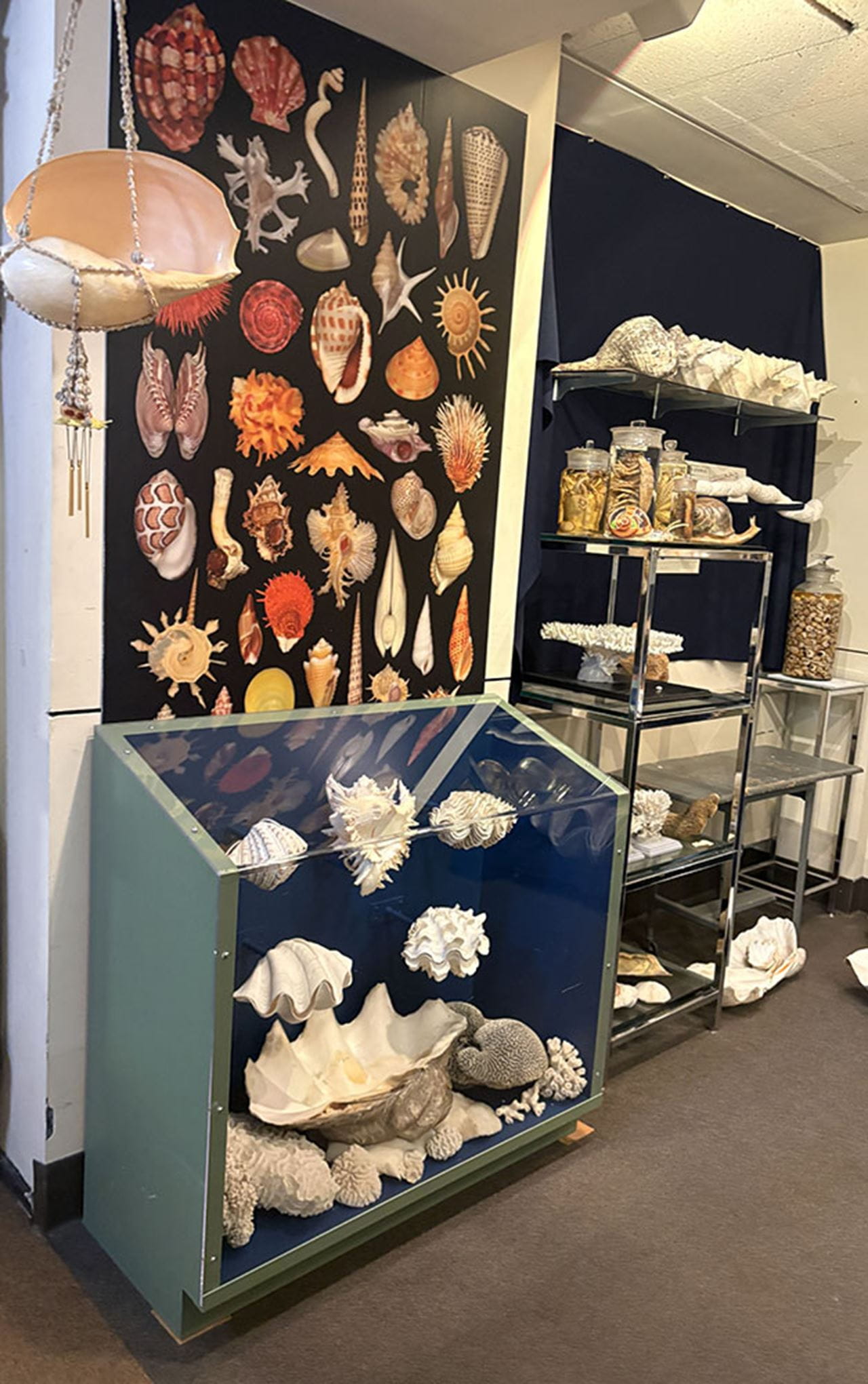
Wet, dry and photographed specimens from the Department of Malacology are displayed even behind the scenes in the Academy’s collections space.
Courses, Co-ops and Connections
After the affiliation with Drexel, an onsite basic sciences laboratory and classroom were renovated at the Academy to host the University’s classes. Drexel students and faculty also use CSBE, Library and Archives and Patrick Center laboratories, collection spaces and other areas for research and academic collaborations.
Some BEES faculty have had dual roles at the Academy: CSBE has five BEES faculty members on its staff, while Velinsky is currently the only Patrick Center staff member with a BEES faculty appointment. Over the years, many staff from CSBE, the Patrick Center and Library and Archives have also taught classes and worked with Drexel students and faculty.
Much of that collaboration comes through the BEES Department, but opportunities extend across Drexel and the Academy for Dragons to deepen their expertise, pursue graduate study and fellowships or scholarships and build careers as researchers, scientists, collections experts and professors.
“That connection to Drexel opened the door for the students to see a whole different world of research that goes on, through both the environmental work in the Patrick Center and everything with the collections in CSBE,” said Velinsky.
A few other American universities have in-house museums with established ties to natural sciences institutions (Harvard and Yale universities, for example), but it’s not the same as the relationship between Drexel and the Academy.
“Ours is unique in the sense of the age of the institution, the historic nature of it and the size and depth of the collections and the environmental research. Also, most museums don’t have this kind of environmental research, but we’ve had it here at the Academy since the ’40s,” said Velinsky.
For students, that relationship can open pathways throughout their Drexel experience.
“I think the Academy gives access to certain subdisciplines and specific fields of research that allow for students to specialize early, and to go into a field that they’re very, very excited about that exists at the Academy,” said Ean Geller Nocella, environmental science ’29 in the BEES Department. Geller Nocella first became involved with the Academy through a summer research program for high school students and chose Drexel in part because of its Academy connections, specifically in relation to fisheries science.
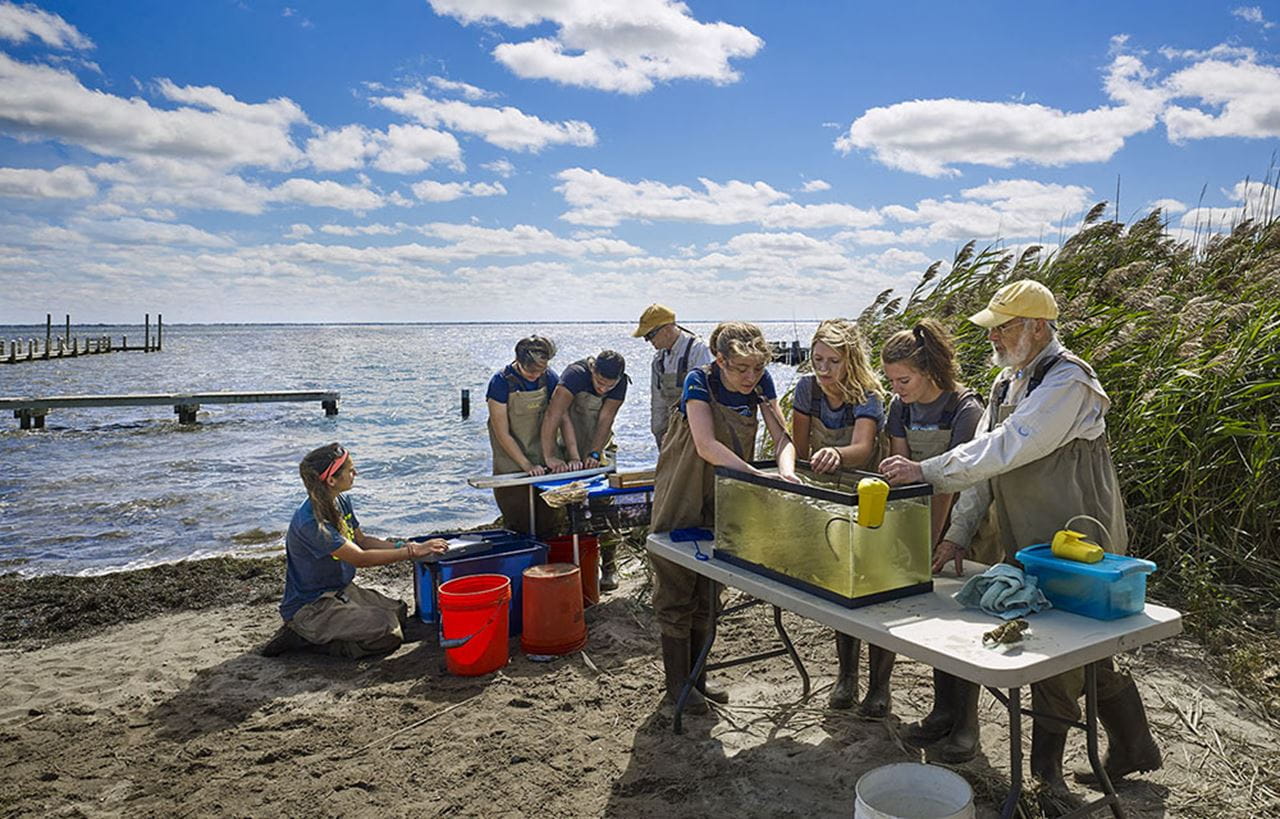
A photo from the early days of BEES: students conducting fieldwork with Richard Horwitz, PhD, professor emeritus of fisheries at the Academy. Photo courtesy the College of Arts and Sciences.
He connected with the Patrick Center’s Fisheries Department through an “Environmental Science 101” class his first year and continued with volunteer work before and after completing a co-op as a Fisheries support staff member. During his co-op, he contributed to departmental projects such as assessing anadromous fish passage in New Jersey’s Cooper River. He also developed science communication and community outreach skills by participating in Academy events and drafting social media posts.
“This co-op solidified my desire to pursue a career in the fisheries science or fisheries management field,” he said. “It had a multi-legged approach with really interesting projects that helped me build a lot of different skills that I don’t think I would have gotten solely through my classes.”
His experience motivated him to begin working on a side project within the department analyzing the diet, age and growth of freshwater drum, an invasive species of fish in the Delaware River watershed. This research started during his co-op and will continue afterward.
“The Patrick Center is not typical of academic or museum settings, but it still overlaps with classes, co-ops and all the collections,” said Roland Wall, executive director of the Patrick Center, who has been at the Academy for 27 years. “We have a lot of students pass through here, and it’s certainly not uncommon for us to do guest lectures, because this is a great place for experiential learning and hands-on work.”
Wall estimates that he taught in about 30 introductory environmental science and environmental studies classes for the BEES Department from 2013 to 2021, and other staff members have taught or hosted classes since the affiliation began. Over the years, there have been about 75 co-ops, most of them students from BEES, working on projects at the Patrick Center, with many later staying on as part-time staff, volunteers or work-study study students.
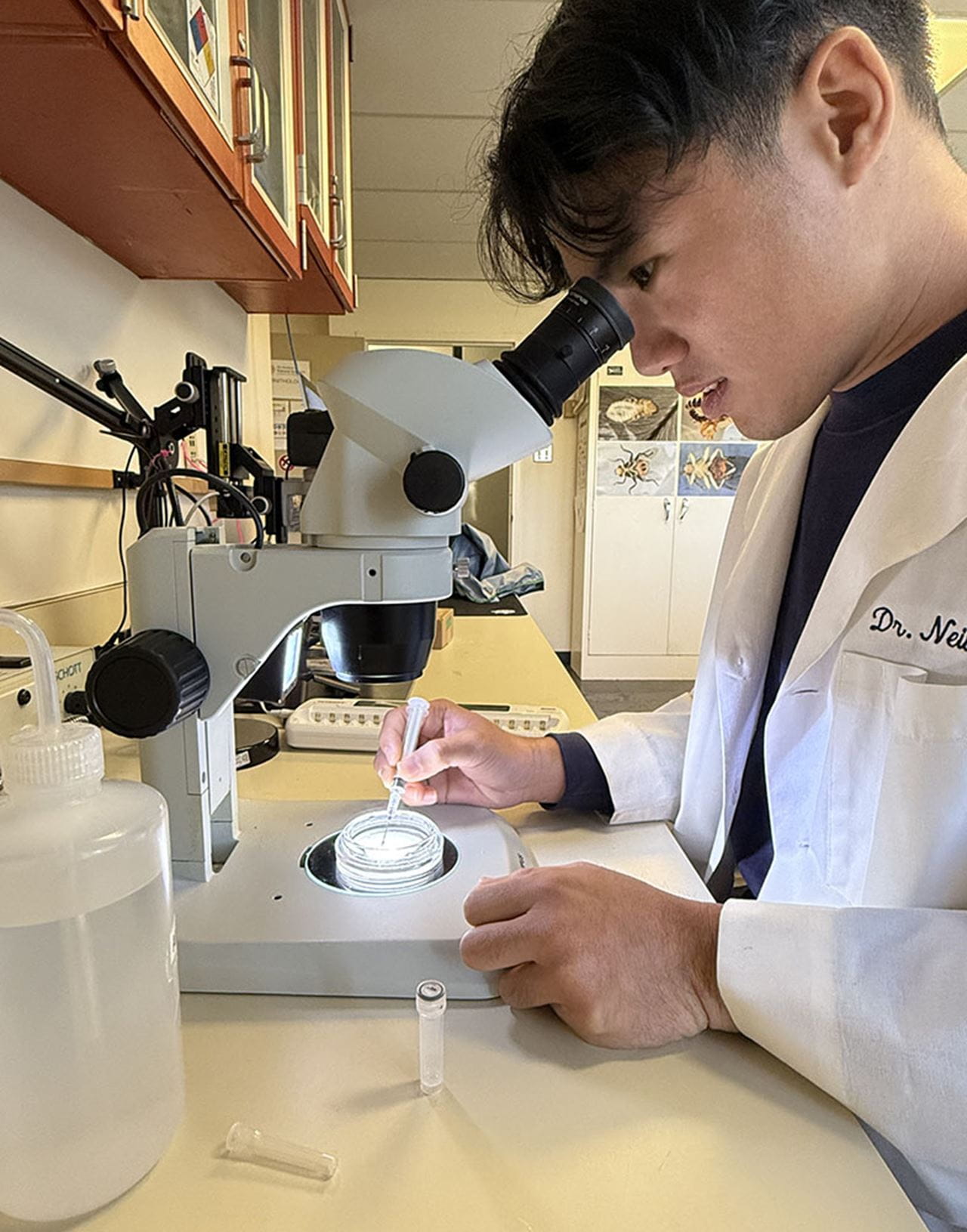
Matthew Soesanto, who graduated this year with a BS in biological sciences and a minor in bioinformatics, completed two co-ops and fulfilled an ongoing internship in Jason Weckstein’s lab for nearly his entire time as a Drexel student. He has contributed to several papers as an author and coauthor and is now working on a manuscript based on his project. He will conduct research on siphon fish and their bioluminescent symbionts in Indonesia after receiving a study/research grant through the Fulbright U.S. Student Program. Photo courtesy Jason Weckstein.
Individual projects and partnerships vary every year, but the Patrick Center frequently works with the BEES Department as well as the faculty and students in the College of Arts and Sciences’ Department of Politics and in the Nick Howley College of Engineering and Computing’s School of Computer and Information Sciences and School of Engineering.
In CSBE, BEES faculty have also held positions in the vertebrate paleontology, botany, entomology, ichthyology, malacology and diatom collections. Jason Weckstein, PhD, has served as a curator of ornithology and BEES professor since 2014. The Ornithology Collection includes three full-time employees, eight undergraduate students, two graduate students and a few postdocs and volunteers, including a retired doctor who prepares specimens.
Because the team works closely together, Weckstein said, students, staff and volunteers learn from one another. That engagement extends to an engaged network of ornithology “alumni,” including a former lab manager who volunteers once a week and Drexel graduates who attend birding trips Weckstein organizes in the fall and spring.
Weckstein also frequently uses labs and specimens in his recurring labs and lectures, as well as an “Introduction to Evolution” class. The Ornithology Collection is the sixth largest in the world, with 215,000 study skins and ~25,000 tissue samples from over 7,000 species — almost 90% of known birds. Ornithology also has more than 200,000 images of birds and adds about 1,500 new specimens per year. That means there’s much to do and learn from.
“All of the co-ops are multi-pronged,” said Weckstein. “The idea is that they learn about research and collections management and curation, so they can do everything from wet lab work to some fieldwork. Right now, I’m working on permits for a series of expeditions to Brazil, and undergraduate students are included in these field work plans.”
Library and Archives similarly uses its extensive collections as teaching tools and opportunities for professional development, with many Dragons staying involved after their primary roles there have ended.
“I like to say that Library and Archives is an active learning lab; there is a lot of ‘learn while doing,’” said Jessica Lydon, the Brooke Dolan Archivist and interim head of Library and Archives, who has been with the Academy since 2022.
This term, Drexel classes visiting Library and Archives include “Literature & Science,” “Research Methods in History,” “Intro to Digital Humanities” and “Tablet Drawing.” The most frequent collaborators include College of Arts and Sciences, Antoinette Westphal College of Media Arts & Design and the School of Computer and Information Sciences, whose students participate through classes, co-ops, internships and work-study positions, Lydon said.
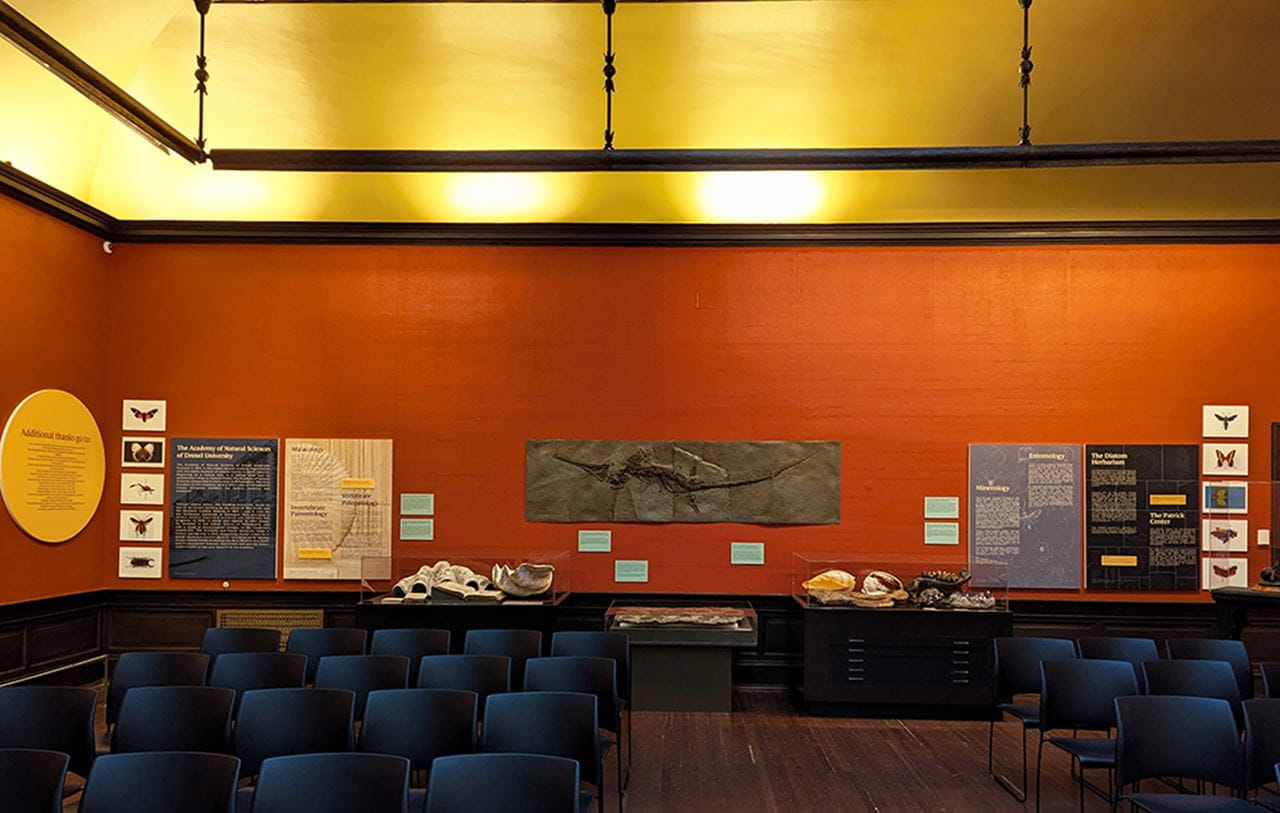
Some of the art and artifacts from the Patrick Center, CSBE and Library and Archives are displayed in the Drexel Founding Collection’s Drexel [Re]Framed: The Dragon Experience exhibition in Drexel’s Main Building.
Students also contribute to ongoing Library and Archives projects. Co-ops, for example, have worked on oral history interviews for the Academy Oral Histories Project. And through a recent grant from the Council on Library and Information Resources’ Recordings at Risk program, work-study students will create descriptive catalog records for some of the more than 450 reels of 16mm film footage shot during scientific expeditions and fieldwork in the Americas, Africa and Asia from the 1920s through the 1970s.
Both CSBE and Library and Archives are connected to Drexel’s Libraries, Collections & Archives, providing exhibition loans and participating in University programming, teaching and outreach. The Library and Archives’ partnership with Drexel University Libraries and the Drexel University Archives allows users to search, explore and access one of the most comprehensive natural history libraries in North America through online databases. And the Patrick Center, CSBE and Library and Archives all loaned specimens and materials for Drexel [Re]Framed: The Dragon Experience, a student-curated exhibition in Drexel’s Main Building.
Experts in Their Own Fields
CSBE, Library and Archives and the Patrick Center frequently collaborate and overlap with each other, and each are internationally known in their own fields. In recent years, they have also expanded access to their resources through digitization, distribution and outreach strategies.
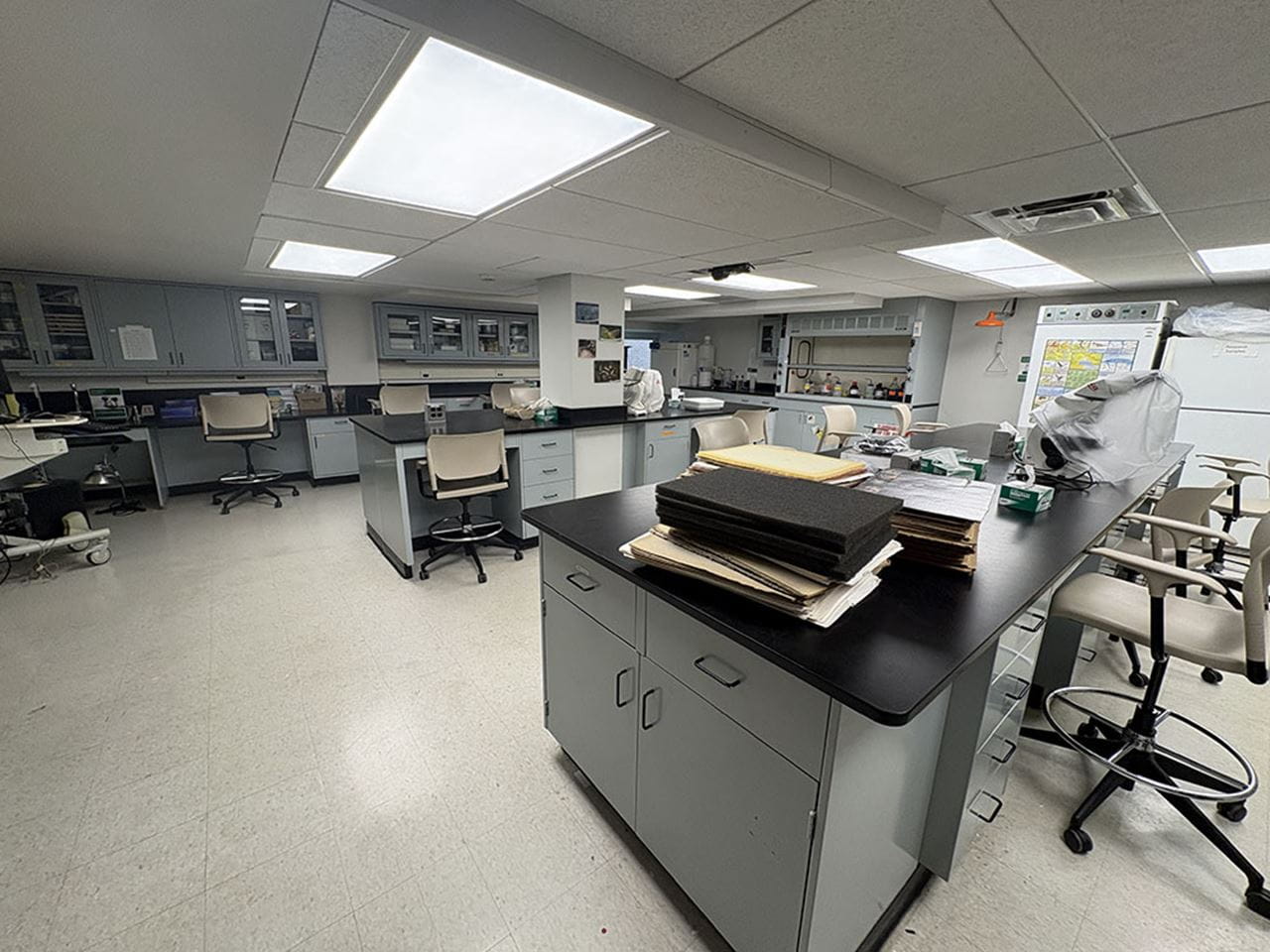
A basic sciences laboratory established at the Academy for Drexel courses taught on-site.
The Patrick Center
“At the Patrick Center, we’re focused on projects and problems,” said Wall, its executive director. “What we do is pretty specialized, and there are not a lot of places that can do what we do.”
The Patrick Center’s 18 staff members study the health of freshwater systems and work on issues ranging from urban climate change to environmental policy and community engagement. The Patrick Center is organized into sections related to biogeochemistry, fisheries, macroinvertebrates, phycology, civic engagement and environmental policy, planning and innovation.
Primarily supported through external funding, the center takes on projects for government agencies, private industry and community organizations, with some partnerships spanning decades.
Current projects reflect that range. Patrick Center researchers are tracing the movement of PFAS chemicals through waterways and fish, tracking aquatic insects in the Upper Delaware River and working with Philadelphia communities and government agencies to evaluate and promote the benefits of green stormwater infrastructure.
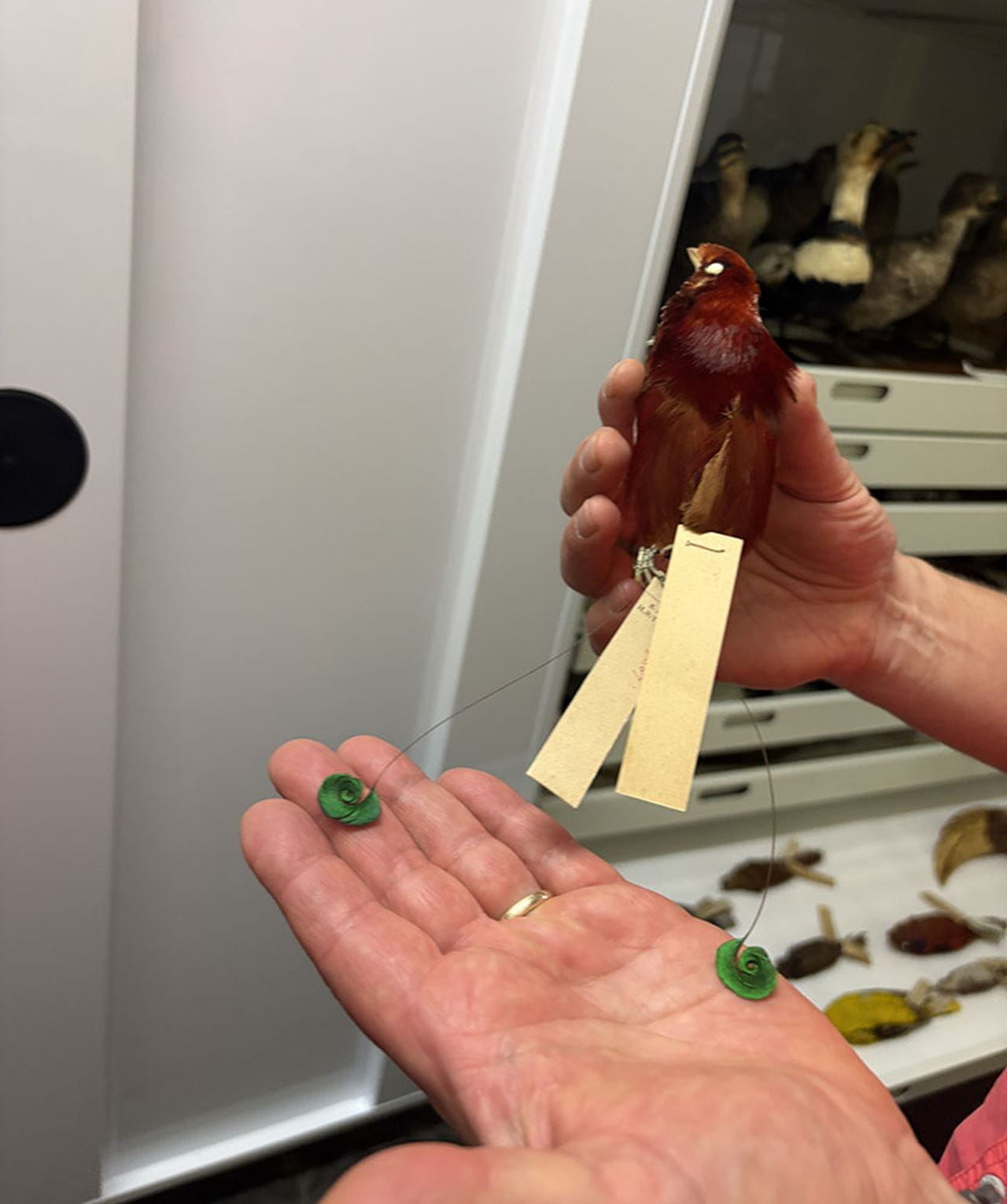
Nate Rice, PhD, collection manager of ornithology, showed off his favorite bird in the Ornithology Collection: the king bird-of-paradise, which was collected by noted naturalist Alfred Russel Wallace in Papua New Guinea in the 1850s.
The Center for Systematic Biology and Evolution
CSBE houses 13 collections, some of which rank among the oldest, first or biggest in the world. Its 19 million specimens spanning three centuries are held in collections for diatoms, botany, entomology, invertebrate paleontology, vertebrate paleontology, general invertebrates, malacology, ichthyology, herpetology, ornithology, mammalogy and minerals — spread out across five floors within the Academy building.
Among them are more than 73,000 type specimens, or the specimens used for the original description of species — making the Academy’s collections crucial for reference and research. The project of collecting and describing new species is perpetual at the Academy, and occurs every year. And specimens gathered decades or even centuries ago document the biodiversity of another time, allowing researchers to study the impacts of urbanization, pollution and climate change.
These collections are also used as teaching and research tools far beyond Drexel classes: CSBE receives hundreds of requests for data and images each year and loans an average of 7,000 specimens and tissue samples annually to researchers and institutions around the world.
Some specimens have human stories, as well. James Bond was the Academy ornithologist from the 1920s to 1980s who authored a 1936 book, “Birds of the West Indies,” that caught the eye of author Ian Fleming. The Ichthyology Department includes a fish named for Ernest Hemingway, who once took Academy scientists fishing in Cuba. And the Lewis and Clark Herbarium is filled with specimens collected during their famed Corps of Discovery expedition (on long-term loan from the American Philosophical Society).
“In literally every cabinet, every tray, every specimen, there’s a story of when something was collected, where it was collected and who collected it,” said Nate Rice, PhD, collection manager of ornithology, who has been at the Academy for almost 30 years. “And that story never stops.”
In recent years, the Academy has undertaken massive digitization projects to publish photographs, resources and other information related to over 1.7 million records online through internal databases and external aggregators.
Since Ornithology Collection data went online in 2018, for example, researchers from 87 countries have used it in more than 700 publications. On average, 2,000 to 3,000 people view 10 to 20 million records each month.
“We have been improving our digital collections infrastructure over the last three years or so. We are aiming to centralize all our collections and make them more accessible and discoverable. We have strengthened our presence in the global aggregators and have published 13 datasets adding almost 2 million records and about 800,000 images,” said Executive Director for the Center of Systematic Biology and Evolution Mariangeles Arce H., PhD.
Arce H. first came to the Academy in 2004 as a post-undergraduate researcher from Colombia to study catfish, continued as an affiliated researcher and returned for postdoctoral work. She was first hired as an ichthyology collections manager in 2015 and assumed her current role in 2023.
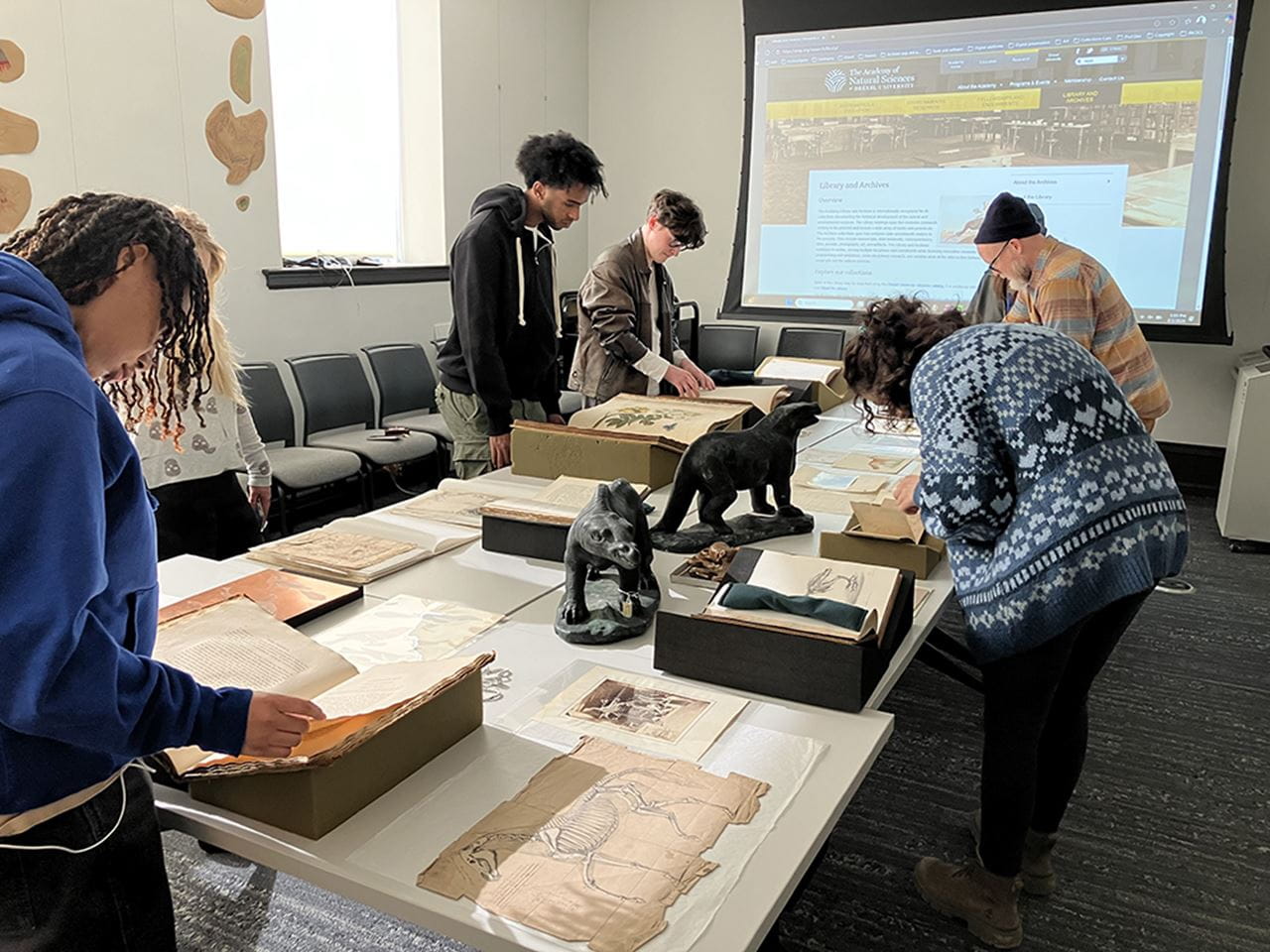
Westphal students enrolled in “Tablet Drawing” learn about the development of natural history illustration from the 17th century forward and the importance of observation and an artist’s composition process through sketchbooks, illustrations, scale models and rare books from the Academy’s Library and Archives. Photo courtesy of the Academy Library and Archives.
Library and Archives
The Academy’s Library was started soon after the institution’s founding, with the Archives formally created in 1893. Now, the Library holds over 75,000 titles from the 16th century to today, including 4,000 volumes in its rare book collection, and is known as one of the continent’s most comprehensive repositories of natural science literature.
Because printed materials were the primary way scientists published and shared information for much of the Academy’s history, the collection provides an esteemed record of how the understanding of the natural world developed over time. The Archives holdings extend beyond books and journals to artifacts including framed portraits, specimen collecting equipment and scientific instruments; approximately 8.8 million pages of paper records such as illustrations, manuscripts, field notebooks, photographs, maps and correspondence; and films and other materials, all spanning four centuries and a variety of disciplines. Many of these materials are also available digitally, including through the Drexel systems and the Biodiversity Heritage Library, the Pennsylvania Photos and Documents platform and the Internet Archive.
“Library and Archives documents not just the history of the Academy itself, but also the history of Philadelphia and the evolution of science in America, since its early days as a republic,” said Lydon, the Brooke Dolan Archivist and Interim Head of Library and Archives.
Each year brings an average of 250 in-person research appointments and requests for information — and new ways of telling stories and sharing history in a variety of different, and creative, ways.
“This includes scholars and academics working on peer reviewed or popular articles and books, undergraduate and graduate students from Drexel and other area universities working on class assignments or independent research projects, local and national media and independent film makers producing stories on the history of the natural and environmental sciences, artists who incorporate historical research and images into their artistic practice, and individuals conducting genealogical research on early members of the Academy — to name a few,” she said.