At Drexel Kline, Elder Law begins with a phone call to someone you’ve never met.
 David R. Hoffman
In the course, students are paired with older adults across Pennsylvania, all of whom are at risk of social isolation. Each week, they call, ask questions, and listen. Conversations often center on everyday challenges, health, family dynamics, and whether basic needs are being met. The structure is simple, but the experience is layered. “It seems so basic,” said Professor David R. Hoffman. “But it’s really so interesting to observe how this works.”
For many, the first call is the hardest part. “It was intimidating to make the first call,” said Nora Mitchell, JD ’27. “I wasn’t quite sure what we would talk about.”
That uncertainty quickly gives way to genuine connection. “Despite it being only about 30 minutes, I learned so much on that first call,” she said. “It stood out to me that this project was special because of the connections it allowed us to make across generations.”
From Doctrine to Lived Experience
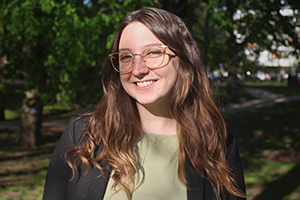 Nora Mitchell
Hoffman draws on decades of experience in elder justice, including his work shaping legislation on guardianship reform and elder abuse, as well as serving as chief counsel for the Pennsylvania Department of Aging. The course isn’t designed to stay in theory. “There are a lot of technical things that students focus on,” Hoffman said. “I wanted to focus on something experiential in value.”
That approach is also reflected in a formal partnership between Drexel Kline, the Pennsylvania Department of Aging, and the Pennsylvania Association of Area Agencies on Aging (P4A). In 2023, Hoffman helped establish this collaboration through a Letter of Understanding that outlines how the program operates and connects students with older adults at risk of social isolation across the state.
Students still study the law governing capacity, planning tools for finances and health care, and surrogate and supported decision-making. They test those frameworks through direct interaction and real situations.
For Alex Koehler, JD ’26, that shift reframed how she understood the subject. “Someone’s legal capacity is far more nuanced than it appears in legal doctrine,” she said. “In class, it felt like a checklist. In practice, it’s more of a spectrum that depends on someone’s individual situation.”
Weekly calls and court observations place those legal standards in context, rather than leaving them abstract.
Rethinking Capacity
One of the central questions is how lawyers assess decision-making capacity and who makes that determination. “There’s a view, albeit incorrect, that once you hit a certain age, you need protection,” Hoffman said. “Ageism is a very real issue.”
The course challenges assumptions, revealing how easily capacity is misread and the impact of such errors. “What stood out to me was how much a person’s ability to make decisions can vary,” Koehler said. “Someone’s lived reality doesn’t fit perfectly into a legal standard.”
That understanding deepens through direct interaction. Students encounter individuals navigating changing circumstances in ways that don’t align neatly with legal categories.
Mitchell saw that play out in her weekly conversations, where independence wasn’t defined by doing everything alone. “Independence takes on many different forms,” she said. “Maintaining independence is an important value to many older individuals. Sometimes it requires acknowledging where help is needed.”
When Theory Meets Reality
 Alex Koehler
In class, students work through hypotheticals and statutory frameworks. Applying them in practice is less predictable. “Our class spent a lot of time reading hypotheticals and choosing the best answer,” Koehler said. “In the hearings, it became clear that determining someone’s best interest involves difficult value judgments.”
As part of the course, participants observe guardianship hearings, often through live proceedings. These observations run alongside their ongoing conversations, allowing them to compare what unfolds in court with what they hear directly from individuals.
“What if the person’s expressed wishes are not what is safe for them?” Koehler said. These questions rarely resolve cleanly. They require judgment, context and an ability to weigh competing considerations without losing sight of the individual.
Seeing the Stakes
The hearings also make clear what is at risk. “What stood out to me most was the weight of the decisions being made,” Koehler said. “Judges are making life-altering determinations about a person’s autonomy.”
“I thought guardianship and capacity matters were only for aging individuals,” she said. “But the cases I observed involved people around my age, including someone with complex disabilities and another who had been in a serious accident. It made me realize how much is at stake in these cases.”
At the same time, they see the human side of the process, including how judges communicate with families and explain legal responsibilities in real time.
Learning to Listen
While the legal components are significant, the course places equal emphasis on communication.
Students build meaningful relationships, rather than advise their assigned partners or solve legal problems. When appropriate, advocacy involving the older adult’s case manager is part of the program. “There’s usually some trepidation,” Hoffman said. “But then very quickly it has worked out to the benefit of both the older adult and to my students.”
Those exchanges often move beyond surface-level discussion. “We mostly discussed our lives and the day-to-day challenges he was facing,” Mitchell said. “It helped me feel more confident in my ability to have those conversations so I can be a more effective attorney.”
Over time, participants begin to understand listening as a professional skill rather than a personal one. “That’s the key here,” Hoffman said. “Listen instead of just talking.”
A Course with Wider Reach

Hoffman is clear that the course isn’t only for those interested in elder law. “I think dealing with older adults requires a different skill set,” he said. As the population ages, such interactions will increase across practice areas. Yet, the core lessons reach beyond the course content and reflect broader efforts shaping how aging-related legal issues are addressed.
Across Pennsylvania, those efforts include initiatives supported by the Elder Justice Consortium (EJC) of Pennsylvania’s law schools, of which Drexel Kline is a participant.
Through Hoffman’s course, students leave with a stronger ability to assess context, question assumptions and navigate situations where the law does not provide clear answers.
The Work in Practice
Within Drexel Kline’s experiential learning, Elder Law is designed to connect students directly with older adults outside the classroom. “In a law school setting, this program is truly unique,” Hoffman said.
The course combines legal analysis, observation and sustained conversation in a way that’s difficult to replicate in traditional settings.
It deepens understanding of elder law and clarifies how law operates in real life and where lawyers fit within it. “To become a better listener in our world is a good thing,” Hoffman said.