“A No-Brainer;” Students Unite Passion and Practice with the Philadelphia Teacher Residency
Drexel University School of Education
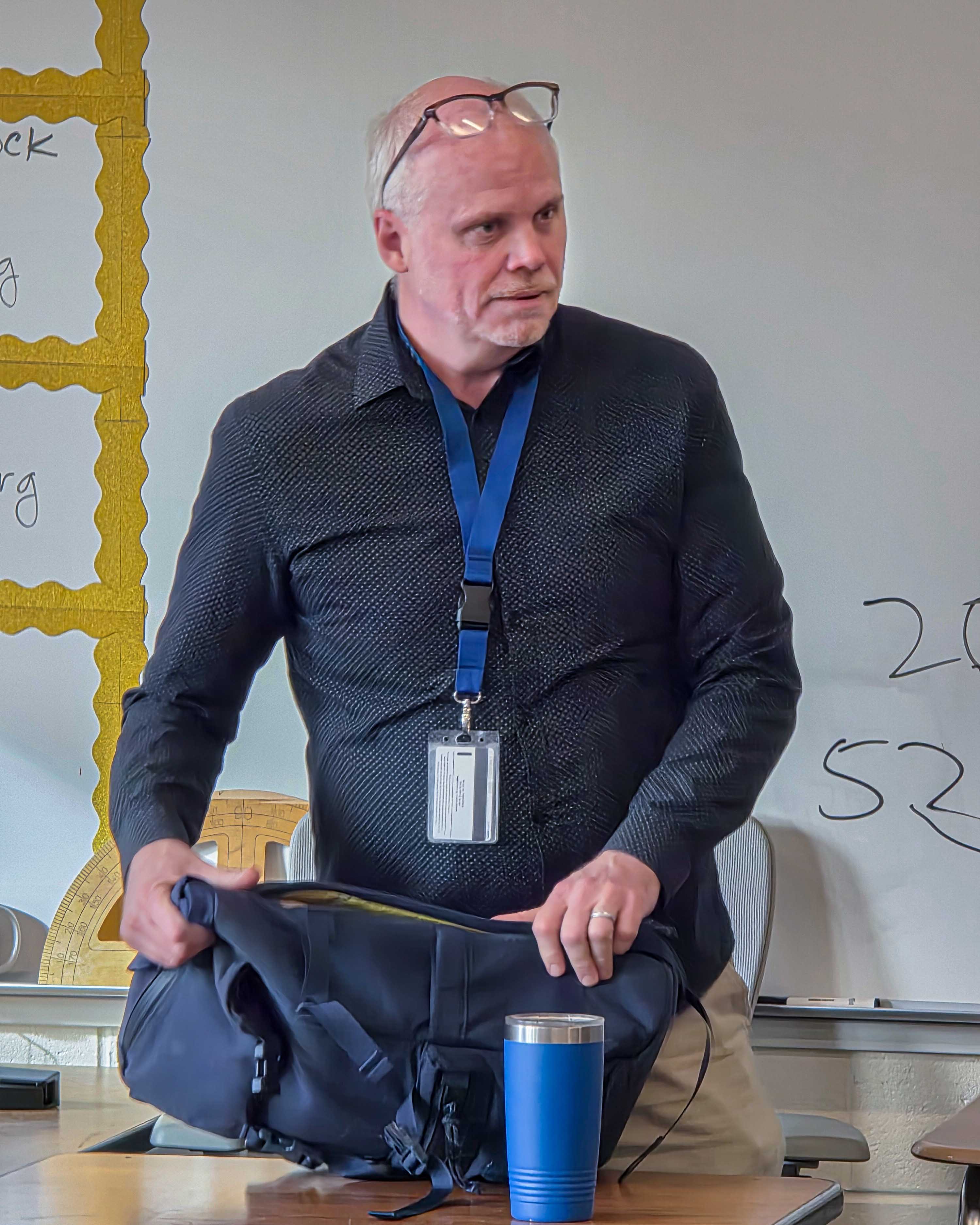 Michael Pollock, a Philadelphia Teacher Resident, oversees his class at Abraham Lincoln High School.
January 12, 2026
By Basil Tutza
Michael Pollock couldn’t believe his Abraham Lincoln High School students had never heard of Bob Marley. Students filing into his third period Personal Finance class are greeted immediately by the soothing sounds of reggae, then by Mr. Pollock himself.
That soothing environment comes to define the 50 minutes spent with Pollock, a student in Drexel’s Philadelphia Teacher Residency program. He is attentive, gently guiding his students through a pre-test. His mentor teacher, Renyu Wu, observes silently from a corner of the classroom. On this mentorship style, Wu explains, “I gave him the freedom to do what he thinks works best. My students are primarily seniors who’ve developed this dismissive attitude toward teachers they don’t think are the ‘main one.’ I thought it would be more helpful, then, if I let him take that role.”
Pollock has taken this responsibility in stride; his students seem undeterred from asking questions of the content, arguing their cases, and, most importantly, incorporating his guidance. This eagerness to engage is what drew Pollock to teaching in the first place, he describes—and, eventually, to Drexel University.
The Philadelphia Teacher Residency program, often abbreviated to PTR, marks a continued partnership with the School District of Philadelphia which paves a clear pathway to a full-time teaching career. Residents are selected through an interview process. They receive a paid position and benefits within the district and a scholarship to cover their required online coursework at Drexel, enabling them to secure a teaching certificate in only a year—not to mention, a guaranteed three-year teaching position at a Philadelphia school. To ensure they are ready to take on a class of their own, teacher residents spend a full school year learning side-by-side with a veteran mentor teacher. “In my experience,” says Pollock, “it was going to be at least a year and a half to two years before I could get my certificate—at least, without doing mostly virtual classes and going into this unsupported. I’m glad I didn’t do that.”
Pollock, a self-described “unicorn” in the program, relocated all the way from Los Angeles, California to join Drexel. Though previously a substitute teacher in California, Pollock knew the move to the Northeast was the right choice for his career. “Philly just has so much potential for teaching. And with the school district financing part of it, it feels like a no-brainer.”
Wu, a PTR alum, expanded on the program’s benefits within the context of her following years of experience: “The main complaint I’ve heard about the emergency cert is that these new teachers are entering their career without really knowing how things operate—not being given that necessary support. The residency alleviates that.” Pollock had first considered an emergency cert before landing on PTR; but the residency’s speed and his resistance to unpaid teaching work cemented his decision to continue pursuing teaching beyond both LA and his history as a substitute.
Said history solidifies Pollock’s “unicorn” title—an older resident, Pollock’s storied career prior to his position at Abraham Lincoln High School paints him as a man who found his truest calling in helping students.
“I had an undergraduate degree in engineering,” Pollock starts. “I worked five years in the practice, but I really wasn’t happy. It just wasn’t my work. So, I went to writing school in New York, after which I was basically a fiction writer.” He progressed from fiction, to transcription, to advertising. Still, Pollock wasn’t satisfied. “I’d write for anyone; I stopped enjoying it after selling a lot of things I didn’t believe in. That’s when I turned to marketing for higher ed and hospitals—until I realized, ‘I just can’t do this anymore, I have to start over.’ Then, I started teaching.”
Something in Pollock seems to light up when he transitions into talking about his time as a substitute. “Teaching is just enormously gratifying. I get to go up, do my thing, and have an audience that is interested, engaged, and hoping for the best from the lesson. When I was in advertising, there was this attitude that was just so empty. The difference is dramatic. With teaching, you can really hear the engagement, and I get to drive the curricula based on what interests me most with the given topic.”
It’s no wonder, then, that Pollock has such a palpable rapport with his students. Wu even comments, “You really learn to take charge as a resident. If you see a student is confused, it’s your job to go up and ask them if they need support. I’ve really seen Michael do that here.”
That introduction to teaching also directly shaped Pollock’s chief career aspiration: ELA for students with special needs. “My current focus started back in LA with a fifth-grade class of autistic students; they’d never written anything before. I thought special ed was interesting because it’s not the conventional learning environment.”
That introduction to teaching also directly shaped Pollock’s chief career aspiration: ELA for students with special needs. “My current focus started back in LA with a fifth-grade class of autistic students; they’d never written anything before. I thought special ed was interesting because it’s not the conventional learning environment.”
Both his academic pathway and his time at Abraham Lincoln High School have been shaped by his particular care for special education students—at Drexel, his coursework revolves around special education frameworks “within the full context of civil rights, aesthetic, and philosophy,” and at work, he applies his source text to real IEPs. Wu, also in special education, notices the progress he has made in a short amount of time, saying, “He’s learning how to interact with special ed students across subjects. He’s taken on a lot of work, but he’s really picking up the skills well.”
Pollock echoes this high responsibility in order to emphasize how supportive the program has been. “I tend not to ask for help,” he says. “I enjoy taking on a lot of responsibility, which the program absolutely encourages; I’m doing about 15 lesson plans per week. But my mentors have consistently made sure to ask about how I’m handling it. I know this would be a much tougher hill to climb without them.”
This, along with the camaraderie he’s developed with his fellow residents, has really made the program “feel like home” to Pollock. Wu went on to praise another aspect of the PTR community: “With Drexel, I could really feel the faculty’s care from even the first interview I did with them. They really emphasized the importance of my school-life balance and provided me with the necessary support. The program just feels better than others.”
“The Drexel program is just terrific,” says Pollock. “I don’t know any other way I’d be able to get my certificate in a year and get the experience I need to tick off all the teaching requirements. I couldn’t ask for more support.”