STAR Students Showcase Summer Studies

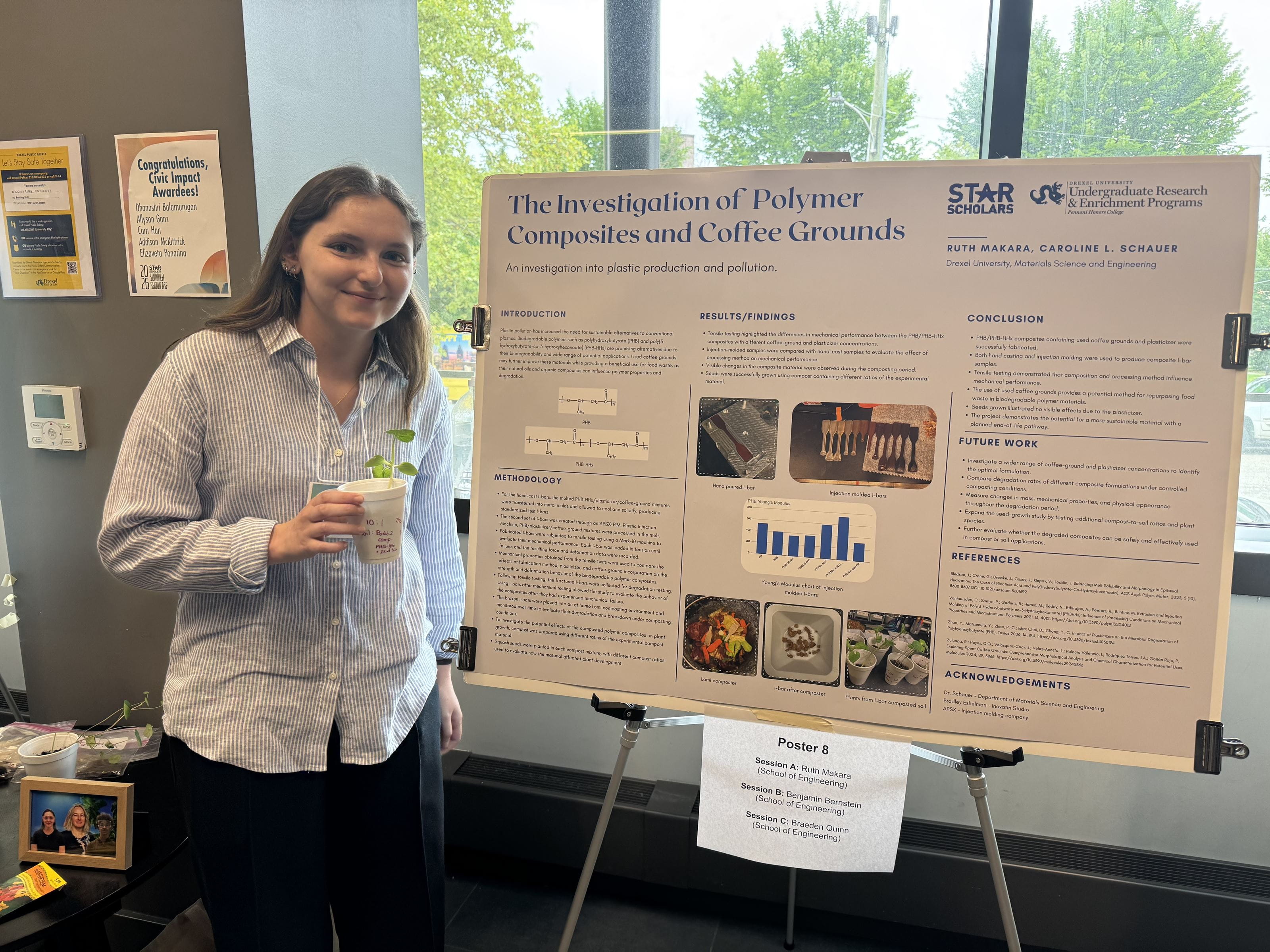
Ruth Makara at the STAR Showcase in 2026.
Since 2003, more than 2,500 rising second-year undergraduate students at Drexel University have spent their first summer in college learning the ropes of research and running high-level experiments. The STAR (Students Tackling Advanced Research) Scholars Program in the Pennoni Honors College brings students together with faculty mentors and allows them to spend 10 weeks conducting research at levels far beyond their years; at the end of the summer, they present their findings and experiences to the community.
This year, the STAR Summer Showcase on Aug. 27 celebrated 98 students from more than 35 majors across 11 of Drexel’s colleges, schools and research centers. Four of those students were DREAM Scholars (Health Disparities, Research, Experiential Learning, Aging Science and Mentorship), and 12 women were also part of the 11th cohort of Frances Velay Fellows, which gives them a chance to meet weekly throughout the summer and reflect on what it means to be a woman in STEM, in the memory of Philadelphia scientist Frances Velay.
Across three poster sessions, students shared findings on self-healing concrete, the World Cup, coffee grounds and more, speaking about their research through charts, props and other ways of visually summarizing a summer spent in labs and the field.
They were guided by mentors who set them on their own paths to study or incorporated them into projects already running and gave the students a chance to connect with experts in their future fields and learn while doing.
Here are a few highlights from the showcase:
The investigation of polymer composites and coffee grounds: Ruth Makara, materials science and engineering ’30
In the future, Makara hopes you can make coffee out of coffee. She spent her summer testing compounds of biodegradable polymers and coffee grounds, seeing if the latter could improve degradation of the former and if one of those compounds could be used to make biodegradable K-cups for coffee, among other things.
“We used two biodegradable plastics, PHB and PHB-HHx, and combined with coffee grounds,” Makara said. “We injection-molded it into these I-bars and basically broke all of them to see how strong they were.”
Durability was the first test, but Makara and mentor Caroline Schauer, PhD, Margaret C. Burns Chair in Engineering, and department head in materials science and engineering, also composted the bars and weighed them after some time to see how much they broke down.
“We were able to grow plants with that soil and then tested the plants to see if they carry any sort of toxic traits or microplastics,” Makara said. “They also all broke down in different ways, so we tracked that as well.”
In high school, Makara researched recycling PLA (polylactic acid), which is used in 3D printing, and was able to recycle about 150 pounds of it; that research led her to this topic once she got to college.
“I’ve been working in her lab throughout the school year here and there, but to be able to do it all the time [during the summer] was a lot of fun,” Makara said.
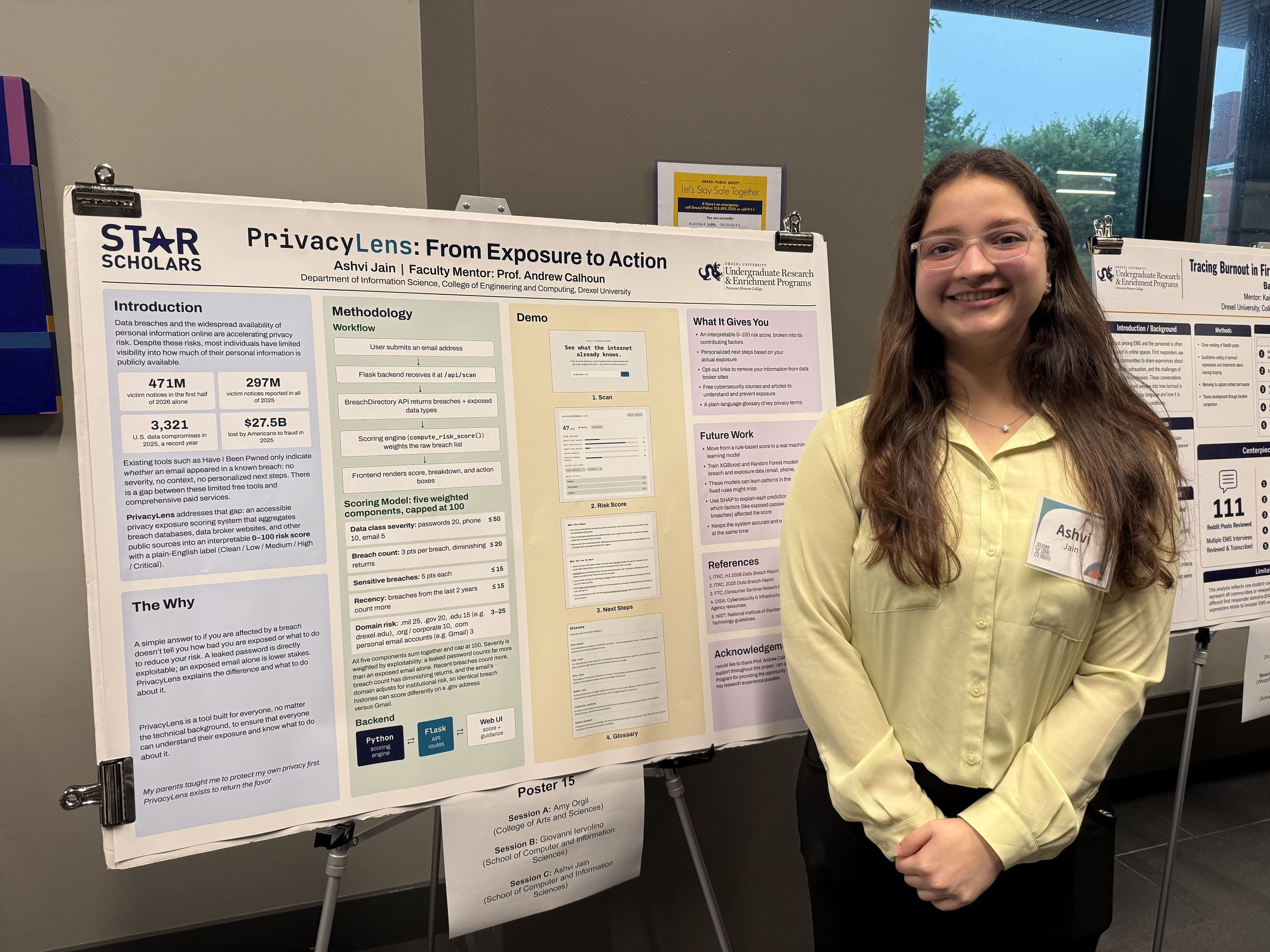
Ashvi Jain at the STAR Showcase in 2026.
PrivacyLens: An Explainable Risk-Scoring System for Data Breach Exposure: Ashvi Jain, computer science ’30
Jain’s project PrivacyLens not only checks whether an email address has appeared in a known data breach, but also tells you how serious the breach was and what to do next. While some websites just tell you if your information has been leaked, PrivacyLens gives users a score from 0-100 to rate how bad the breach was, Jain said.
The number is based on several factors, including the recency and number of breaches, whether the email belongs to a personal, business, or government domain, and whether it was just your email that was leaked or your password as well. You enter your email, then get a risk score broken down into its components along with resources such as opt-out links, cybersecurity courses, and articles to help you know what to do next. Jain even created a glossary for common terms in case users don’t know what they mean.
Jain was inspired to create PrivacyLens by her own social media experiences. She wanted to build something that would help people understand what personal information about them may be out there online. For time’s sake, this summer she just focused on email breaches, but in the future, she wants to continue working on PrivacyLens and expand its scope.
“This was a steppingstone towards a larger project,” Jain said. “I was thrilled to do this project, especially with my mentor.”
The mentor: Andrew Calhoun, professor of information science in the Howley College of Engineering and Computing’sSchool of Computer and Information Science, is part of the Air Force and was working abroad this summer, so Jain set her own schedule and communicated virtually with her mentor. She had weekly targets to hit and got to learn about Calhoun’s work in cybersecurity, both of which she felt helped her grow as a student.

Navneeth Nalajala at the STAR Showcase in 2026.
Evaluation of the Antibacterial Activity of Lycium barbarum Extracts Against Cutibacterium acnes: Navneeth Nalajala, biological sciences ’30
Can berries help prevent some early symptoms of Alzheimer’s disease? Nalajala found some early evidence that some solvents extracted from goji berries can kill cutibacterium acnes, which cause early symptoms of the disease.
“It can actually cross the blood-brain barrier and enter your brain, so we’re trying to find a good way to kill them before they enter the brain,” Nalajala said.
These bacteria are notoriously hard to kill, so researchers have turned to plants with antibacterial properties, many of which have been used in alternative medicine like ayurvedic medicine for centuries. Nalajala extracted different sets of chemicals from the berries and tested them in different solvents to see how well they killed the C. acnes. In his methanol and ethyl acetate solvents, he found some level of antibacterial activity in them, and they were able to kill the C. acnes.
C. acnes take around 14 days to grow, compared to other bacteria that take just a couple of days. Nalajala had to be patient with his testing material, which also needs to be grown in an anaerobic chamber. It’s a relatively new area of research, and one that he hopes to continue working in throughout his time at Drexel.
Nalajala is a BS/MD student, meaning that he will complete his four years of undergrad at the College of Arts and Sciences and then go on to Drexel’s College of Medicine for another four years. He’s already been involved in research and jumped at the opportunity to do STAR. Nalajala also won second place in the STAR Quick Pitch Competition for his to-the-point presentation of his research and its applications.
“I think the most interesting thing that I loved was talking with my peers, because we’re all in the same boat, all trying to find something new,” Nalajala said. “A lot of times when my project wasn’t working or I had questions, I would turn to my peers in the lab, and they were able to help because a lot of things cross over.”

Andy Deng at the STAR Showcase in 2026.
The Use of Microbially-Induced Calcium Carbonate Precipitation for Self-Healing Concrete and the Need for an Effective Manufacturing Solution: Andy Deng, mechanical engineering ’30
Researchers at Drexel have been working on creating self-healing concrete that can seal its own cracks, and this summer, Deng joined that research. What he worked on is something that can extend the life of concrete by another century.
BioFiber is a Drexel-created technology that consists of a core fiber, a hydrogel containing bacteria and a protective responsive coating. It’s incredibly strong and intended to be added to concrete “self-healing” through an autonomous microbially-induced calcium carbonate precipitation process to seal cracks. The problem is that the process of creating BioFiber is very inefficient.
“This fiber would be dipped in a sodium alginate solution and cross-linked in a calcium acetate solution to become calcium alginate, and that would harden after drying for 24 hours,” Deng said. “I wanted to work on a process that could be automated and uses less human work of dipping the fibers.”
He used a syringe to extrude the fiber and coat it consistently, which was a first step in inspiring a more automated process. In the future, he hopes to use 3D printing to make it even more efficient. This summer, he tested different concentrates for viscosity and found that generally, the higher the concentration of sodium alginate, the thicker in diameter the fibers become, though there’s a drop-off where it becomes less optimal.
Most of Deng’s summer was him working on his project independently and while the freedom surprised him and was difficult at times, he enjoyed the learning that the leeway provided. Deng will continue to work on BioFiber manufacturing through his second year and hopes to see to its completion.
“I was the one who thought about what I had to do in the lab the next morning and what I had to do to make that a reality,” Deng said. “I had to think more independently compared to traditional lecture and class.”
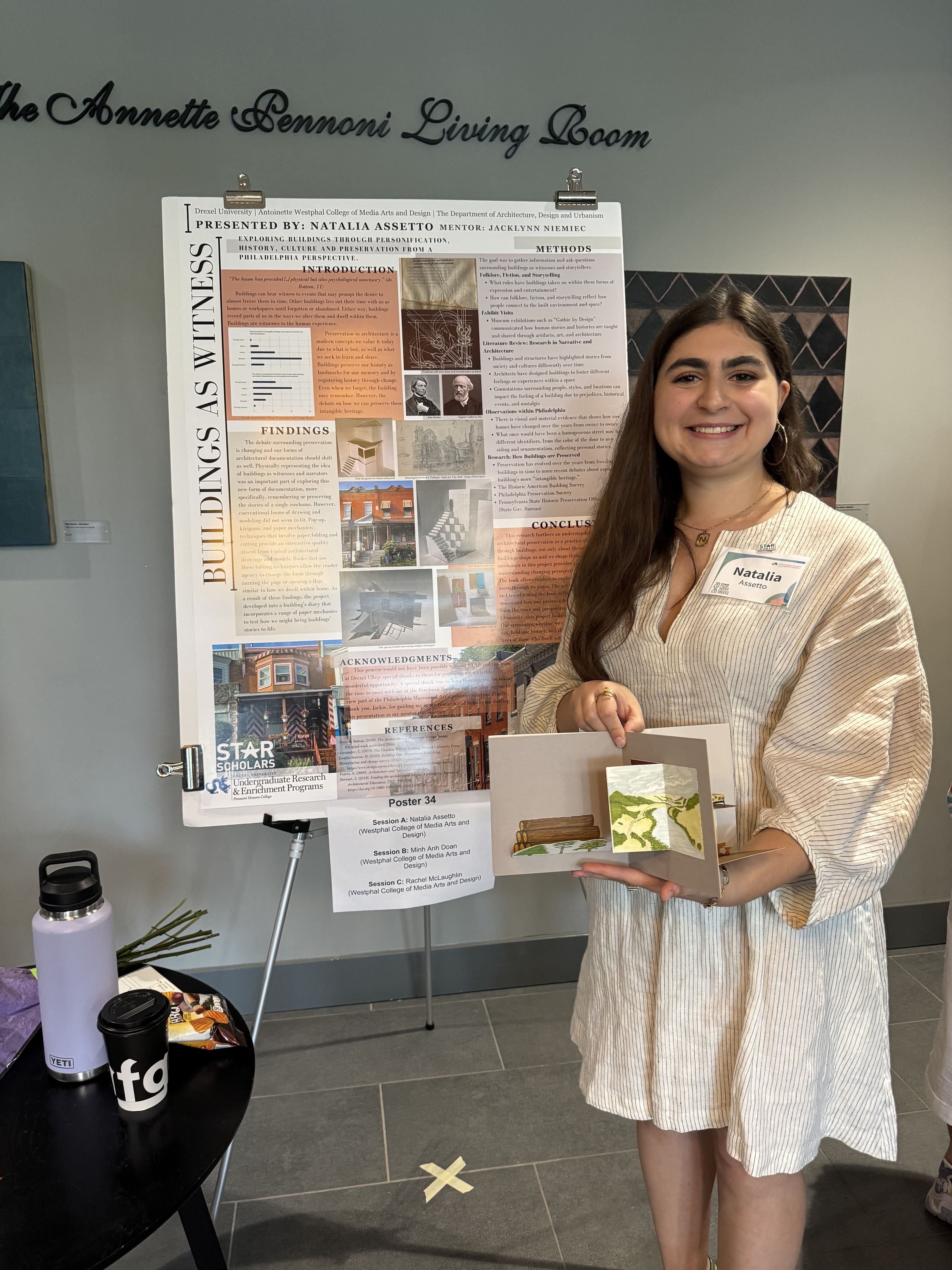
Natalia Assetto at the STAR Showcase in 2026.
The Witnesses of Our Lives: Natalia Rose Assetto, architecture ’31
Today, opinions on building preservation are changing, and efforts are more focused on intangible heritage rather than the material of the building. It’s about the stories historic buildings have to share, and it was around that idea that Antoinette Westphal College of Media Arts & Design student Assetto built her research.
“Our relationship with buildings has always existed,” Assetto said. “It’s how we create and structure our environments, it’s where we live and work and go to school. We’ve personified them in different ways across different cultures.”
Her summer was spent studying storytelling, museum exhibits and actual buildings in Philadelphia, reading about how architects intentionally design buildings with experiences and stories in mind. She also visited the Metropolitan Museum of Art in New York City to learn about architecture throughout the centuries.
Ultimately, she created a fictional Philadelphia rowhome — one that won’t necessarily be preserved but is still important — to show what she learned and tell a story.
“I wanted to highlight a lived space because a building doesn’t grow or change without us living in it and changing it,” Assetto said. “How many people have walked through this space? How many stories could these walls tell?”
The story starts with the materials: Eastern hemlock and Eastern white pines for lumber, and Delaware Valley clay for bricks. She created a diorama that showed her fictional rowhome going through changes like a freshly painted door and ivy creeping up the walls, then showed a new building that’s begun to replace the rowhomes of yesteryear.
“This whole experience has deepened my care and love for buildings and storytelling through architecture and how it relates to humans and the built environment,” Assetto said.