Student Showcases Highlight Research at Drexel University


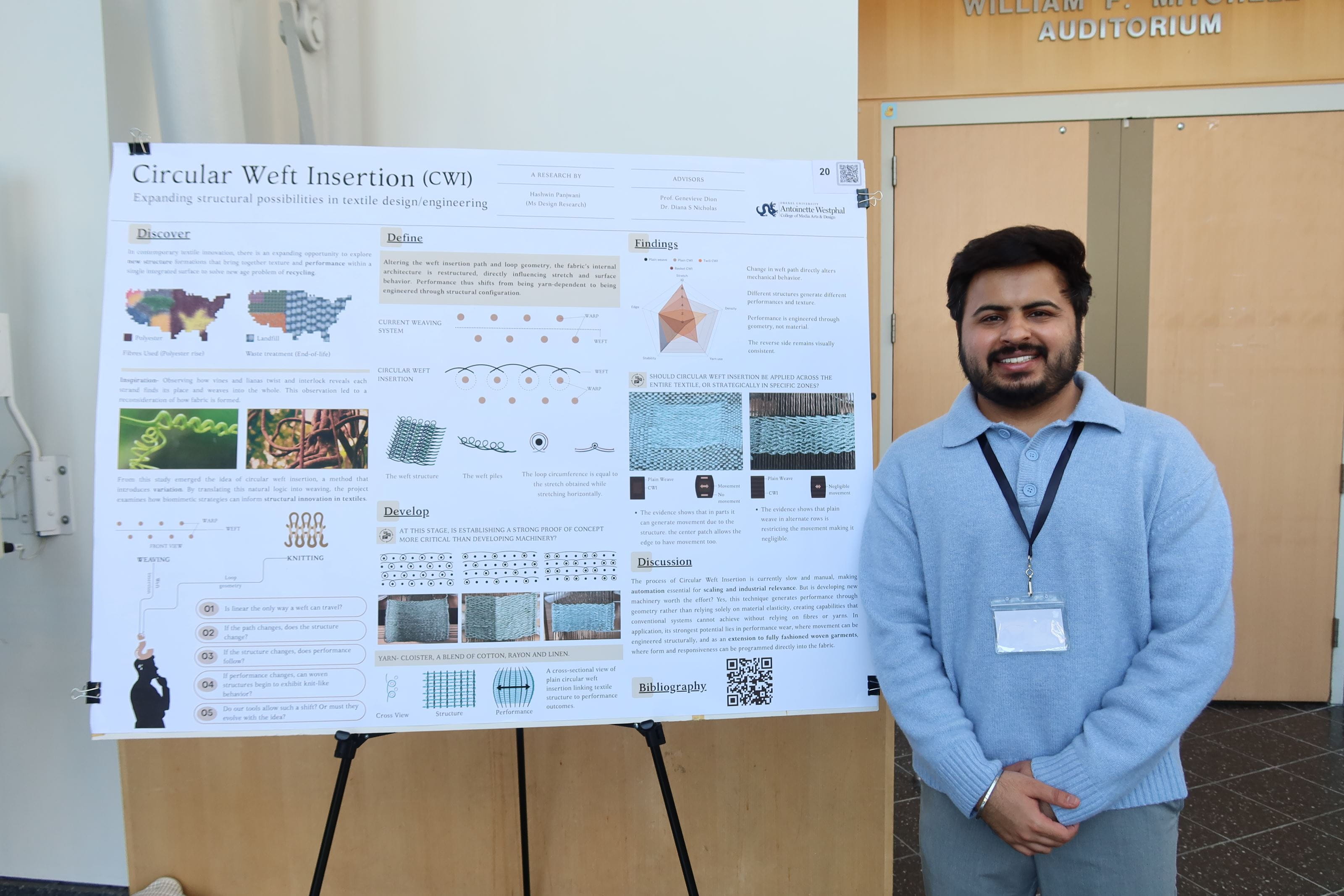
Hashwin Panjwani presents research at DEGS.
Though the inauguration of Drexel University’s 16th president, Antonio Merlo, PhD, was the reason for celebrations around the University City Campus, on April 14, several colleges and schools celebrated the work of their students at conferences and showcases.
10th Annual Drexel Emerging Graduate Scholars (DEGS) Research Showcase
More than 60 graduate students from around Drexel presented posters at the Bossone Research Enterprise Center on diverse topics from climate and sustainability, AI, cell therapy, housing inequality and more. The DEGS Research Showcase is an annual showcase hosted by the Graduate Student Association that highlights the innovative projects of Drexel’s grad students and gives them a chance to connect and network with others outside of their disciplines.
Hashwin Panjwani, a MS design research student from the Antoinette Westphal College of Media Arts & Design, presented his poster on circular weft insertion, a project he’s been working on for three years that he’s continuing to develop at Drexel. It’s a type of weaving system that allows for more stretch with yarn and would increase sustainability by making fabric easier to recycle into other forms.
“We are surrounded by polyester, and it usually goes to the landfills,” Panjwani said. “Very little of it is recycled, so I wanted to create new structures that can be recycled but still have the same performance as polyester. Performance of the fabric shifts from being dependent on the yarn to being dependent on structural configuration.”
Panjwani was a fashion design student in India before coming to Drexel, where he is creating fabrics and textiles. He had started researching sustainability when he met his future advisors: Associate Professor Diana Nicholas, PhD, and Professor Genevieve Dion, both from Westphal’s design department. He’s been experimenting with the application of circular weft insertion in patches, like on sweater elbows, and the next step is thinking about automation.

Brooke Schaeffer presents research at the Conference for DrexLab.
Conference for DrexLab
Undergraduate students from the College of Arts and Sciences can apply for the DrexLab Program and receive $1,500 for six months of research and be matched with a faculty mentor or PhD candidate. Students in the program, which has been around since 2023 and is on its fifth cohort, showcased their research through lightning talks and posters in the lobby of the Papadakis Integrated Sciences Building (PISB). Nearly 40 students presented on topics from black hole winds to weather balloons, to green stormwater infrastructure and more.
Brooke Schaeffer, psychology ’26, chose to study the emerging concept of autistic burnout and how its perceptions may vary across autistic adults who had ADHD versus those who don’t. Autistic burnout itself is a fairly new concept, and there hasn’t been any specific research on ADHD in conjunction with it, so Schaeffer pulled data from a broader study that asked autistic adults to evaluate different self-report items for measuring autistic burnout. Some challenges described in those items were found to be more impactful for those with ADHD.
“Clinically, it’s about emphasizing the importance of considering all aspects of an individual’s identity and cognitive profile to make sure you’re really understanding how they function in different settings,” Schaeffer said.
Schaeffer, who has worked with and been mentored by doctoral fellow Jared Richards for DrexLab, has always been interested in working with and supporting people with developmental disorders; they’ve already done a co-op at the A.J. Drexel Autism Institute and still work there in another lab. Schaeffer has appreciated the DrexLab experience for its flexibility.

Caroline Kokolus presents her research at the Pennoni Student Showcase.
Pennoni Student Showcase
Students had the chance to present their projects, research, capstones and more, all of which were connected to or made possible by the Pennoni Honors College’s programs and funds.
Caroline Kokolus, nursing ’26, Honors, secured a travel grant from Pennoni to present research at the National Student Nursing College Conference in Seattle. Her research, which she’s been working on since 2023 and has presented at the State Student Nurses Association, is focused on roadblocks faced by Deferred Action for Childhood Arrivals (DACA) recipients when becoming licensed nurses. Kokolus was inspired by both the country’s nursing shortage and the way the nursing workforce could better reflect the general population.
There are more than 570,000 DACA recipients in the country, and about 88,000 who either could become or already are nurses. But because DACA is a federal status and nursing licenses are handled state-by-state, hospitals can reject licenses of DACA recipients. There are only six states that allow DACA recipients to become licensed, and two states prohibit recipients from becoming licensed.
“States don’t have legislation around this because it’s just kind of a gray area, but the problem could be fixed by passing state legislation that recognizes all state licensures if you have this protected status,” Kokolus said.
Elsewhere in Bentley Hall, more than a dozen projects were displayed from a “How to Save the World” honors class taught by Gina Lovasi PhD, dean of the Dana and David Dornsife School of Public Health, and Steve Weber, PhD, senior vice provost for undergraduate affairs. “How to Save the World” is a new, online class that encourages students to find interdisciplinary solutions to modern problems.
“It worked even better than we had envisioned,” Lovasi said. “Seeing connections between topics I didn’t think were related was really fun and seeing the build from individual decisions around what you eat and wear to how we address pandemics, elections and climate change, it all built together in a great way.”
Each week, students were presented with complex threats or social issues, said Samirah Rahman, international business and management information systems ’27, Honors, from the Bennett S. LeBow College of Business, who presented an infographic she created for the class. Students discussed climate change alongside fast fashion, the rise of AI and the spread of disinformation, and other similarly related issues, and then created an infographic on either elaborating on a topic discussed in class or introducing one they came up with.
“I got the idea for this infographic from an Honors College program I was part of called the Pennoni Community Fellows,” Rahman said. “There, I saw that a lot of students in Philadelphia don’t have access to a school library, and as someone who grew up in libraries, they had a great impact on me and my development. For this project, I focused on the U.S. as a whole and how students have limited public library access.”
Her infographic showed the underutilized opportunities that libraries present and that students have higher likelihoods of struggling with literacy and collaboration without robust school libraries. Though her major isn’t related to the research and topic she picked, it’s been a personal interest of hers that she’s glad she’s gotten to explore while at Drexel.
“This course definitely encouraged me to think through social issues from various perspectives,” Rahman said. “You can get stuck in a bubble of the information around you, but opening your mind to the possibilities of why a problem is occurring and how to solve it is an important skill.”