The Kaczmarczik Lecture, hosted by the Department of Physics, is a significant event at Drexel University. For nearly 30 years, guest lecturers have included numerous Nobel Laureates and renowned scientists from around the world who present on topics that range from mapping the universe to revolutions in fundamental physics. The Kaczmarczik Lecture consistently draws outstanding scientists who are advancing the forefront of physics research.
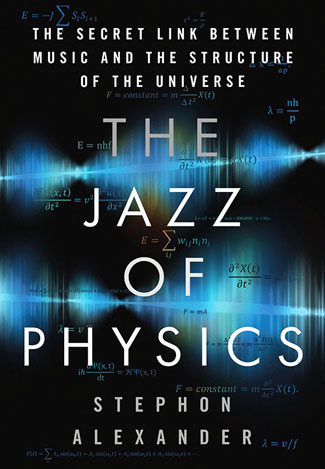
2025 Lecture Topic: The Jazz of Physics
Physicist Stephon Alexander explores the interconnection between music and the evolution of astrophysics and quantum physics. He reveals new ways music, in particular jazz music, mirrors modern physics, and the physics of the early universe. He also discusses ways that innovations in physics have been and can be inspired from “improvisational logic” exemplified in jazz performance and practice.

Stephon Alexander, PhD
Professor of Physics, Brown University
Stephon Alexander is a theoretical physicist of international repute, author, and jazz musician whose work is at the interface between cosmology, particle physics, quantum gravity, AI and music theory. His expertise lays in constructing new theories of the early universe and elementary particle physics that has predictions for the universe at present, such as dark energy and dark matter.
Alexander is a Professor of Physics at Brown University, and a past President of the National Society of Black Physicists and is currently the CEO and Founder of the non-profit focused on high school music and science students, SoundPlusScience Inc. Alexander was also the Executive Director of the Harlem Gallery of Science and is currently on the Board of MfA. He had previous appointments at Stanford University, Imperial College, Penn State, Dartmouth College and Haverford College. Alexander is a specialist in the field of string theory and cosmology, where the physics of superstrings are applied to address longstanding questions in cosmology. In 2001, he co-invented the model of cosmic inflation based on string theory.
In his critically acclaimed book, The Jazz of Physics, Alexander revisits the ancient interconnection between music, astrophysics and the laws of motion. He explores new ways music, in particular jazz music, mirrors modern physics, such as quantum mechanics, general relativity, and the physics of the early universe. He also discusses ways that innovations in physics have been and can be inspired from "improvisational logic" exemplified in Jazz performance and practice.