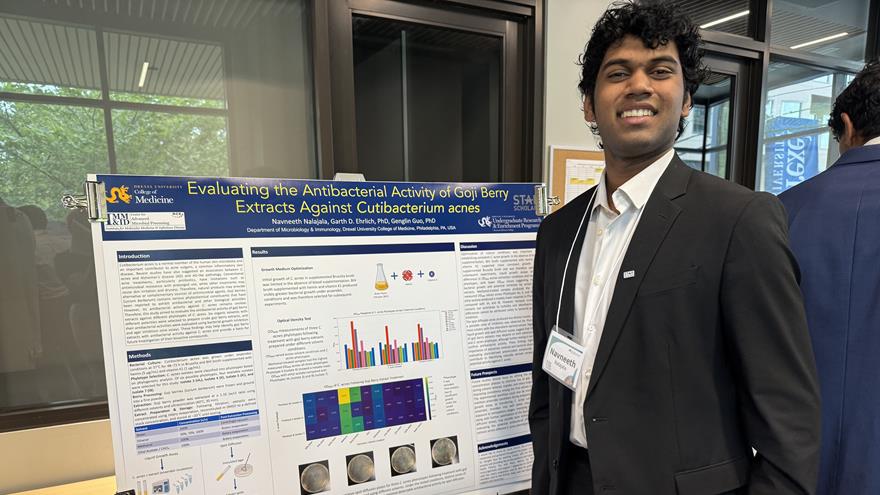
- STAR Students Showcase Summer Studies
- New Process for Making MXEnes Via Vapor-Phase Synthesis Could Expand Its Technological Applications
- Dementia Advances in Two Phases, Suggests New Drexel-Led Study
- Comcast Taps Drexel University to Offer Custom MBA Degree in Artificial Intelligence for Executive Leaders

Many studies have demonstrated that music-based interventions – such as listening to music – can help reduce pain from a variety of conditions like cancer or osteoarthritis, but researchers still do not understand how and why it helps. A new review study led by Joke Bradt, PhD, a professor in Drexel University’s College of Nursing and Health Professions, examined biological, psychological and social mechanisms that may explain the pain-reducing effects of music. The study, recently published in PAIN Reports, identified important gaps that future research on music-based interventions for pain relief should address.
“In clinical care, music-based interventions may range from music listening initiated by the patient — or recommended by a healthcare provider, like a doctor or a nurse — to music experiences facilitated by a trained music therapist,” said Bradt, who leads the Music4Pain Research Network, a National Center for Complementary and Integrative Health-funded, multi-disciplinary network that helps advance music and pain mechanistic research. “The findings from our study help explain why music can be an effective, low-risk approach for pain management and how we can maximize its potency.”
Bradt and the research team found converging evidence for three promising mechanisms that contribute to the effectiveness of music-based interventions:
- positive emotional valence associated with music
- sense of control or agency, such as choosing one's own music
- synchronizing movement with music, such as tapping or drumming along with the music
This evidence, Bradt explained, suggests that it is important for people to select their own music that they enjoy – rather than music provided by the healthcare provider – and that they should actively engage by tapping, playing or moving along with it when using music for pain management.
“One study also showed that singing along is more effective than just listening to music,” Bradt said. “And brain imaging studies found that music may influence both early pain processing in the brain and higher-level cognitive and emotional responses to pain.”
The research team reviewed more than 600 records searching for studies that investigated mediators, moderators or predictors of music's effects on pain. Ultimately, 57 emerged as the dataset for review.
By better understanding the mechanisms through which music affects pain, clinicians and researchers can develop more targeted, personalized and effective music-based interventions for people experiencing acute or chronic pain, Bradt explained.
While the review study helped explain why music-based interventions can be an effective pain management approach, it also emphasized the need for more rigorous research into the mechanisms that make interventions effective.
“Researching how music affects pain may sound simple, but it is actually very challenging because of the complexity of music and the complexity of pain,” Bradt said.
Bradt further explained that there is a need for more mechanistic research in people living with chronic pain and more studies that examine active music-making and music therapy, not just music listening.
“In my clinical work, I mostly use active music-making, such as singing, vocal improvisations and playing instruments because I have seen this to be much more effective for chronic pain than merely listening to music,” Bradt said. “However, researching the mechanisms underlying active music making is much more challenging than those underlying listening to music. For example, it is much easier to conduct brain imaging studies with music listening than active music making because with music listening you can ask people to sit still, standardize the music stimulus — so everybody listens to the same piece of music — and so forth.”
In many clinical practices, music therapists mainly use active music-making, so it is important that researchers expand on this work to help them understand how active music making helps to reduce pain.
Additionally, there is limited mechanistic research on music-based interventions for people experiencing chronic pain. So, Bradt suggests that an important next step would be to determine whether findings from studies with healthy adults can be generalized to individuals with chronic pain, especially because pain processing differs in individuals with chronic pain.
In addition to Bradt, contributing to this research were researchers from collaborating music and pain research networks ENSEMBLE and audioanalgesia, including authors from Indiana University, the University of Washington, McGill University, the University of Memphis, the University of California-Irvine, the University of California San Diego, The University of Padova and The Ohio State University Wexner Medical Center.
This research was supported by the National Center for Complementary and Integrative Health (NCCIH) and the Office of Behavioral & Social Sciences Research (OBSSR) of the National Institutes of Health (NIH); the National Endowment for the Arts (NEA); the Office of the Director (OD) of NIH. The content is solely the responsibility of the authors and does not necessarily represent the official views of NCCIH, OBSSR, OD, NIH and NEA.
Read the full study here: https://journals.lww.com/painrpts/fulltext/10.1097/pr9.0000000000001467~a-scoping-review-of-music-based-pain-treatment-mechanism.