Music Industry Students Take Center Court with Drexel Basketball Halftime Shows
In Westphal’s “Live Music II” experiential learning course, lessons in live production happen courtside - at the Daskalakis Athletic Center, in front of a game-night crowd
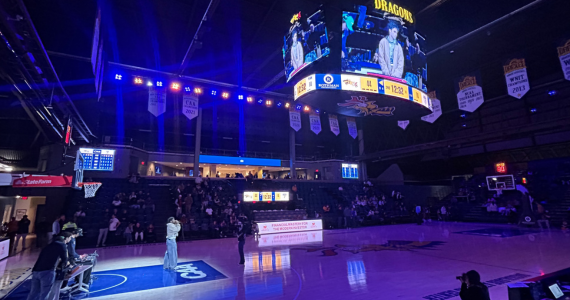 Omesi performing during the Drexel Halftime Concert Series on November 12, 2025
February 12, 2026
On game nights at the Daskalakis Athletic Center (DAC), Drexel basketball already brings the energy. This year, there’s a new layer to the experience: live music halftime performances — booked, advanced, staged, and produced by students in the Music Industry (MIP) program.
The work is happening through Live Music II, an experiential learning (ELO) course led by associate professor Joe Steinhardt, in which students organize seven halftime shows across a block of seven men’s and women’s basketball game dates. The class is structured like the industry: students operate in seven teams, with each group owning a single game from start to finish.
“It’s not plug-and-play,” Steinhardt said. “Each group is in charge of everything from booking the artist, [to] the full production."
Learning in a fast-paced, real-world environment
This year’s course launched with an unusual starting point: the concept came first, and the workflow had to be invented along the way.
Steinhardt explained that while the DAC has hosted concerts and entertainment before, music-focused halftime shows haven’t been a standard, repeatable format. That meant the class began by meeting on-site with partners who make game days run — learning the building, the timelines, and the non-negotiables of a sports production environment — then designing what a halftime show at the DAC could realistically be.
MIP students have creative range within the halftime framework, but every show requires the same professional steps: artist outreach, confirming tech needs, advancing the performance plan, coordinating load-in, staging and soundcheck logistics, then managing the live moment. The halftime show at a Drexel basketball game is an exciting stage for emerging local acts, but it’s especially gratifying when students can bring in home-grown Drexel talent. Previous acts have included student bands, Jess Urlwiler and Zach Marsden; Redletter Radio headlines the next halftime show on Friday, February 13.
“It really does mirror live music production,” Steinhardt said — and specifically the world of sports entertainment.
Experiential learning is a hallmark of Drexel’s curriculum across every major. In Live Music II, students aren’t operating in a controlled venue where live music is the only priority. They’re working inside a building designed to serve athletics first — and that’s part of the learning. Teams get the opportunity to take on unique problems and get creative with their solutions.
Steinhardt described the DAC environment as fast-paced and rule-driven: where audio inputs can run, where equipment can be staged, where people can stand, when carts have right-of-way, and how quickly a crew has to move… It’s the kind of experience students may not fully recognize as career preparation until later — when they’re working festivals, arenas, or touring shows with similarly complex constraints.
“It’s a basketball game in the real world,” Steinhardt told students — and the production expectations are real-world, too.
A collaboration that brings Drexel communities together
The halftime series also reflects something bigger than a single course: collaboration across Drexel.
Steinhardt traced the project back to early conversations with Drexel Athletics leadership, including Maisha Kelly, Director of Athletics, where the goal was to activate the DAC as a hub for campus life — not only for sports fans, but for the broader Drexel community. From there, Athletics staff helped identify the opportunity and the game dates, and the Music Industry program shaped it into an ELO course that could meet learning objectives while delivering something meaningful on game night.
As the series developed, Steinhardt emphasized that this kind of ELO can’t happen single-handedly. He specifically credited Brandon Monahan for being instrumental on day-to-day audio and production support, and pointed to Athletics partners Sean Joyce and Makenzee Shaffer as key collaborators in making the logistics work.
“It’s a deceptively simple idea,” Steinhardt said.
When you zoom out, it’s a web of moving parts across Drexel that creates a uniquely deep learning experience.
Early results — and momentum for what’s next
By Steinhardt’s measure, the project is off to a strong start, and feedback from Drexel Athletics and Dragons fans has been positive.
“If we actually get someone on the stage and they get off on time, we succeed,” Steinhardt laughs.
With two shows remaining this season, Steinhardt is already thinking ahead: how to refine the process, how to scale the opportunity, and how to deepen the learning by bringing in more collaborators.
For now, it’s about execution and putting on great a show on game night — for fans, for campus leaders, and for prospective students who want proof that “experiential learning” is more than a buzzword.
Because in Live Music II, students aren’t simulating the industry. They’re doing the work.
---
Come cheer on Drexel basketball and enjoy the last two shows of the Halftime Concert Series:
- Feb 13, Drexel Women’s Basketball vs Elon | Halftime Show Artist: Redletter Radio
- Feb 26, Drexel Men’s Basketball vs Campbell | Halftime Show Artist: ARIEH
To purchase tickets for Drexel men's and women's basketball games, click here.