From Hokusai to Hendrix: Drexel Exhibition Examines Rhythm Across Art Forms



When you think of rhythm in the arts, what comes to mind? For most, it’s likely something heard in a song or felt on a dance floor or watched on a stage. But what about rhythm in “The Great Wave,” that famous woodblock print by the 19th century Japanese artist Hokusai? A photograph of Jimi Hendrix playing guitar? Or, perhaps, a small, green Tiffany swirly glass bowl?
At Drexel University, 15 graduate and undergraduate students spent weeks deliberating over that question and are now asking it of viewers in a new, free pop-up exhibition: Taking a Line for a Dance: What is Rhythmic Movement in the Arts?
The show explores how rhythm impacts art and culture, and shapes how people see, think and create. It was co-curated and designed by graduate students (and a few undergraduates) in an “Exhibitions and Programming” graduate-level course taught by Distinguished Teaching Professor Derek Gillman from the Antoinette Westphal College of Media Arts & Design.
Taking a Line for a Dance is available for viewing in the Rincliffe Gallery on the third floor of Drexel’s Main Building, located at 3141 Chestnut St. The show is free and open to the public Monday through Friday, 10 a.m. to 5 p.m., through Aug. 25.
The exhibition’s prints, paintings, photographs, books, timepieces, ceramics, objects and videos reflect what the students explored over the term. Most were hand-picked by the students, who chose pieces from two of Drexel’s collections in Libraries, Collections & Archives: The Drexel Founding Collection, the University’s flagship collection of art, and the Robert and Penny Fox Historic Costume Collection (FHCC), which contains garments, textiles and related materials. Other reproductions, like “The Great Wave off Kanagawa,” were also selected and can be seen on display.
“Rhythm in the arts is such a big idea, but one thing about making good exhibitions is that you take an idea, and you refine it, and you keep on distilling it down until you get something coherent and usable. How do you move that big idea into something you can display?” said Gillman. “When you’re planning any exhibition, before you even get to the point where you decide to have, say, 50 objects in it, you’ve got to have thought about what sort of objects should be there. That, for me, was what the class was going to be about this quarter.”
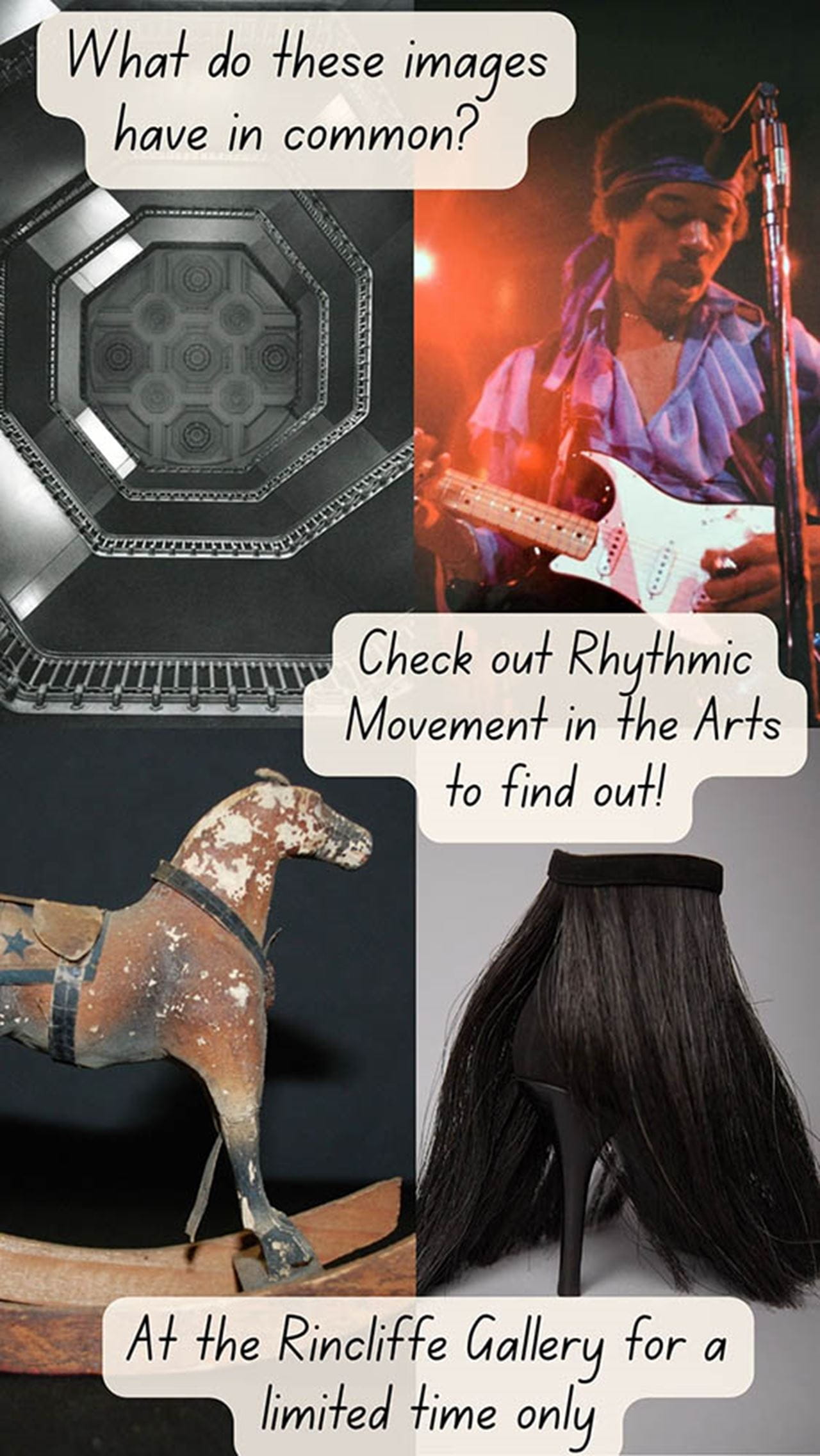
This digital flyer promoting the show features art seen in the exhibition. It was created by Jillian Cartwright, an arts administration graduate student.
He also expressed gratitude to the collections’ curators, Lynn Clouser Waddell, director of The Founding Collection and executive director of University Collections & Exhibitions, and Clare Sauro, Cara Keegan Fry Curator and director of the FHCC and associate professor of design and art history in the Westphal College of Media Arts & Design, “for their enthusiastic support, both with the loans and installation,” he said.
Dragons learned how to adhere to borrowing protocols, follow permissions for copyright, abide by display procedures and initiate transfers within teaching collections. And as part of the hands-on experiential education embedded in the course, students also developed the theme of the exhibition, designed displays, wrote object labels and, for some, promoted the exhibition through additional marketing efforts. The show’s labels and text panels were designed by Athava Gogate, a graduate student in design research in the Westphal College of Media Arts & Design and intern at The Drexel Founding Collection.
“We experience rhythm so innately that everyone has a unique way of experiencing or expressing rhythm, so communicating such a vast idea benefited from having such a large number of people to bring their own experience and create the best exhibition we can,” said Ryan Sharples, architecture ’28.
All the collaborations — not only in class but also working with Drexel’s collections — added to the real-life experience of putting together an exhibition and created a unique form of experiential learning.
“This class was informative in a way where it allowed emerging curatorial students to develop the skills needed to create profound exhibits in the future,” said Caroline Goulet, an arts administration graduate student in Westphal who also helped promote the exhibition on the arts administration program’s Instagram account. “It was integral to understanding what it is like to create an exhibit in a short amount of time that integrates people from various backgrounds and skill levels to create an impactful exhibit.”
To view the pop-up show is its own form of rhythm influencing art. Big framed photographs hang on the wall in between smaller, unframed ones — ba-dum, ba-dum, ba-dum. A television screen showing videos of dancers plays continuously near a display case full of inert dance-related art and items, such as black dance shoes and a book open to a page showing Henri Matisse’s “Le bonheur de vivre” painting.
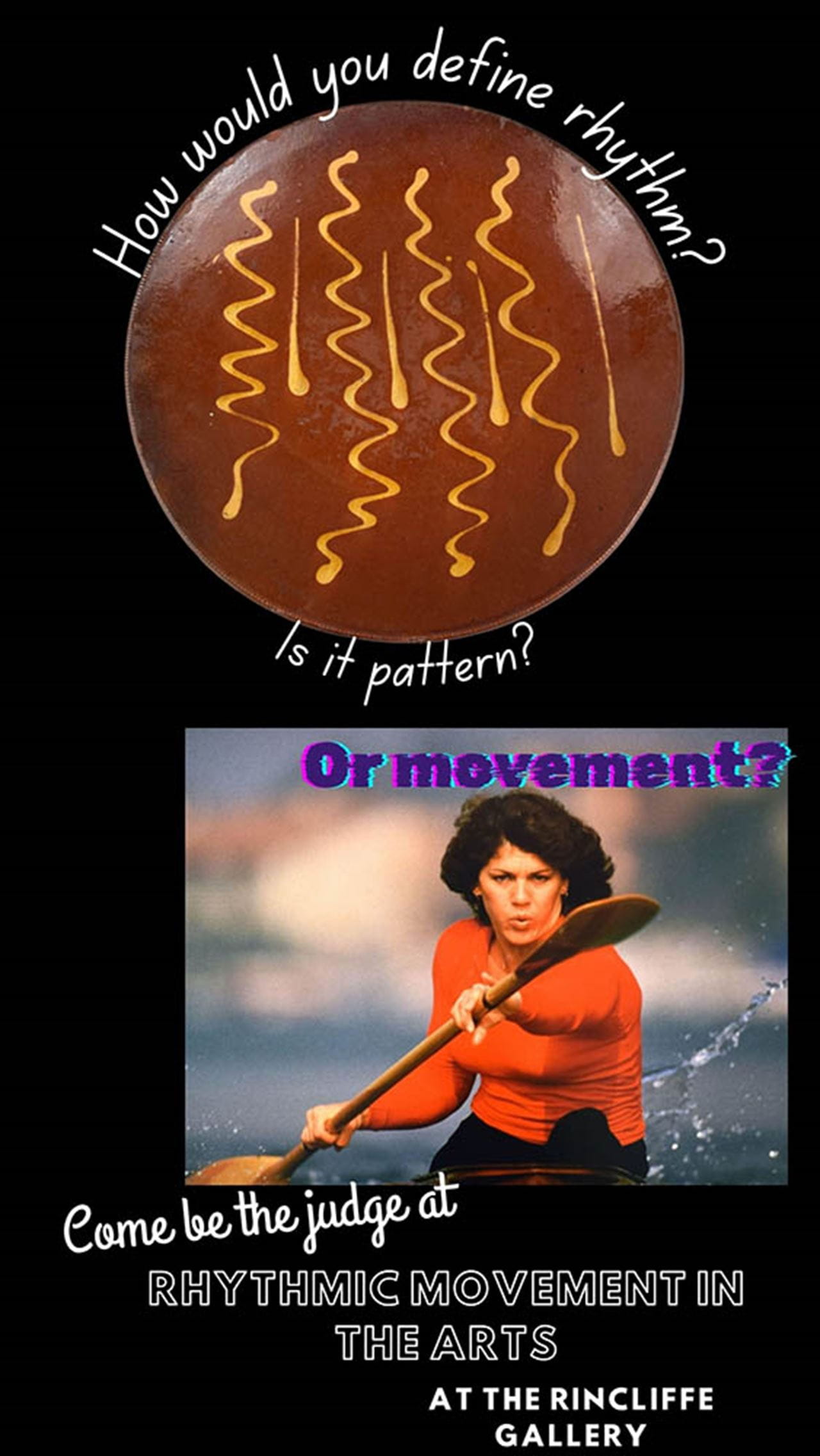
Jillian Cartwright also designed this promotional flyer for the exhibition, which showcases art seen in the show.
Jillian Cartwright, an arts administration graduate student who is graduating this term, helped create that compilation of dance videos seen in the show; it includes footage she shot of her friend for a short documentary workshop she took as an undergraduate journalism major. She also created the flyer used in the show’s marketing.
“I said in class last week that I feel like marketing is getting someone into the door, and then the job of the curators and the designers and everyone involved is to keep you there. I'm also involved in the exhibit, so my job is to get you there and to keep you there,” she said.
The starting premise for the show is one that Gillman has been thinking about, and incorporating into other exhibitions and his museum work, for a long time. But the movement to connect art and rhythm started more than a century ago.
“Rhythm was one of the major words used in discussions of modern art 100 to 120 years ago. Back in Paris or New York or London around 1910, everybody in the avant-garde world was talking about rhythm and the relationship between all the arts, including music and painting, poetry and so forth,” he said.
Gillman has overseen collections influenced by that thinking, including the Barnes Foundation, where he was executive director and president from 2006–2013. At Drexel, this is now his second exhibition examining the topic, and that first show also involved students in a class. Electrified: 50 Years of Electric Factory, which ran in 2023, explored the legacy of the Philadelphia-based Electric Factory and Electric Factory Concerts, and included a section related to rhythm’s role in music.
Both Electrified and Taking a Line for a Dance include collaboration and expertise across disciplines and departments at Drexel. The first show featured panels and the second photographs from Eric Zillmer, PsyD, Carl R. Pacifico Professor of Neuropsychology in the College of Arts and Sciences, and Drexel’s Athletic Director Emeritus. Zillmer came to an “Exhibitions and Programming class to speak about the psychology and neuroscience of rhythm not just in the arts, but also in sports; sports is also examined in Taking a Line for a Dance, as one student-written label explains: “skillful performance is a feature both of sport and the performing arts.”
Another in-person guest speaker was Gene Coleman, a noted composer Gillman first met when speaking at the American Academy in Berlin in 2013, where Coleman was a fellow. Coleman shared his experiences as a composer and discussed the connection between music and the brain, providing another perspective students learned about in addition to art history, collections-based learning, psychology and neuroscience.
“There are so many dimensions about making exhibitions that actually getting engaged in the making of one gives you lots of different experiences,” said Gillman.
For Cartwright, the graduating arts administration student, this was one of the best classes to take as one of her last classes at Drexel. It was her first in-person class, besides the required practicums (she is an online student and lives in the Philadelphia suburbs), and getting to meet and work with everyone was an example of the kind of collaborative work she wants to do in museum development after graduation.
“This is a great culminating class. It takes all of the elements of all the disparate classes that I took and puts them together: marketing, leadership, curation, development,” she said. “I learned basically how to weave everything together.”
This sentiment was echoed by another student, quoted anonymously below, on the class discussion board for a post about how exhibitions might form a part of Drexel’s undergraduate curriculum:
“While grouping objects by theme or in chronological order is a great starting point, a class like this would help students think more critically about how everything is connected.”