Sky Harper has walked many paths; a journey which has taken him from a first-gen student who became Drexel’s first “Triple Crown” scholar, to Mayo Clinic biomedical researcher, to a molecular pharmacology doctoral student and devoted advocate working to amplify indigenous youth’s access to education. In this Q&A, Harper describes how his experiences at Drexel helped him transition into a PhD program, exercise his voice for community reclamation, and shift the healthcare paradigm across tribal communities.
1. How did the College of Arts and Sciences prepare you to successfully transition into the PhD program at Medical University of South Carolina?
My time at Drexel’s College of Arts and Sciences—particularly, my chemistry major—was very useful in transitioning to the Medical University of South Carolina (MUSC) PhD program because of how comprehensive it was. The more basic classes like UNIV 101 really eased my mind when it came to being an undergraduate, then UNIV 201 at the end of my time guided me through the next steps post-grad. It covered the application process, writing personal statements, and really narrowed down my options for after my bachelor’s.
Then, overall: the College of Arts and Sciences provided so much opportunity. Being the biggest college on campus, I believe they truly push that idea of being “interdisciplinary.” I was working on many of my courses, with not only other college majors, but majors from all over Drexel. That collaboration was very valuable. Beyond that, I was also an Arts and Sciences student ambassador, so I was able to meet with prospective students, talk through opportunities, and reflect a little bit more on my own Drexel journey—and, eventually, using that reflection to guide my next steps academically and professionally. I got a lot of good out of that.
The College of Arts and Sciences was also incredibly supportive with extracurricular activities. I still ask for letters of recommendation from professors. Throughout my undergrad, I frequently had mock interviews with a few different professors. One of them was with Dean David Brown; that interview led directly to my current fellowship.
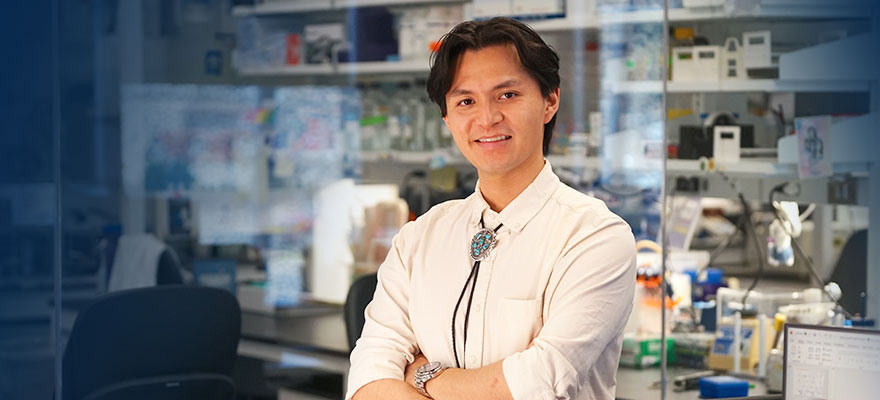
Drexel alum Sky Harper, BS chemistry '24, is a doctoral student at the Medical University of South Carolina where his program of research combines biomedical sciences, molecular pharmacology, and experimental therapeutics.
2. Are there mentors at Drexel who challenged your perspective on what being a scientist means?
A physics professor who really challenged my thinking was Michelle Dolinski. Professor Dolinski taught a class called Improbable Research about the less serious side of science. It was an interesting deviation because a lot of my classes were very analytical and quantitative. But Dr. Dolinski brought in this fun aspect that I hadn’t been exposed to before. We even had a food scientist present!
Another great mentor was Jun Xi, Associate Teaching Professor in the Chemistry Department. Dr. Xi prepared me a lot for grad school; he emphasized thinking through my choices post-grad, especially beyond chemistry.
3. You are now deep into molecular pharmacology research. How has your doctoral program met—or shifted—the goals you set for yourself at Drexel?
During my time at Drexel, I was involved in more basic science research, and here at this school, it’s more translational. The question, “How are we going to get these discoveries into the clinic?” is the main focus. That's been my paradigm shift with all my research: we're moving a little bit away from discovery, and now we're looking more at, “How is this relevant?” “How could this benefit?” “How can we leverage this to make new drugs, new therapies?”
But at the same time, at the grad versus undergrad level, the way you're involved with research is very different. As an undergraduate, you’re learning techniques; you're a little bit less responsible, you're doing more routine work. Here, they emphasize building experiments from the ground-up—fully considering what needs controlling, what procedures will create the best results. It’s all about putting our conclusions in the context of this bigger system.
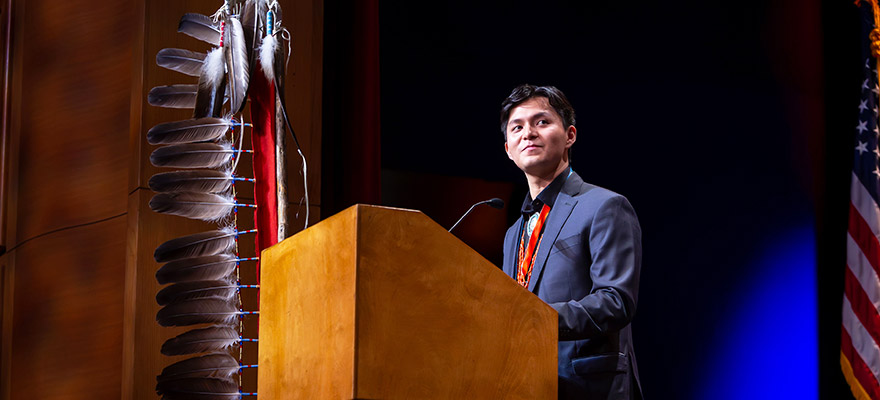
Sky Harper served as the keynote speaker at the 2025 American Indian Science and Engineering Society (AISES) National Conference. Sky also advocates for AISES as their National Student Representative.
4. As the national student representative for AISES, how do you bridge the gap between STEM research and the needs of your community?
Throughout my two-year term with AISES (American Indian Science and Engineering Society), I got to focus on passion projects. I was awarded a $30,000 grant to work on any project that I could think of. I wanted to use that funding to meet some needs in my community, driven from my own experiences: and I landed on how most Native students don’t even know what research is. As a high school and early undergraduate student, I kept hitting that steep learning curve that comes with lab research. For a lot of Native students, especially first-gen Native students, we don't have anybody we can ask. We don't have that information. My goal with this grant was to create peer-mentored introductions to research.
The other barrier that I needed to overcome was lack of access to technology—a lot of Native students live in rural areas with low access to Wi-Fi and computers, especially. What I wanted to do with this grant is buy all the participants laptops to log in through Zoom; so, they can join in this program from wherever they're at. Throughout the program, we brought in about 30 different students from across the U.S.—we gave everybody a laptop, then set them up with virtual peer mentors. We had people speaking on what research is, how to form a research question, what a hypothesis is, what to consider when designing an experiment. We even covered what to do after the research. How do you put it on a poster? How do you write a paper? I wanted to make sure that even as a high schooler, you're aware of these opportunities, and moving forward, when you get to college, you're able to say, “Okay, I know what to do.”
I was also part of a project to build digital literacy in Native communities. We taught the basics: how to use various programs, how a laptop works, and those types of things. I was also part of a few different peer mentor programs, wherein I spoke on my experiences as a first-gen Native student, my introduction to research, and life away from our community. With AISES, I've been thoroughly involved in introducing people to both research and collegiate opportunities.
5. Your fellowship with the Emergence Circle focuses on "balance and intentionality" in AI. I’m curious– how can the next generation of tribal scientists ensure AI systems protect community sovereignty?
There are a lot of different considerations that come with that. Last year, for instance, I did a post-bac at the Mayo Clinic, and when I was there, I got to see how AI is being used in the clinic’s medical research. But, around that time, I also attended the Navajo Genetics Research Summit, where I learned about some of the genetic research being done in my own community. The researchers there explained that the reason for the summit was a complete lack of genetics research in the community. In 2002, they said, there was a moratorium put into place by the Navajo Nation government that blocked all genetics research in the community. The researchers, though they understood the reason for the blockage –a lack of consent and exploitation of the Native community they, too, were part of– seeing the limitations it imposed on genetic research since 2002. There were so many gaps that could be addressed.
Now, thanks to Emergence Circle, those same researchers and communities are talking about AI. I got to talk with a few different tribal leaders, not just in my home community, but a few other tribal communities in the U.S. and I asked them for their thoughts on AI. Some saw the benefits. Others were hesitant—they don’t know how it works, or how it might improve their communities. I compared it to their relationship with genetics research: we stepped away out of hesitation, and that set us so far behind the genetic consensus. Now, we need to shift that paradigm and change that stigma of, “It's scary and unfamiliar, let's step away,” to, “Let's learn more about it so we can apply it.”
We’re particularly trying to change that mindset with a question: “How can we use AI in our tribal communities?” But then we must consider the accessibility of the data. When you're trying to use AI for tasks like language revitalization, or as a cultural library for the next generation, how do you ensure that this data stays within the community? How can we enact laws which define those boundaries? In a lot of our communities, we just don't have the infrastructure. It’s the chicken and the egg dilemma: how can we focus on AI when we don't have the resources to do so? How do we bridge that barrier between AI and community members; how do we train them after?
We’re also grappling with the expectation for younger community members to go out, get educated, and return to uplift the community. How can they be expected to uplift our community when there's no infrastructure, job opportunities, or economic stability? That’s a big part of the conversation, too: we don't have the infrastructure for AI, and at the same time, we don't have the infrastructure to bring back the professionals who know AI, either. And when we get that infrastructure, how do we ensure that AI is being used properly as a tool, not a replacement? We’re even grappling with the cultural history of oral tradition; we’re getting resistance from elders who have only known tradition in that one form, and now we're talking about putting it onto these servers, putting it into these algorithms. How do we ensure that, culturally, things stay consistent while growing with technology? It’s all a big series of conversations that are shaping our policy moving forward.
6. You rose from small-town science fairs to global impact. What is your best advice for a Drexel student who wants to turn their personal identity into their greatest research strength?
Be proud of who you are and remember where you came from. My community is my motivation, and my goal is to repay that by uplifting them. When I return to my community, I feel like I'm always welcome back—like I’m helping everyone there. It’s been my passion for years now.
Don’t be afraid to use your voice. I recently heard Peggy Flanagan, who’s also a Native American, speak at a conference. She said something that really stuck with me. When you sit at a conference or a meeting, surrounded by people, it’s easy to shrink into yourself. But what you need to remember, she said, is to have all your stuff laid out on the table. Don't be afraid to take up that space. For Native people, there’s a big emphasis on “land back,” the idea of reclaiming space—and you can do that even beyond that “table.” It’s in your everyday life, in your research. That was the biggest thing that stuck with me in the past year: you should be proud of who you are, and, in any space, you go into, don't be afraid to take it up a little bit.
The last thing that I want to drive home is don't be afraid to get rejected. Don't be afraid to put yourself out there, because the worst that you can get told is no. And if you do get told no, you move to the next thing. People can be so afraid to speak for themselves or pursue opportunities. But there are so many opportunities in the world, and even if one of them might not be the right fit, there’s always the next.