
Game night at Westphal House
This story is part of a series on Drexel’s Academic Transformation — a sweeping initiative launching in Fall 2027 that is reimagining classes, calendars, and curricula to prepare graduates for the contemporary world of work.
For years, when film and television students at the Antoinette Westphal College of Media Arts & Design searched for a score for their projects, they routinely turned to music catalogs outside the college. Down the hall, students in the Music Industry program were writing, recording and producing their own original tracks, owning every recording they made through Drexel’s student-run music group, MAD Dragon Records.
Academic Transformation is helping bring those two creative communities closer.
Through a pilot merger of Westphal's Arts & Entertainment Enterprise and Cinema & Television departments, MAD Dragon's student-produced recordings will become a music library that film and television students can draw on to score their work.
"This is an example of expanding interdisciplinary experiences through the work our students and faculty are already doing. It's incredibly exciting to see these collaborations open new possibilities for innovation and impact," said Deb Ruben, interim dean of Westphal College.
The collaboration emerged from broader conversations taking place across Westphal: How can a creative college better prepare students for industries where success increasingly depends on working across disciplines? And, as a college that operates at the intersection of creative industries, how does Westphal want to teach students now and in the future?
The Idea: Learning Beyond the Small Pond
For Westphal, the answer became a concept called the Big Pond, an idea that emerged from its strategic plan's subgroup on curriculum and interdisciplinary education, led by James McKinney, assistant professor of music and music industry, and Mike Glaser, associate professor of product design.
The Big Pond model recognizes that students typically learn within smaller "ponds," or within their programs. By intentionally bringing students together across these boundaries, a larger, shared learning environment is created where diverse perspectives, experiences and faculty expertise interact. The "pond" is an interconnected ecosystem at the college and ideally across the University, where knowledge flows across disciplines, and collaboration becomes the foundation for innovation and deeper learning.
When Academic Transformation began, Westphal already had a clear direction: its strategic plan had committed the College to a more integrated, multidisciplinary curriculum. As subgroup leaders, McKinney and Glaser presented the Big Pond concept as a way Westphal could move more seamlessly between disciplines, encouraging an environment where a fashion student, an animator, an entertainment and arts management major and a game designer might collaborate on a single project.
Academic Transformation pushed the college to accelerate its vision of a creative ecosystem where students develop expertise in one discipline while routinely learning, creating and collaborating across many others. It is work faculty were already doing before Academic Transformation, but the three-year, university-wide initiative gave that vision structure, urgency and a deadline, while the shift to semesters will give it something equally important: time.
"You're immersed in your major, pursuing your passions, and moving at a rapid pace during quarters, and we believe semesters will put everybody into a bigger pond,” said Michelle McHugh, interim associate dean of academic affairs at Westphal College. "It gives faculty room to develop a topic more fully and gives students room to breathe, reflect, and work across disciplines in ways that mirror the real world."
A class in Fashion, Industry & Merchandising (FIM), for example, now uses immersive visualization tools from the Digital Media Department’s motion capture and virtual reality studio to model store layout and merchandising displays, exemplifying the kind of cross disciplinary collaboration the Big Pond envisioned.
The Structure: Building Pathways Across Disciplines
If the Big Pond is the vision, regular Friday meetings over the last year became the mechanism for bringing it to life. Those conversations gave faculty a space to identify opportunities that would benefit students across programs. The pilot merger between Arts & Entertainment Enterprise and Cinema & Television departments emerged from those discussions, as did a new college-wide academic framework designed to make interdisciplinary learning a defining feature of the Westphal experience. The framework consists of three elements:
Required Core Courses — Every incoming Westphal student will complete courses spanning three shared areas:
- Visual and information literacy
- Global and cultural perspectives
- Making and storytelling
Rather than moving through discipline-specific introductory courses, students will choose from a menu of offerings that bring together students from across the college. That means animators learning alongside dancers, filmmakers alongside fashion designers and musicians alongside game designers.
Cross-University Minors New pathways are being designed to encourage students to build expertise beyond their primary major and explore complementary fields that may reside inside or outside of Westphal.
Knowledge Centers The most ambitious component may be Westphal's six faculty-led Knowledge Centers. Organized around themes shaping the future creative workforce, from artificial intelligence and emerging technologies to community practice and sustainability, the centers are designed to connect programs through shared ideas rather than departmental boundaries.
"One of the most powerful ways Drexel is transforming higher education is to have us think beyond the students of a single major and instead challenge us to ask how higher learning can bring disciplines together,” said Ruben. "When we create opportunities for students to engage across colleges and fields of study, we prepare them not only to excel in their professions but to lead in an increasingly interconnected world."
The Reach: Extending the Big Pond Across Drexel
The college's service programs, which include minors in areas such as dance, theater, screenwriting, music, photography and studio art, already draw students from across Drexel, and a collaboration with Pennoni Honors College brings honors students into fashion, animation and other courses.
The University's new combined major structure, which allows students to pair the core requirements of two disciplines, has revealed possibilities even broader than McHugh initially imagined.
"As we began exploring potential combinations, colleagues and faculty continually expanded my thinking," McHugh recalled. "Whenever I questioned whether two disciplines naturally fit together, someone would point to pairings like bioengineering and animation, interior design and construction management, user experience and interaction design, or graphic design and culinary arts. Those conversations reinforced an important lesson: innovation often happens at the intersection of fields we don't immediately think belong together."
This pattern is also emerging at the program level.
Art History replaced its longstanding ARTH 101-103 sequence with a new set of foundation courses open to students from every major with no prerequisites. Rather than the typical chronological survey, "Learning to Look" prioritizes visual analysis and the core principles of design, and "The Politics of Style" explores styles as containers for ideology. A third course, "Contemporary Art," invites discussion of today's core discourses and debates through works from global contemporary artists. Where the old model funnels students through an ordered three-course sequence, the new model invites exploration of art through different lenses, and the minor and the major become much more flexible.
The clearest evidence that the Big Pond extends beyond Westphal is its interdisciplinary minor: Sustainability in the Built Environment. The 18-credit, transdisciplinary program draws from programs across the campus in arts and sciences, architecture and engineering, public health, and business and innovation. Students move through a curriculum that starts with climate foundations, advances into regenerative design and culminates in an evidence-based climate lab.
"Where theory meets reality," reads the program's own framing of that capstone. "Solve real and conceptual design challenges for emerging industries before you graduate."

The Culture: Belonging Starts in Year One
While Westphal has long fostered strong community within individual majors, Academic Transformation created an opportunity to strengthen that sense of belonging across the entire college. That effort starts before students arrive on campus.
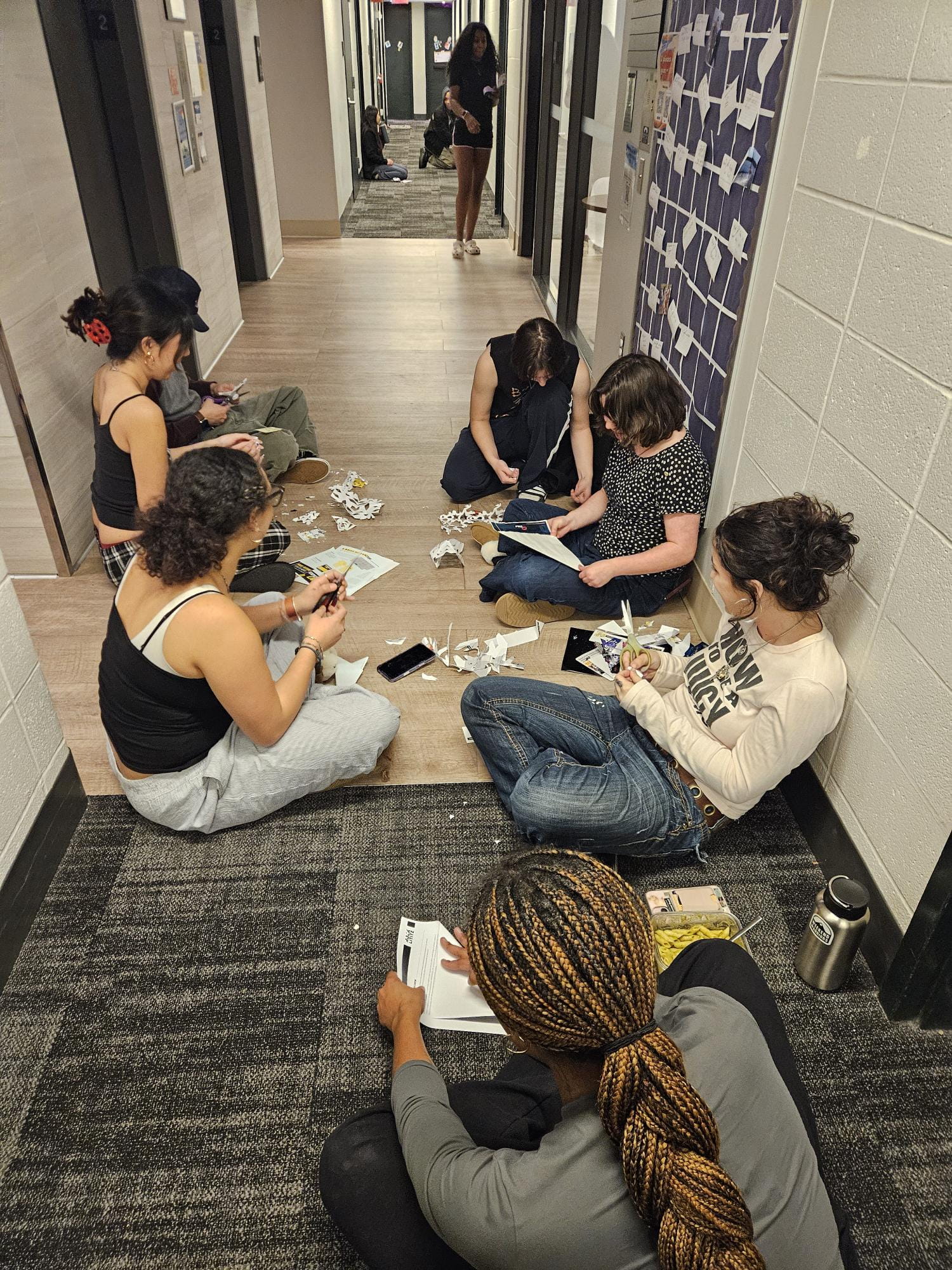
Westphal Ready began as an orientation experience for incoming first-year students and now runs throughout the academic year rather than concluding after Welcome Week. Complementing this is the Westphal Living and Learning Community (LLC), a residential program in Kelly Hall. The living-learning community allows students from different Westphal programs to share living spaces and classes throughout the year as part of a creative cohort.
The program enters its second year this fall with 39 students residing on one floor of Kelly Hall. "When students feel a sense of belonging, they're more engaged, more willing to explore new ideas, and better positioned to thrive," Ruben said.
The residential layer fosters connections that might not otherwise happen. Students who share a creative mindset, though not necessarily the same major, gain exposure to work happening across the college.
The Challenge: Redesigning While in Motion
The redesign hasn't been without its challenges. Early in the process, before many questions had answers, there was hesitancy.
Moving from 10-week quarters to two primary semesters, fall and spring, with a minimum of 30 weeks of instructional time, required faculty to re-evaluate how they teach foundational skills.
Other programs used the transition to rethink degree structures entirely. For example, Architecture restructured its longstanding 2+4 program — two years full time, then four years part time while working — into a new 3+2 model, giving students a stronger academic foundation before they enter the workforce fulltime, attending part time for their final two years. And Game Design & Production eliminated restrictive prerequisites, enabling first-year students to begin building games immediately upon arrival, but without limiting students from transferring in later.
The Future: Evolution, Not Reinvention
These many efforts reflect an expansion of the strengths that have long defined Westphal.
Graduates enter industries where creative professionals must move comfortably between independent work and collaborative problem solving. On any given day, a graduate might be deep in a niche technical craft; the next, leading a cross-functional team across multiple creative disciplines. The interdisciplinary structure built through Academic Transformation is designed to foster that agility as well as the critical professional skill of giving and receiving constructive feedback.
"We've always done that at Westphal, but a strengthened interdisciplinary approach under semesters gives students the rigor to engage more deeply with feedback, reflect through multiple lenses, and approach complex challenges with greater openness and curiosity," McHugh said.
The college's identity remains intact, but the opportunities for students to connect disciplines, ideas and communities continue to expand.
"We have been, and always will be, at the intersection of media, arts, design, entertainment and the management of the arts," said Ruben. "Now, we are strengthening that position for a future where creative work is increasingly interdisciplinary, making sure Westphal is the place where students find their voice, build their craft and lead the creative industries of tomorrow."