James R. Spotila

James Spotila, PhD

L. Drew Betz Chair Professor, Department of Biodiversity, Earth & Environmental Science
Spotila's research interests are centered in the areas of environmental science, physiological and biophysical ecology, fisheries biology and ichthyology and conservation biology. He is an expert in the physiological and population ecology of sea turtles.

A pioneer in the field of sea turtle research, Spotila has made key contributions to the understanding of their physiology and behavior, and brought awareness to the threats they face. He was part of the team that attached a transmitter to a sea turtle for the first time, was first to recognize the impending disappearance of the leatherbacks from the Pacific Ocean and the first to document the connection between sex determination and nest temperature.

In 2005, Spotila published the award-winning illustrated book Sea Turtles: A complete guide to their biology, behavior and conservation and donated all proceeds from sales to The Leatherback Trust. He is a professor of environmental science at Drexel and director of its Center for Biodiversity and Conservation. He worked in the Clinton Administration as Chief Environmental Scientist for the Department of the Army.

In The News

Endangered Green Sea Turtles May Be Making a Comeback in the U.S. Pacific
James Spotila, PhD, L. Drew Betz Chair Professor of BEES in the College of Arts and Sciences, was quoted in an April 26 Science News article about how beleaguered populations of green sea turtles living in and around Hawaii and American Pacific island territories are increasing in number.
In 'Pandas' Film, Drexel Team Helps Release Artificially Bred Bears Into the Wild
James Spotila, PhD, L. Drew Betz Chair Professor in the College of Arts and Sciences, was quoted in a June 5 Philadelphia Inquirer story on the new IMAX movie "Pandas" that will hold a sneak-peek this week. The story also features Spotila's former doctoral students and current student Wenlei Bi.
ECOVIEWS: Alligator Questions Are on the Rise
James Spotila, PhD, L. Drew Betz Chair Professor of BEES in the College of Arts and Sciences, was mentioned for his past study on basking alligators in a Feb. 25 Tuscaloosa News story.
China’s Pandas, Flowers Threatened by Global Warming
James Spotila, PhD, L.D. Bets Chair Professor in the College of Arts and Sciences, was quoted in a June 14 Climate Home story covering his study into giant panda metabolism and how climate change might threaten them. The study’s lead author, graduate student Yuxiang Fei, was also mentioned.
Identifying Danger Zones Could Help Prevent Sea-Turtle Deaths
James Spotila, PhD, a professor in the College of Arts and Sciences, was quoted in a LiveScience article on Jan. 18 about his research mapping danger zones in the Pacific for leatherback turtles’ encounters with industrial longline fisheries.
Drexel prof helps effort to keep sea turtles free of life-threatening lines
James Spotila, PhD, a professor in the College of Arts and Sciences, was quoted in a story on WHYY-FM/Newsworks.org on Jan. 13 about research he conducted to map areas of the Pacific Ocean where critically endangered leatherback turtles are most likely to interact with fisheries where they may be killed.

Related Articles

Giant Panda Free-Roaming Dogs Prevent Giant Pandas from Thriving in the Wild
Before China declared giant pandas a protected species in 1962, hunters in pursuit of the black and white bear used dogs to track them. Since then measures have been put in place to protect the vulnerable pandas, but more than half a century later, dogs are still jeopardizing their safety, according to a group of researchers that included Drexel's James Spotila, PhD.
Jacob Owens standing and holding Qian Qian 'Pandas' IMAX Movie Follows the First Artificially Bred Panda into the Wild - And Features Plenty of Drexel Connections
From the professor who dreamed up the panda release program to the alums who run it, Dragons play a huge role in "Pandas."
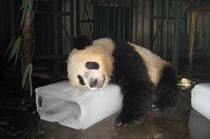
A giant panda cooling off with a block of ice. Photo by Mingxi Li. Pandas Don’t Like It Hot: Temperature, Not Food is Biggest Concern for Conservation
China’s bamboo supply is more than enough to support giant pandas after it was discovered that they have bigger appetites than originally believed, but climate change could destroy their plentiful food source anyway.
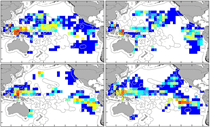
Maps showing probable relative interactions between leatherback turtles and industrial longline fisheries in the Pacific, over four quarters of the year. (Top row: Q1-Q2. Bottom row: Q3-Q4.) GPS Traffic Maps for Leatherback Turtles Show Hotspots to Prevent Accidental Fishing Deaths
The leatherback turtle in the Pacific Ocean is one of the most endangered animals in the world. Its population has declined by more than 90 percent since 1980. One of the greatest sources of mortality is industrial longlines that set thousands of hooks in the ocean to catch fish, but sometimes catch sea turtles as well. Using modern GPS technology, researchers are now able to predict where fisheries and turtles will interact and to reduce the unwanted capture of turtles by fishermen.
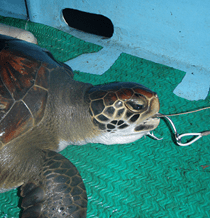
This green turtle was captured on a fishing longline in Pacific waters near Costa Rica. Study Shows Longline Fishery in Costa Rica Kills Thousands of Sea Turtles and Sharks
The second-most-common catch on Costa Rica’s longline fisheries in the last decade was not a commercial fish species. It was olive ridley sea turtles.
Giant pandas. Photo by Zhang Zhihe. Giant Panda Conservation Researchers from China to Speak at Drexel
Three leading scientists involved in the conservation of giant pandas at the Giant Panda Breeding Research Base in Chengdu, China will present a mini-symposium, “Biology and Conservation of the Giant Panda,” at Drexel University on August 22.
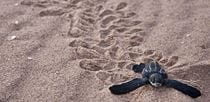
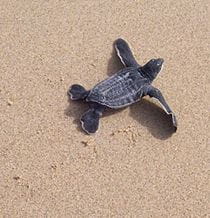
Leatherback sea turtle hatchling on the beach. Credit: Jolene Bertoldi / ZA Photos http://www.flickr.com/photos/za-photos/5406890987/ Rising Heat at the Beach Threatens Leatherback Sea Turtles, Climate Change Models Show
New research suggests that climate change could exacerbate existing threats to critically endangered leatherback turtles and nearly wipe out the population in the eastern Pacific. Deaths of turtle eggs and hatchlings in nests buried at hotter, drier beaches are the leading projected cause of the potential climate-related decline, according to a new study in the journal Nature Climate Change by a research team from Drexel, Princeton University, other institutions and government agencies.
Baby leatherback turtle on the beach El Niño Weather and Climate Change Threaten Survival of Baby Leatherback Sea Turtles
Drexel University researchers have found that the climate conditions at a major leatherback turtle nesting beach affects the early survival of turtle eggs and hatchlings. They predict, based on projections from multiple models, that egg and hatchling survival will drop by half in the next 100 years as a result of global climate change.
Top