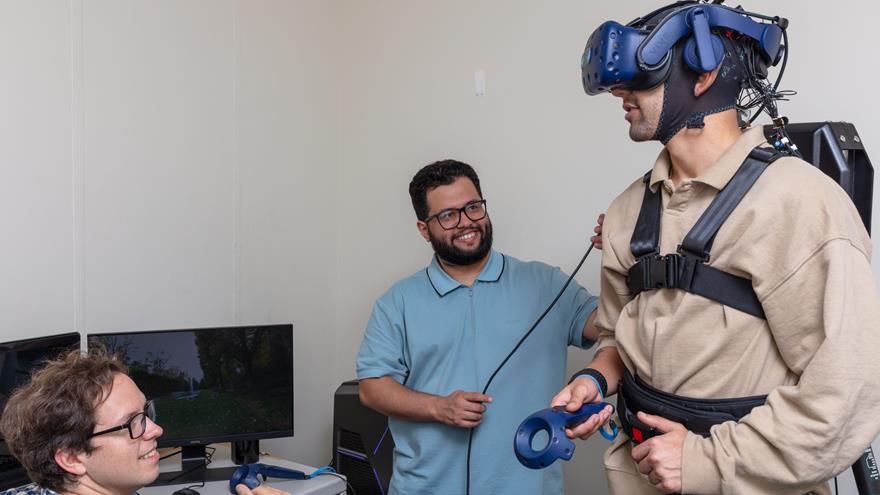

The Leonard Pearlstein Gallery of Drexel University’s Antoinette Westphal College of Media Arts & Design has been awarded a grant from The Pew Center for Arts & Heritage to support Escape->Control->Play: The Art of the Video Game. A Press Preview will be held on Thursday, Oct. 8 at 10 a.m. at the Pearlstein Gallery (3401 Filbert Street).
Escape->Control->Play is an interactive exhibition that highlights video games as sites of resistance, spaces to imagine alternative worlds and opportunities for collaboration. This interdisciplinary group of artists, designers and historians from around the world use gaming to upend the homogenization of mass entertainment, using play as a means of cultural disruption and critical reflection.
Visitors who attend the exhibit will have the opportunity to engage with retro, whimsical and cutting-edge gaming technologies - from Hsin-Chien Huang’s surreal virtual reality experience, to bespoke 3D printed consoles for Derek Yu’s 8-bit world in UFO50, to Erin Truesdell’s giant bowler hat controller.
“As an artist and father of a teen boy who loves sandbox spaces, like Minecraft and D&D, I am excited to explore the potential for video games to transform the white cube of Pearlstein Gallery,” said Pearlstein Gallery Director Mark Stockton. “For Escape->Control>Play, I envision creating the sound and interactivity of an arcade and in exploring how the aesthetics and nostalgia of video games can be platforms for subverting the norms of play.”
Visitors will be able to interact with video games and experiences divided into three thematic sections:
In <Future Imaginaries>, artists straddle the worlds of contemporary art and independent gaming, utilizing immersive storytelling, game play, sculpture and installation to critique our past and help imagine a different future.
Hsin-Chien Huang’s Bodyless, is a surreal virtual reality experience based on his memories from Taiwan’s martial law period in the 1970s.
Jeremy Couillard’s game Escape from Lavender Island is a third-person, open world exploration game inspired by anarchist anthropologist David Graeber’s critiques of capitalism and debt.
Lu Yang will be showing a game film, Great Adventure of Material World, and two arcade games exploring themes as diverse as genetics, cosmology, gender, and anime aesthetics.
.Compost Co-Op will present The Alembic Hotel, a first-person adventure arcade game and installation about information overload, radicalization and trying to find spirituality in the ruins of the internet.
In Queer Games >> Histories + Futures, Temple University Professor Adrienne Shaw, PhD collaborated with Drexel’s Ari Gass, PhD, assistant professor in the Antoinette Westphal College of Media Arts & Design, to present a display exploring the past, present, and future of LGBTQ+ representation and community building in video games, contextualizing the conversation within the larger political landscape of The United States.
The section features a vintage 1980s game, Caper in the Castro, as well as contemporary games featured in the Trans Game Zine.
Collaboration->Community highlights the spaces, both virtual and physical, that games create to bring people together, showcasing forms of collaboration that happen in the making, playing and internal metafiction of games.
Multibowl by Bennett Foddy and AP Thomson is a mash-up of more than 300 real multiplayer games you have never played into a single decathalon-style event.
Derek Yu’s UFO 50 builds a world around 50 video games by a fictional game design studio from the 1980s, UFO Soft.
Drexel graduate Erin Truesdell will present Haber Dasher, her cooperative video game in which two players work together to control a giant bowler hat.
Artist and musician Brian Gibson collaborated with engineers to create his VR games Thrasher and Thumper - high-tech, abstract experiences that are both visually enthralling and physically immersive.
The opening reception will take place on Thursday, Oct. 15, at the Pearlstein Gallery from 5:00-7:30 p.m. The exhibit will open on Tuesday, Oct. 13 and run through Saturday, Dec. 12.
Hours for the exhibition are Tuesday-Friday 12-5 p.m. and Saturday from 12-6 p.m. For more information about the exhibition and related public programs, please visit: http://Drexel.edu/EscCtrlPlay