The Cognitive Neuroscience of the 2026 World Cup


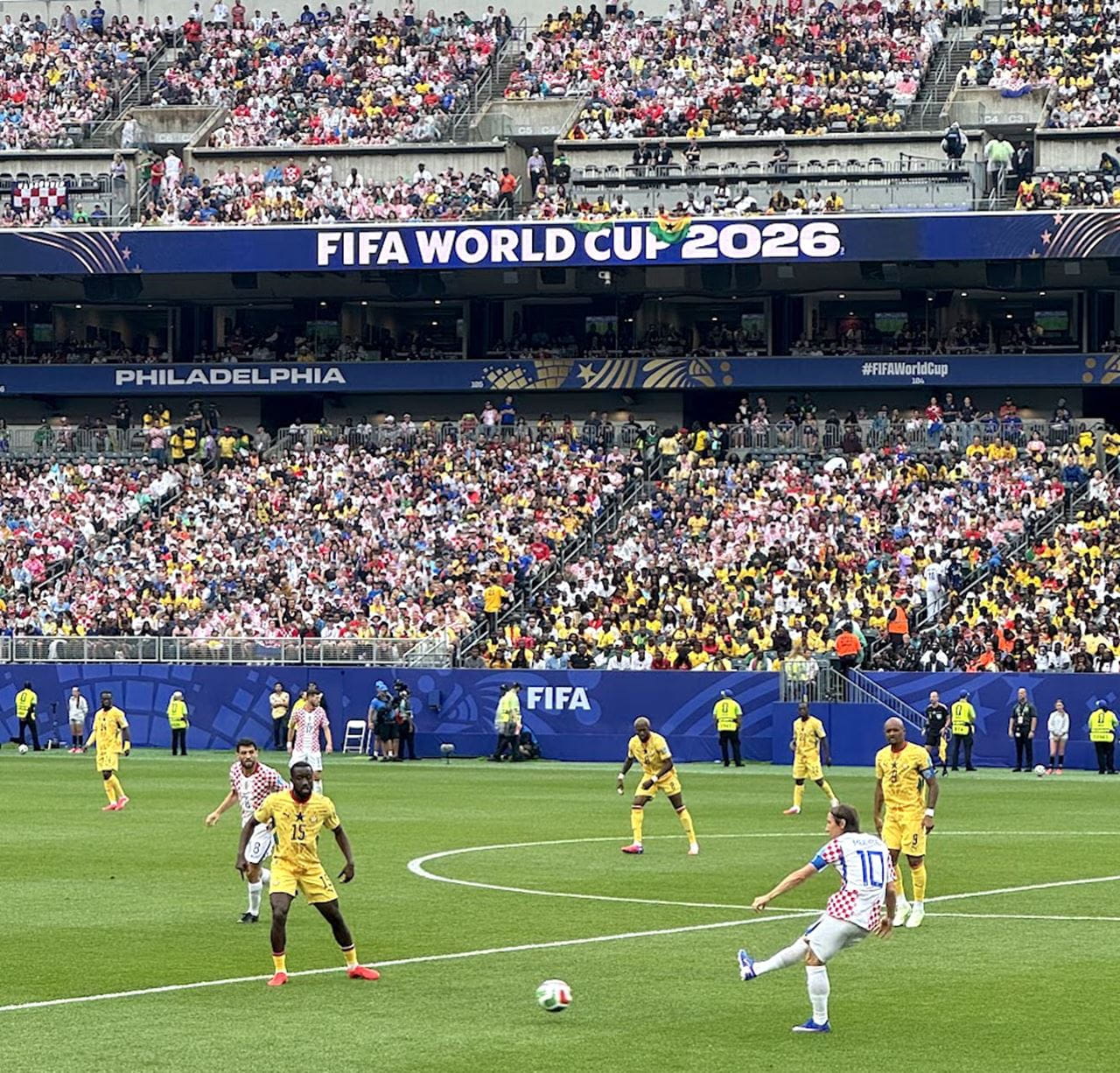
The 2026 World Cup can be a major potential catalyst for Major League Soccer (MLS) and U.S. soccer culture. The 1994 tournament in the U.S. set all-time attendance records and fueled interest in MLS, which began playing its first matches as a league shortly after, in 1996. Pictured here is a home game at Subaru Park of the Philadelphia Union. Photo credit: Eric Zillmer.
Eric Zillmer, PsyD, is the Carl R. Pacifico Professor of Neuropsychology in the Department of Psychological and Brain Sciences at Drexel University’s College of Arts and Sciences. He is a practicing sports psychologist and the director of the Global Sports Leadership Solution Lab. Drexel University has a proud soccer history, having won the men’s national championships in 1958. Under Zillmer’s leadership as the institution’s athletic director for 23 years, the men’s soccer team was crowned conference champions five times and qualified for three NCAA national championship appearances. Zillmer was also instrumental in arranging a friendly for Drexel’s women’s soccer team against the national team of North Korea, then ranked 7th in the world.
The 2026 World Cup
The FIFA World Cup 2026, hosted by Canada, Mexico and the United States, is deep into the knockout phase, and I think it is fair to say it has been a smashing success: sold-out stadiums, passionate fans and amazing matches. By all accounts, this has been the largest, best, loudest and most colorful World Cup yet. With 104 matches and 48 teams, it is the largest sporting event ever staged. In fact, the 2026 World Cup is as much a cultural event as it is a sporting one.
To the casual U.S. observer, it must, however, appear like chaos with 22 men chasing a ball with their feet. But don’t be fooled: professional soccer at the World Cup knockout phase is a game of imagination. Even though sports scientists assess that soccer is approximately 50% unpredictable, the challenge is to manage the chaos through creativity and tactics in your side's favor.
In fact, part of soccer’s beauty lies in its dynamic interplay between chaos and order. In that sense, as the world’s most popular sport, it reflects life itself. As a sport psychologist, I am very interested in identifying, applying and teaching the cognitive skills required to perform at a world-class level not only in the sporting arena but also in one’s professional and personal life through the work I do at the Happiness Lab at Drexel University.
Water Cooler Cognitive Neuroscience Soccer Talk
As we are set to crown a World Cup champion on July 19, below are some of my observations on the World Cup from a sport neuropsychology perspective, informed by the work of my colleagues at Drexel.
In the Department of Psychological and Brain Sciences, we do not gather around the traditional water cooler in Drexel’s Stratton Hall to talk sports. Rather, we dive into the World Cup’s advanced X's and O's in our offices, hallways and via e-mail.
Of course, our soccer discussions are more cerebral, literally.
One aspect of the star players on the teams that advanced deep into the knockout stage of the World Cup, beyond their football skills, is their mindset. Elite players anticipate better, are more creative, and make game-deciding judgments, seemingly effortlessly.
As I wrote in a piece for The Conversation, elite soccer players think soccer differently!
Most casual observers naively assume that world-class soccer players are innately talented or that soccer is luck. The German philosopher Friedrich Nietzsche has always been skeptical of effortless accomplishment, arguing that mastery is the result of discipline and deliberate achievements of those who refuse to settle for mediocrity. I could not agree more.
Consider the top scorers in the hunt for the Golden Boot, a prize awarded to the player who scores the most goals during the World Cup. Candidates include France’s Kylian Mbappé, Argentina’s Lionel Messi, England’s Harry Kane and Norway’s Erling Haaland. They are as creative as they are lethal. To understand their brains, one must examine how creativity is shaped in soccer.
Creativity in the World Cup
My colleague in Drexel’s Department of Psychological and Brain Sciences, Evangelia G. “Lila” Chrysikou, PhD, is a global expert on cognitive flexibility and creativity. According to Lila, creativity is the ability to generate ideas that are both novel and useful.
She argues that a common misconception about creativity is that most people think naively that “some people are creative and some people are not.”
The facts are, creativity engages processes that everyone has, including, of course, soccer players. In fact, the creative side of soccer is the “wow” effect, in which the laws of time and space seem to be manipulated to create an extraordinary solution to a complex problem that can lead to a goal-scoring opportunity. A singular moment of “awe.”
Contrary to the popular belief that creativity is an innate gift, contemporary creativity research suggests that expertise provides the building blocks of creative performance. Extensive training, knowledge, and experience allow individuals — including athletes — to recognize opportunities and flexibly combine existing skills in novel ways.
On the soccer field, these moments may appear spontaneous, but psychological research suggests that they reflect a sophisticated interaction between experience and cognitive flexibility. Creative experts are often able to move beyond habitual responses and rapidly adapt to dynamic situations, producing solutions that are both unexpected and effective.
Lila’s work on creativity is instrumental in understanding how soccer players manage and execute creative play. For example, creativity can be practiced; Lila proposes that if one is intentional about being creative, there is a greater likelihood of new ideas. It is important to prepare the brain for these scenarios by deliberately training it to generate both divergent and convergent thoughts.
This is exactly what Daniel Memmert, PhD, executive director at the Sport Science Institute at the University of Cologne in Germany, proposes. In his work on the tactical creativity approach to soccer, Memmert argues for a practice environment that fosters tactical creativity. In other words, top World Cup players have consciously practiced problem-solving situations on the pitch, so they are 100% present and ready during a magical, unscripted moment in the game, making it look as if it just happened.

The ‘Aha!’ Effect in Soccer
Just a few steps from my office in Stratton Hall is professor John Kounios, PhD, who is one of the brightest minds in neuroscience and an expert on creative flashes, which he calls “aha! moments.” Because soccer is such a low-scoring affair, creative insight during a World Cup knockout phase is worth its weight in gold! Indeed, soccer can be thought of as a unique, complex problem-solving situation. John compares it to, “a sequence of problems to solve, and any one of those problems could be solved by insight (i.e., an “aha! Moment”).” John argues that the elite soccer player can suddenly “realize a non-obvious strategy or move,” resulting in an exceptional creative moment often associated with a“sudden burst of high-frequency gamma waves in the brain's right hemisphere,” suggesting that all psychological processes are, of course, biological.
Indeed, the top players have, through extensive training and experience, developed an expert neural network that enables an ongoing state of high performance characterized by “effortless attention.” In this state, there is minimal conscious intervention by executive processes. That is why it appears, on the surface, to be “automatic.” In this sense, improvising on the soccer pitch is very similar to improvising in music: to be fully present, to focus on the moment, and to anticipate the next. But again, just as the jazz guitarists John has studied to research creative flow states, the world-class soccer performer has deliberately practiced improvising throughout their career.
Mind-Wandering in Soccer
I see that the office door of my colleague Aaron Kucyi, PhD, an assistant professor, is open, and I can’t wait to ask him about mind-wandering in soccer. Aaron recently published an interesting paper in Imaging Neuroscience that discusses what happens in the brain when our minds wander.
This is of interest to me as a sports psychologist because great players like Messi, seemingly counterintuitively, look away from the ball by mind-wandering. Why? To process their immediate environment more holistically. Aaron explains that during mind-wandering, the brain's "default network" turns on, which is entirely understandable given that it would be impossible to stay on task for 90 minutes, the length of a match. Aaron argues that during mind-wandering, the brain is not actually off but is processing information differently.
This is important for soccer players who must anticipate an extraordinary moment or opportunity on the pitch. In other words, for elite soccer players, activating the default network through mind-wandering makes them more productive and better able to understand the larger temporal-spatial matrix of their immediate environment.
Elite soccer players practice this to make it look automatic and effortless. It is an important cognitive skill to anticipate one’s next soccer move and execute a creative solution.
The Final Whistle
What a fun spin around my department. Sometimes the most interesting moments in academia are these brief exchanges between two colleagues at the mythical watercooler.
As we prepare to watch the 2026 World Cup finals, it is important to remember that elite soccer players possess the creativity and neurocognitive connectivity of world-class artists, architects, musicians, or poets, painting their skill on the canvas of the soccer pitch. It is astonishing to watch. And it celebrates the beauty of the moment in sports and in life on the world stage.
Amanda Moore, program director of the Happiness Lab at Drexel University, assisted with this article.