Students and Community Members Explore the Sky at Astronomy Night
by Sydney Davis
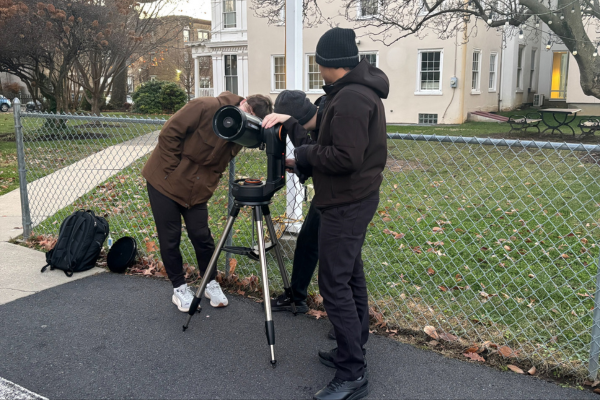
Drexel physics students Dimitar Zhekov (left), Konnor Seace (middle) and Neshal Kothari (right) set up a telescope for Astronomy Night
January 12, 2026

Photo of the moon by Sydney Davis
On December 3, Drexel University’s Department of Physics and the Dornsife Center for Neighborhood Partnerships hosted an Astronomy Night for the entire Drexel community. This event continues a long-standing collaboration between the two organizations, previously facilitated by the former director of the Dornsife Center and Professor of Physics Gordon Richards, PhD, who leads the Joseph R. Lynch Observatory. Under the leadership of the current director, Christopher Spahr, PhD, this tradition of shared outreach and engagement has remained strong.
Richards regularly hosts monthly telescope open houses at the Lynch Observatory with the help of student volunteers from the Department of Physics. However, the observatory presents accessibility challenges, as its only entrance requires navigating multiple flights of stairs. By hosting Astronomy Night at the Dornsife Center using portable telescopes, the event became far more accessible—not only for individuals with disabilities, but for the broader community as well.
The impact of this improved accessibility was evident throughout the evening. Attendees included a diverse group of Drexel students from fields such as physics, biological sciences, computer science, criminology and justice studies, as well as students from neighboring institutions like Temple University. Community members also joined in, and even Drexel Public Safety officers stopped by to take part. Guests were able to observe celestial objects, including the stars Vega, Deneb, and Altair, along with the Moon, Saturn, and even the International Space Station.
“The best time to see satellites in the sky is for two hours after sunset and two hours before sunrise,” Richards explained to attendees. “If they’re not blinking, they’re satellites. I like to say they’re UFOs—unidentified flying objects—until you look them up, and then they’re no longer UFOs,” he joked.
The return of Astronomy Night provides a welcoming space for anyone to learn about astronomy, offers a fun opportunity to explore the night sky, and—perhaps most importantly—serves as an inclusive environment where Drexel students and community members can connect and build a stronger sense of community.