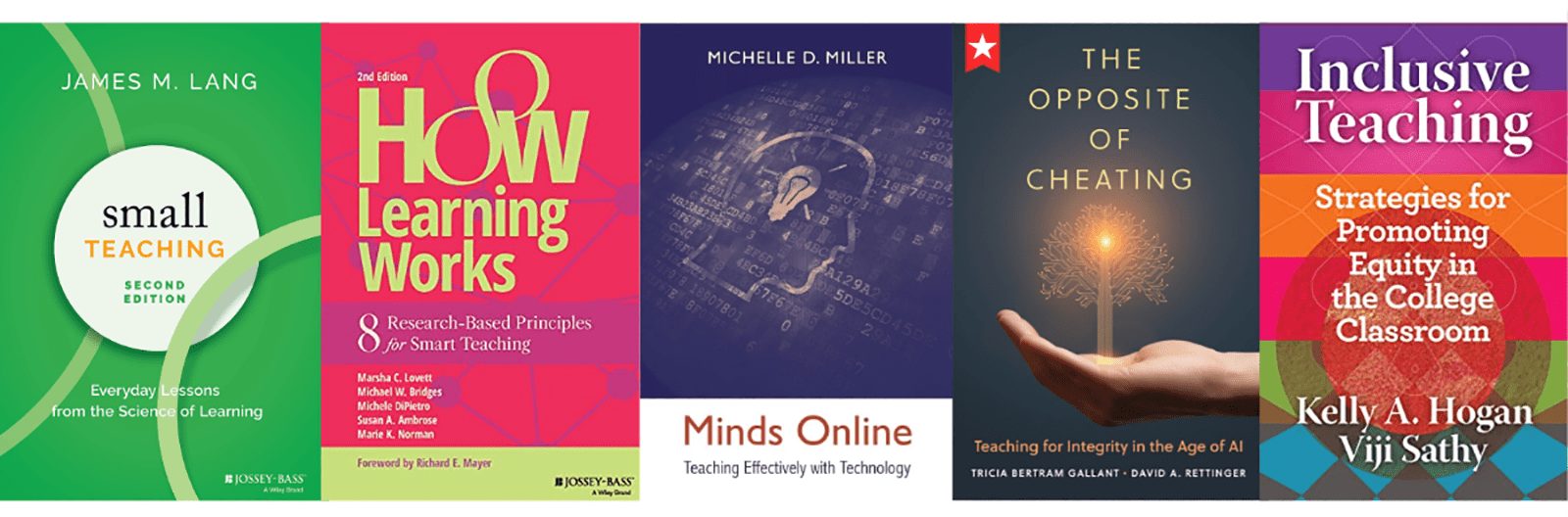
Five Books to Help Jumpstart Your Teaching!
 By Simmee Abiko
To teach in academia, we complete years of extensive study in our disciplines but often receive limited training in the art and science of teaching. Many junior and even senior instructors rely solely on prior experiences, advice from colleagues, or their own intuition to guide how they choose to teach. While these sources provide much needed guidance, there are also countless books, studies, podcasts, and blogs that offer insights into how students learn, models for designing courses, and practical strategies for effective teaching. If you are new to teaching or new to the scholarship of teaching and learning (SoTL), attempting to do a deep dive into these resources can leave you wondering where to begin.
Below, we have curated a list of common goals for teaching, with five excellent books that we continuously draw on in our programs. These are either foundational readings in SoTL, or are timely in addressing trending themes in teaching, each with a link to access the full version with Drexel Libraries.
I want to know more about the science of how my students learn
How Learning Works: Eight Research-Based Principles for Smart Teaching, 2nd Edition, 2023
By Marsha C. Lovett, Michael W. Bridges, Michele DiPietro, Susan A. Ambrose, and Marie K. Norman
How Learning Works is an introduction to the science of learning and research-backed strategies that tap into how students learn best. This book helps you to create a solid foundation of knowledge to support great course design and sound pedagogical choices.
I want to make small changes to my courses that are still impactful
Small Teaching: Everyday Lessons from the Science of Learning, 2nd Edition, 2021
By James Lang
When making a change or adding new components to a course, an overhaul is not always necessary. Small Teaching combines learning science with practicality, to provide a robust collection of small but mighty strategies for impactful teaching. This book helps you to implement new ideas in your courses, even if you only have 10 minutes in class or a limited amount of time to prepare.
I want to ensure that my online courses are engaging
Minds Online: Teaching Effectively with Technology, 2014
By Michelle Miller
Despite online courses being a well-established learning modality, both students and faculty sometimes hold the belief that we should expect less from online learning. Minds Online provides the theoretical framework for creating online courses that are effective, engaging, and capitalize on the advantages of an online format. This book helps you design or update an online course and expand your ideas of what is possible in an online teaching and learning.
I want to prevent cheating, but don't want to assume my students are being dishonest
The Opposite of Cheating: Teaching for Integrity in the Age of A.I., 2025
By Tricia Bertram Gallant and David Rettinger
Academic dishonesty is one of the biggest areas of concern for faculty today. With the rapid growth of online resources, particularly generative A.I., many are concerned that students simply aren’t doing their own work anymore. The Opposite of Cheating aims to revise the conversation around cheating by providing insight into why some students use these resources and how changes to the structure and goals of our assessments can refocus our courses on learning. This book helps you to rethink some of your assessments and provide hope if you are concerned about the impact that generative A.I. has had on teaching and learning.
I want to create a positive learning environment for students and a positive teaching environment for myself
Inclusive Teaching: Strategies for Promoting Equity in the College Classroom, 2022
By Kelly Hogan and Viji Sathy
When students feel a sense of belonging, they are more likely to overcome obstacles, be motivated to learn, and ultimately succeed in their college career. Inclusive Teaching introduces readers to pedagogical strategies that help to foster a sense of inclusion and belonging for all students and reduce barriers that may disproportionately hold some groups of students back. This book helps you to create a more positive learning environment, both for your students and for you as their instructor.
As you work to build or rebuild your approach to teaching, these resources support the development of evidence-based pedagogy; cultivating deeper learning for students and more meaningful teaching for instructors.
Looking for more research, strategies, or inspiration? Be sure to follow our monthly teaching tips, participate in one of our upcoming workshops or programs, or schedule a consultation. We are here to help you jumpstart your next idea!
Contact Us
3401 Market Street
Philadelphia, PA 19104