Meet 2026 Kaczmarczik Lecture Keynote Speaker Tatiana Erukhimova, PhD
By Sydney Davis
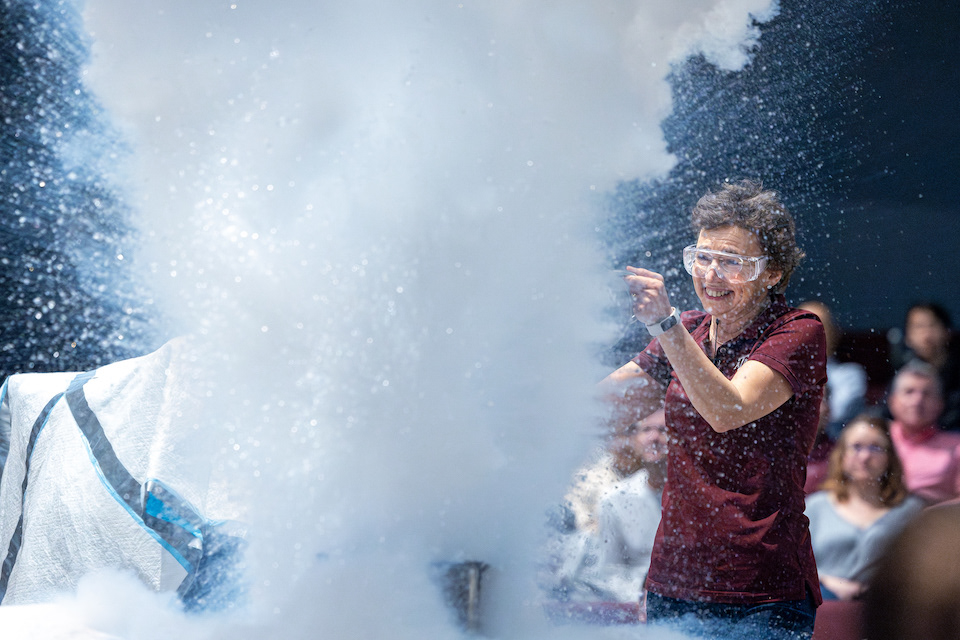
Tatiana Erukhimova, PhD, has become a viral sensation | Photo: Abbey Santoro, Texas A&M University Division of Marketing & Communications
March 5, 2026
Texas A&M professor Tatiana Erukhimova, PhD, has become a viral sensation thanks to her energetic demonstrations of physics experiments on social media. The College of Arts and Sciences Department of Physics is pleased to welcome Erukhimova as the keynote speaker at the 2026 Kaczmarczik Lecture on March 12. Erukhimova will showcase some of her most exciting physics demonstrations for the Drexel community as part of this special presentation. Learn more about her in the Q&A below.
Why did you decide to start recording your videos and posting them online?
Making physics accessible and enjoyable for people is a mission of our department. Over the last two decades, we have built a large outreach program, with 10–15 thousand people attending our events every year. We run the Texas A&M Physics & Engineering Festival, attended by more than seven thousand people annually, as well as Physics Shows for K–12 students. We have created videos of our demonstrations through the RealPhysicsLive program, and we bring our demonstrations to places where people already are—football games and First Fridays. Posting videos on social media is yet another way to bring physics to people’s homes and dinner tables. We share many demonstrations that can be done with household materials, and people often repeat the same experiments at home.
What is your favorite demonstration to perform and why?
I love my Big Cloud demonstration. I started doing it as part of the Physics Show. I mix two liquids — boiling water and liquid nitrogen, which is about 400 degrees Fahrenheit colder than the temperature of your skin. The combination produces a huge, towering cloud. I hope to make one during my presentation at Drexel University.
Why is it important to reach out to the younger generations and teach them about physics?
I do Physics Shows for K–12 students. My favorite age group is second graders — they are physicists by design. You need to start early, when they are still so enthusiastic about physics and science in general. Not everyone will become a physicist, but everyone deserves the chance to play with physics and develop an interest in science. Many people use cell phones, yet very few realize that almost every component inside them is based on a fundamental invention made by physicists and many of them received Nobel Prizes for their work.
Did you face any challenges being in a largely male-dominated field, especially when you were first starting out?
When I started teaching at Texas A&M, I taught a junior level atmospheric thermodynamics course and immediately enjoyed it. Three years later, I was assigned to teach my first large introductory class. At 8 a.m., I walked into a classroom of one hundred students fresh from high school. They expected an Einstein-looking professor; instead, they got me! My first class was a disaster. It took time to find my voice, but that experience taught me the importance of earning students’ attention and respect from the very first moment, and of making every class engaging and memorable. Since then, I always begin my first freshman lecture with a striking demonstration to create a “wow” moment.
What advice would you give to young women who are starting their academic and professional careers in physics or another STEM field?
Stay committed to the projects you truly believe in. Along the way, surround yourself with a support team: family, friends, and colleagues, who can encourage you through the challenges and celebrate your achievements.
Have you seen positive results from your study on how undergraduate student participation in informal physics outreach programs for K-12 students affects their success as physics majors so far?
We interviewed our alumni and upper-level undergraduates who were involved in facilitating informal physics programs. They told us that this experience not only helped them succeed in their studies but also helped them land dream jobs and thrive in their careers. More studies are needed to convince the physics community and university administrators that informal physics outreach programs not only benefit the general public but also enhance the educational experience of our students.
Are there any exciting projects you are currently working on, or plan to do in the future?
I am very proud of our DEEP program, Discover, Explore, and Enjoy Physics and Engineering, in which undergraduate students work in teams under the guidance of graduate students. They research, design, and build new hands-on demonstrations that they present to the general public at the Texas A&M Physics & Engineering Festival. Our next festival will be on March 28, and preparations are in full swing! We will have more than 200 demonstrations presented by our faculty and students, a science circus, and amazing talks by world-renowned physicists and an astronaut. I am looking forward to our annual celebration of physics with the community!