Projects
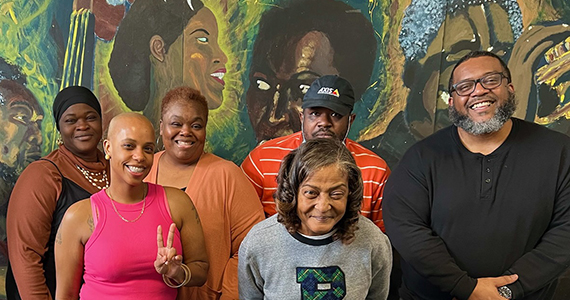
The Center for Hunger-Free Communities (the Center) was originally founded in 2004 by Mariana Chilton, PhD, at Drexel University’s School of Public Health and Children's Healthwatch. Since its inception, the Center has focused on addressing child hunger through research, advocacy and community-engaged work. Throughout its 22 year history, the Center for Hunger-Free Communities lead several impactful projects:
The Grow Clinic (2003-2013)
The Grow Clinic was a specialized clinic at St. Christopher’s Hospital in North Philadelphia that provided integrative medical care for young children struggling with proper weight gain ("failure to thrive"). The Clinic worked to prevent long-term health and developmental effects in young children caused by inadequate nutrition. The Grow Clinic served more than 300 families per year in Philadelphia and was modeled after the Grow Clinic at Boston Medical Center, started by Deborah Frank, a pediatrician and founding researcher with Children’s HealthWatch. The Philadelphia Grow Project was launched in 2003 by Mariana Chilton, PhD, and became a part of the Center for Hunger-Free Communities during its creation in 2004. It was renamed the Grow Clinic in 2005. The Center oversaw the funding and operation of the project during its first six years. In 2010, the clinic began transitioning to new leadership. Upon completion in 2013, the Grow Clinic operated independently from the Center. While the Grow Clinic is now closed, St. Christopher's continues to support children experiencing failure to thrive through their Gastroenterology (GI) Department.
Children's HealthWatch (2004-2019)
From 2004 to 2019, the Center for Hunger-Free Communities coordinated the Philadelphia site of Children’s HealthWatch, a multi-site surveillance study founded in 1998 by Deborah Frank, PhD, to examine the health and well-being of children under age four. Because this period reflects rapid brain development, even mild to moderate under-nutrition can have lasting effects on growth and development. Children’s HealthWatch brought together pediatricians and public health researchers who collected data from families in emergency rooms and clinics across several sites, including St. Christopher’s Hospital for Children (Philadelphia), Boston Medical Center (Boston), University of Maryland School of Medicine (Baltimore), University of Arkansas for Medical Sciences (Little Rock), and Hennepin County Medical Center (Minneapolis).
Since 1998, the study has produced one of the nation’s largest and most current datasets on food insecurity and early childhood development among families living in poverty. In Philadelphia alone, more than 10,000 caregivers participated. Findings consistently demonstrated the protective impact of public benefit programs such as WIC, SNAP, and LIHEAP on child health and development. Through its research with Children’s HealthWatch, the Center became nationally recognized for its expertise in child food insecurity.
Beginning January 1, 2020, administration of the project transitioned to the Department of Epidemiology and Biostatistics in the Dornsife School of Public Health under the leadership of Félice Lê-Scherban, PhD, MPH.
Witnesses to Hunger (2008-2020)
Launched in Philadelphia in 2008, Witnesses to Hunger was a participatory research and advocacy project that partnered with mothers and caregivers of young children who had experienced low-income and food and economic insecurrity. Through photography and storytelling, participants used their lived experience to advocate for their families and influence policy change at local, state, and national levels. The project quickly drew attention from major media outlets and Congressional leaders. Senator Bob Casey, Jr. from Pennsylvania invited Witnesses to Hunger to display their photo exhibit in Washington, D.C. and hosted their traveling exhibit across Pennsylvania in 2010.
The project began in Philadelphia and expanded into a national network of sites, including: Philadelphia, Baltimore, Boston, Camden (NJ), Connecticut, New Haven (CT), Washington, DC, Pennsylvania (statewide), and Martha’s Vineyard (MA). Each site engaged parents in documenting daily realities of food insecurity, housing instability, and economic hardship, and in sharing those experiences directly with policymakers and the public. Witnesses to Hunger centered the leadership of those most affected by poverty, positioning mothers and caregivers as experts in shaping more effective responses to hunger and inequity. The work combined visual storytelling with advocacy, testimony, and community engagement to drive systemic change.
During its time at the Center, Witnesses hosted more than 25 exhibits across the east coast highlighting the lived experiences of 77 community-member advocates. Exhibits were held in state houses, city halls, universities and community centers. Members of Witnesses testified before Congress and their local leaders about hunger, housing, education and poverty during its impactful work.
While most Witnesses to Hunger sites ceased activities as of 2020, the New Haven site remains active with the support of the United Way of Greater New Hampshire. Inquiries and requests to connect with active members of the program could be directed to Kim Hart (kimberlyhart224@gmail.com), Susan Harris (harrissusan82@yahoo.com), or Billy Bromage, MSW (billy.bromage@yale.edu).
Witnesses to Hunger is a registered trademark of Drexel University, and use of its name and materials required approval from the Dornsife School of Public Health.
Beyond Hunger: Real People, Real Solutions National Conference on Poverty and Hunger (2012)
The Center for Hunger-Free Communities and Dornsife School of Public Health hosted a national conference on hunger and poverty in May 2012 to reignite a national dialogue on hunger and poverty in America and ensure that legislators were discussing and reporting on what they will do about it. Conference participants consisted of 350 attendees including researchers, anti-hunger advocates, government representatives, government officials, public health experts, philanthropists, members of the media, and most importantly, those who had experienced hunger and poverty first-hand. The conference included keynote speakers Antwone Fisher, Gwen Ifill, and Rajsekhar Budithi.
Building Wealth and Health Network (2014-2026)
Seeing the power in group saving and financing in India, Center Director Chilton brought the idea to the Center. In 2014, the Center founded the Building Wealth and Health Netowkr as a randomized control trial (RCT) study. It was a trauma-informed, healing-centered financial empowerment program that combined financial education with emotional and peer support to build self-efficacy and resilience.
The Network strengthened intergenerational wealth and health by focusing on individual and collective healing, building peer support networks, and delivering financial education rooted in real-life application based on members lived realities. By addressing the relationship between trauma and financial well-being, it responded to gaps in public assistance programs and traditional financial education that did not support low-income families effectively to support them in breaking cycles of deep poverty. It also worked to shift how public systems understood and supported human potential, emphasizing healing and long-term economic stability alongside financial security. The program used matched savings, and later guaranteed financial incentives, to provide members the opportunity to apply classroom learning in their lives, which contributed to skill development and sustainable behavior change.
Designed in partnership with communities and grounded in real-life financial conditions, the model helped participants build new habits, address underlying emotional drivers of financial behavior, and follow through on clear, personalized financial plans. The program demonstrated strong impacts, including improved economic stability, reduced isolation, and better food security, employment outcomes, and physical and mental health, alongside an improved sense of hope for the future.
During its time at Drexel, the Network engaged more than 3,000 members and their families across 13 partner sites to strengthen economic stability, health, and wellbeing. Classes were taught in person across Philadelphia beginning in 2014 and transitioned online in 2020 in response to the COVID-19 pandemic, expanding access beyond Philadelphia. The program also supported a successful partner-led expansion in Richmond, Virginia, and trained dozens of organizations in trauma-informed, healing-centered practices to support community healing. Through the program's post-class engagement initiative, Network Nation, community members were empowered to serve as peer leaders and organized hundreds of hours of community-led programming focused on ongoing learning, connection, and advocacy
The program’s work serves as the foundation for the Economic and Community Healing (EACH) Network, which plans to continue the Network's commitment to trauma-informed, healing-centered financial empowerment as an independent, fiscally-sponsored project following the closure of the Center on June 1, 2026.
EAT Café (2016-2019)
Involvement in research and advocacy showed the Center the deep isolation that comes hand-in-hand with hunger and poverty. This recurring theme led the Center to create the EAT (Everyone At the Table) Café, located at 3820 Lancaster Avenue. This project was a collaboration between Drexel, Vetri Community Partnership and the West Philadelphia community. As Philadelphia's first pay-what-you-can restaurant, it provided a welcoming space where all community members could share a high quality, delicious 3 course meal regardless of income or ability to pay. The EAT Café relied on an intentional customer mix where some guests overpaid, while others underpaid or did not pay at all for the same meal.
The EAT Café was open from October 2016 to April 2019 and provided hundreds of families and individuals experiencing hunger with a safe space to have a healthy meal in a nurturing, supportive environment. Simultaneously, it created a space where people with resources could participate in a meaningful social experience by giving back to their community through good food and positive social contact. The space was beautifully designed, embracing of all people, and provided a venue for job training and community engagement. The Eat Café also hosted numerous events aimed to create community and connection across the diverse neighborhood.
In summer 2019, the EAT Café was host to a summer meal pilot in partnership with Share Our Strength/No Kid Hungry. This Test Kitchen project explored a potential model that could encourage restaurants to address hunger in their local communities by offering summer meals for children during non-business hours in their space. The pilot will took place June 17 to August 22, 2019, offering lunch time meals four days per week in the former EAT Café restaurant space. The Center partnered with Nutritional Development Services to provide ready-to-eat meals to children as part of the federally-funded, state-administered Summer Food Service Program, which reimburses providers who serve free healthy meals to children and teens in low-income areas during the summer months when school is not in session.
Research to Accessible Policy
The Center for Hunger-Free Communities advanced policy change by translating research into accessible policy briefs and engaging policymakers, advocates, and the public through legislative testimony, op-eds, media outreach, and public education efforts. Notable briefs addressed the impact of minimum wage policies, TANF cash assistance, paid family leave, Universal Basic Income (UBI), discrimination and economic insecurity, and community member-led solutions to hunger, helping elevate evidence-based and lived-experience-informed approaches to reducing poverty and food insecurity.