Balancing Nursing School and Division 1 Athletics Takes Grit and Determination
November 17, 2025
Most mornings, Kelsie Peters’ alarm rings at 5:20 a.m. Within 40 minutes, she’s already lifting weights, and by 7:45 a.m. she’s on the field for softball practice. If she doesn’t have a class or a lab, she stays at practice until 10 a.m.
But Peters isn’t anywhere near done for the day. In fact, she’s just beginning as she steps into her role as a junior in Drexel University’s College of Nursing and Health Professions (CNHP). That includes classes, time in the clinic and studying for the next nine hours.
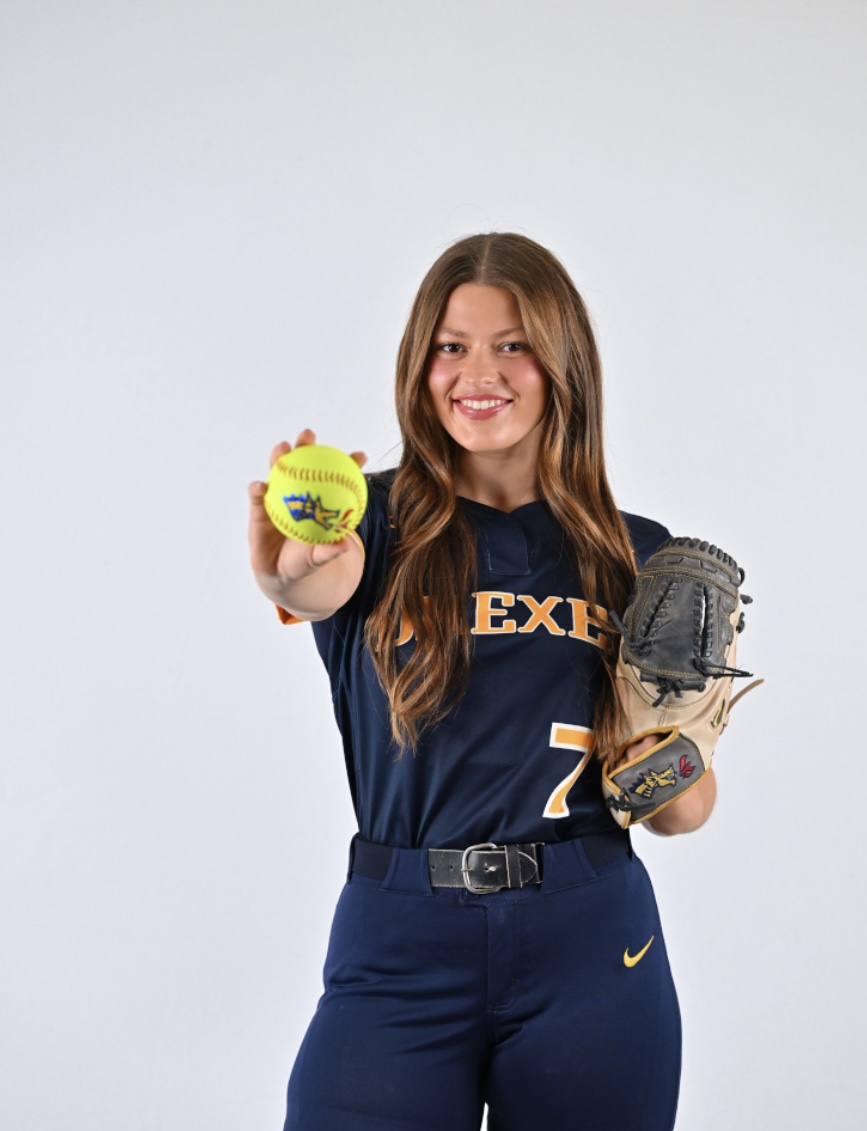
That’s just a typical day for student-athletes studying nursing, health sciences and exercise science. It can be a daunting task, filled with time management challenges and mental toughness, to find enough hours in the day to be not only a high-level student but an elite Division 1 athlete.
“I try not to look ahead too far, I just focus on the present and the people around me and what I’m doing in that moment,” said Peters, from Drums, Pennsylvania, the starting catcher on the Drexel’s women’s softball team. “If I look too far in advance, I’ll get overwhelmed. I plan out the week and take it day-by-day and get it done.”
To that goal, CNHP is there to help nursing student-athletes navigate the challenges associated with academics and athletics, according to Mary Yost, PhD, chair of BSN Co-op and RN to BSN programs. She added CNHP currently has 1,220 undergraduate students, of which 57 compete for various Drexel teams.
“While balancing Division 1 athletics with the demands of a nursing program is challenging, our student-athletes consistently rise to the occasion,” said Yost. “They demonstrate resilience, discipline and leadership — and many of them are among our top-performing students. Their success is a point of pride for both the College and the University.”
.ashx?la=en)
That support from the College is what attracted Emma Flickinger, a senior distance freestyler on the Drexel women’s swim team, to the University. Flickinger went through the recruiting process with Drexel’s swim coaches but had already secured her place in CNHP’s nursing BSN Co-op program.
“One of the main reasons I decided on Drexel was that it is one of the only places that not only allowed me to be an athlete and a nursing major, but seemed to encourage it and welcome the challenge,” said Flickinger, of McLean, Virginia. “The other schools that I visited either said I couldn’t do both or really didn’t think that I should be doing both.”
Time Management
For both Peters and Flickinger, figuring out how to fit everything into the day takes some effort. But each of them handles it a bit differently to achieve the same results.
Peters believes if she is going to put everything she has into both academics and athletics each day, she has to take care of herself first. “There has to be something in it for me,” she said. “I always say I have to fill up my own cup before I can pour it out to others.” That includes activities she enjoys, like working out, going for walks and runs and frequently talking to her family, whose love and encouragement she said provides the backbone of her efforts.
Flickinger employs a similar approach, although she adds there are other aspects that go into making the task load doable, such as proper nutrition and getting enough sleep.
“That’s something that has been a really hard learning curve for me, that everything else also needs to be in place to be successful in nursing and in swimming,” said Flickinger. “I’d be lying if I said I had completely conquered that.”
Mental Toughness
Rolling over and hitting that early-morning alarm can be exasperating, especially because the student-athletes are well aware of what the day has in store for them.
“Some days are extremely difficult to get out of bed, especially in the middle of our season,” said Flickinger. “You’re tired, beat down, you just want to sleep through practice, but that’s really not an option.”
In those times, she turns to her close friends, family and coaches and takes advantage of the mental health resources offered by the University.
“This is what I signed up for. Even if it’s something that you don’t want to do, it’s a commitment that I made and it’s something that I’m going to see through,” said Flickinger, who recently finished a co-op as a nurse tech in the Children’s Hospital of Philadelphia (CHOP) emergency department.
Peters realizes that as a nurse, she’s doing shifts where she’s in high-pressure situations working with people who physically can’t get out of bed. That allows her to take a step back and understand that she gets to wake up every morning and have the privilege of moving her body and playing a sport she loves.
She added that support from CNHP has enabled her to balance both academics and athletics, which greatly helps her mental approach.
“The faculty definitely understand the demands of athletics and are flexible with travel and practice schedules,” said Peters. “I have had conversations with almost every professor personally to introduce myself, tell them what’s going on with me, and all of them have been nothing but supportive and willing to help me. It’s absolutely fantastic.”
Why Do Both?
The simple reason Peters and Flickinger challenge themselves to balance both academics and athletics is that they are passionate about their profession and they thrive on competition.
But Flickinger added it’s not unusual for her to ask herself why she wanted to do nursing and swimming, knowing it’s a difficult position.
“For me, I just revert back to my younger self. This is something I’ve wanted for so long, longer than I’ve wanted nursing school. I wanted to be a D1 athlete and swim in college. I think about how proud the 12-year-old me would be, and it’s something that really motivates me to see it through,” she said.
Peters said being a nursing major and D1 athlete has grounded her and helped her realize it’s something she gets to do that other people may not have the opportunity and ability to do.
“I just want to say it is possible to do both nursing and athletics,” she said. “A lot of times, there are so many students who want to play a D1 sport and go into the medical field. It is a very misunderstood thing, where a lot of people think you can’t do it. It is possible, but you have to want it.”
By Michael Morsch