
Community Health Profile: Neighborhood Poverty and Health in Philadelphia

Data Brief
May 2017
View the brief: Neighborhood Poverty and Health in Philadelphia [PDF]
This brief describes the evolution and spatial distribution of poverty in Philadelphia and illustrates the relationship between neighborhood poverty levels and selected health measures.
Philadelphia is among the poorest large cities in the United States, and the city is home to large social inequalities that manifest themselves across neighborhoods.
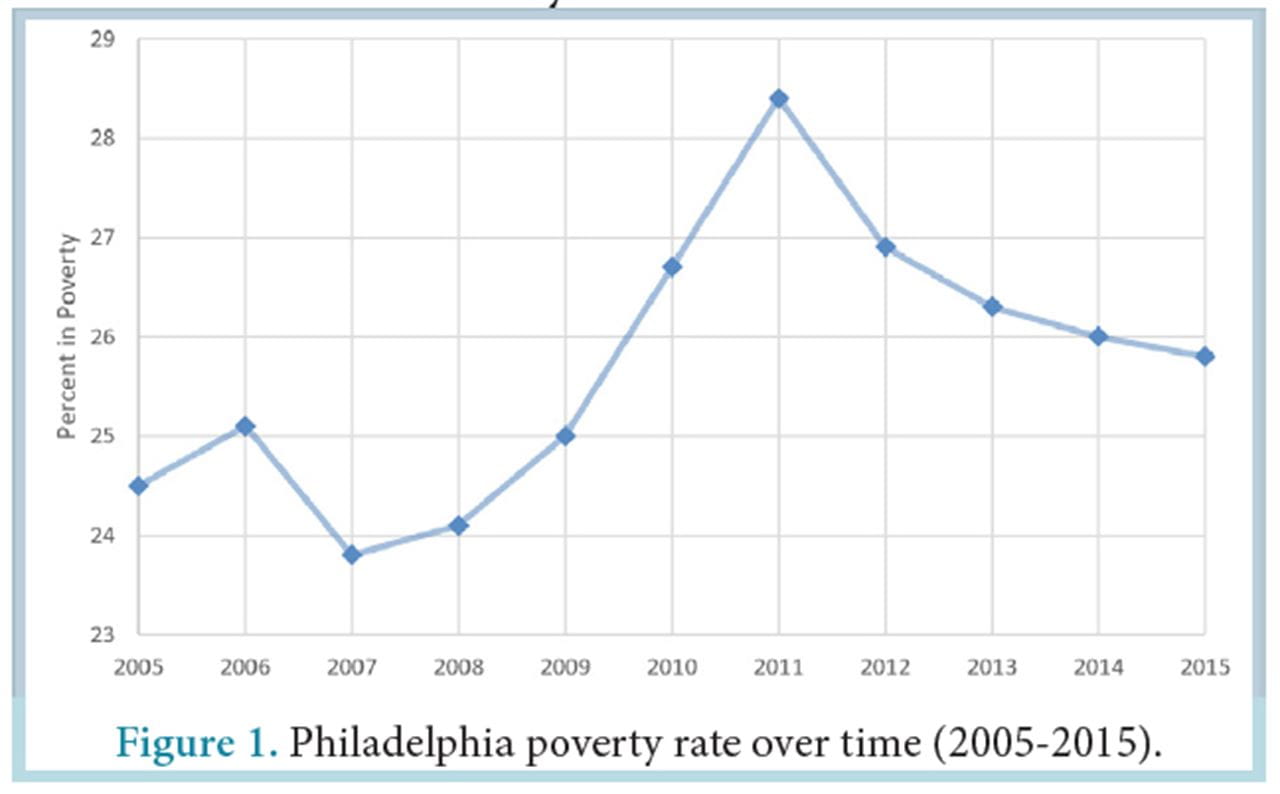
In Philadelphia, as in many US cities, people living in poverty are highly segregated from those who are more affluent. This results in important differences in poverty rates across the city. A large body of research has shown that higher neighborhood poverty is linked to poorer health across the lifespan.
Together with other research, the findings reported in this brief imply that improving health requires intervening simultaneously on individuals (e.g., through improved health care and health education) and on the contexts in which they live and work (e.g., through community development policies and reduction of occupational hazards).
Read the full brief Neighborhood Poverty and Health in Philadelphia [PDF], which concludes with a discussion of the implications of the findings for actions to improve population health in the city.