
The Impact of COVID-19 in Latino Communities in Philadelphia
UHC researchers used the framework of differential exposure and vulnerability to illustrate the context in which factors converged to result in disproportionately large COVID-19 impact among Latinos in Philadelphia.

Data Brief
June 2021
View the brief: The Impact of COVID-19 in Latino Communities in Philadelphia [PDF]
A Disproportionate Toll
The COVID-19 pandemic has resulted in the loss of many lives in Philadelphia. The impact, however, has been disproportionately high among Latino and Black communities. Over the past year, excess rates of infection, hospitalization and deaths have unfolded among the Latino community. In this brief, we use the framework of differential exposure and vulnerability to illustrate the context in which factors have converged to result in disproportionately large COVID-19 impact among Latinos in Philadelphia.
Latinos in Philadelphia
Latinos in Philadelphia represent a large and diverse population with respect to ancestry and their migration status. In 2014-2018, around 15% of the population in Philadelphia self-identified as Hispanic or Latino. One in five Latinos living in Philadelphia was born outside of the US. More than 60% of Latinos in Philadelphia have Puerto Rican ancestry, followed by 12% with Dominican ancestry. Latinos with ancestry in Mexico or countries in Central America are around 8% and 7% respectively. Latinos are concentrated in North Philadelphia, where most of the Latinos with Puerto Rican or Dominican ancestry reside, and in South Philadelphia, where most of the Latinos with Mexican or Central American ancestry reside.
Summary and Conclusions
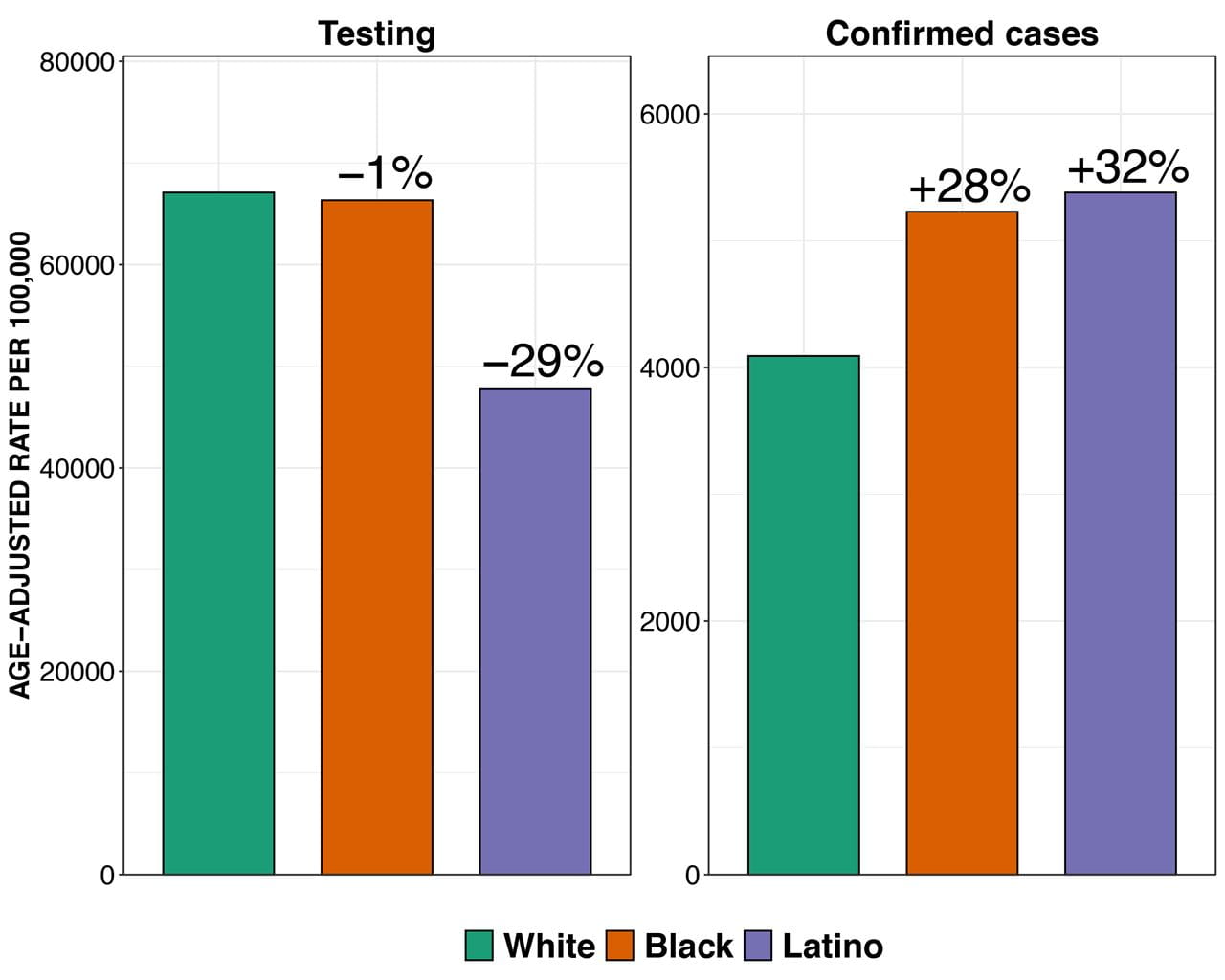
Latino communities in Philadelphia have been disproportionately affected by both the public health and the social components of this pandemic. The Latino population of Philadelphia has seen some of the highest incidence, hospitalization, and mortality rates of all racial/ethnic groups in the city, and have had the lowest rates of testing (see Figure 2). The Philadelphia Department of Public Health, together with multiple partners of the community responded decisively and earnestly to address the needs of the Latino population. However, disparities have remained which suggest that additional efforts will be needed to address the fundamental drivers of differential exposures and vulnerability levels:
References and Other Resources
- Philadelphia Department of Public Health. COVID-19 Testing and data. URL: https://www.phila.gov/programs/coronavirus-disease-2019-covid-19/testing-and-data/#/
- Philadelphia Department of Public Health. COVID-19 Impact by Age and Race/Ethnicity in Philadelphia. CHART 2020; 5(7):1-5. https://www.phila.gov/media/20200918100441/CHARTv5e7_revise.pdf
- Philadelphia Department of Public Health. AIDS Activities Coordinating Office Surveillance Report, 2017. URL: https://www.phila.gov/media/20190130165248/HIVSurveillanceReport_2017_Web_Version.pdf
- Philadelphia Department of Public Health. Access to Primary Care in Philadelphia. PDPH Chart Dec 2019, 4(8) https://www.phila.gov/media/20191218101940/CHART-v4e8.pdf
- Philadelphia Department of Public Health. 2020. Health of the City. Philadelphia’s Community Health Assessment. https://www.phila.gov/media/20201230141933/HealthOfTheCity-2020.pdf
- Philadelphia Department of Public Health. July 2020. Coronavirus-Interim-Racial-Equity-Plan. https://www.phila.gov/media/20200727145003/Coronavirus-Interim-Racial-Equity-Plan_revise.pdf
- Philadelphia Department of Public Health. Unemployment and mortality in Philadelphia. PDPH Chart February 2021, 6(3) https://www.phila.gov/media/20210216093428/CHARTv6e3.pdf
- National Conference of State Legislatures. COVID-19 and Immigrants. URL: https://www.ncsl.org/research/immigration/covid-19-and-immigrants.aspx
- Pew Research Center. Economic Fallout From COVID-19 Continues To Hit Lower-Income Americans the Hardest. URL: https://www.pewsocialtrends.org/2020/09/24/economic-fallout-from-covid-19-continues-to-hit-lower-income-americans-the-hardest/
- Pew Research Center. Mexicans decline to less than half the U.S. unauthorized immigrant population for the first time. URL: https://www.pewresearch.org/fact-tank/2019/06/12/us-unauthorized-immigrant-population-2017/
- Centro de los Derechos del Migrante. Ripe for Reform. URL: https://cdmigrante.org/ripe-for-reform/
- Center for American Progress. Protecting Undocumented Workers on the Pandemic’s Front Lines. URL: https://www.americanprogress.org/issues/immigration/reports/2020/12/02/493307/protecting-undocumented-workers-pandemics-front-lines/
- Center for American Progress. Congress Must Strengthen SNAP To Support Essential Workers During the Coronavirus Crisis. URL: https://www.americanprogress.org/issues/poverty/news/2020/06/11/486187/congress-must-strengthen-snap-support-essential-workers-coronavirus-crisis/
- Migration Policy Institute. Profile of the Unauthorized Population. URL: https://www.migrationpolicy.org/data/unauthorized-immigrant-population/state/PA
- Evans T, Whitehead M, Bhuiya A, Diderichsen F, Wirth M. Challenging Inequities in Health: From Ethics to Action. Oxford University Press; 2001.
- Blumenshine P, Reingold A, Egerter S, Mockenhaupt R, Braveman P, Marks J. Pandemic Influenza Planning in the United States from a Health Disparities Perspective. Emerg Infect Dis. 2008;14(5):709-715. doi:10.3201/eid1405.071301
Citation:
Lazo M, Bilal U, Correa C, Furukawa A, Martinez-Donate A, Zumaeta-Castillo C. The Impact of COVID-19 in Latino Communities in Philadelphia. Drexel University Urban Health Collaborative; June 2021.