ON VIEW
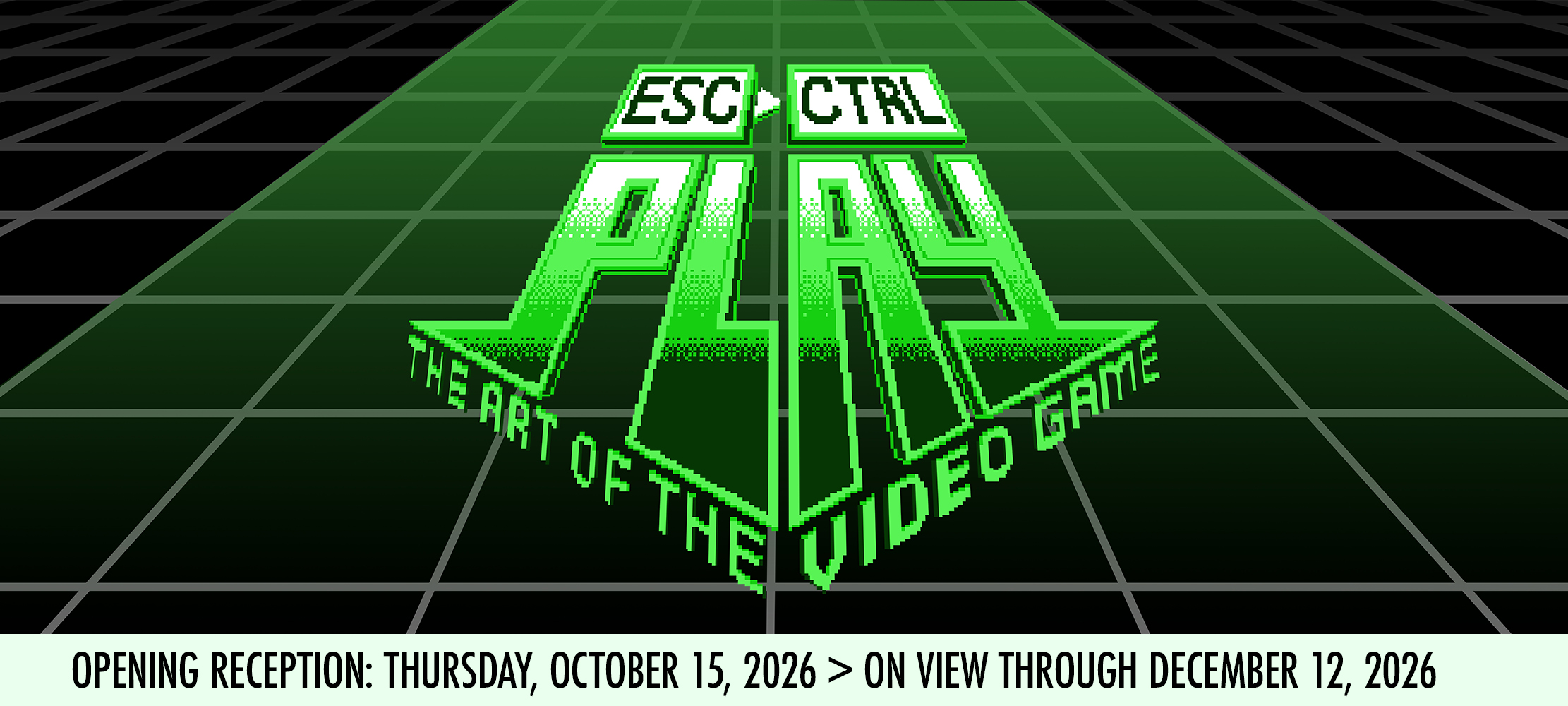
Opening Reception: Thursday, October 15, 2026; 5:30–7:00pm
October 13 – December 12, 2026
Escape>Control>Play is an interactive exhibition that showcases video games as sites of resistance, spaces to imagine alternative worlds, and opportunities for collaboration. The interdisciplinary group of artists, designers, and historians featured in the exhibition create experiences that subvert the homogenization of mass entertainment, using play as a means of cultural disruption, critical reflection, and community building. Through groundbreaking, cutting-edge, and whimsical game play, the exhibition highlights the powerful potential of video games to impact, disrupt, and reimagine our cultural landscape.
Through bespoke arcade games, immersive VR experiences, a giant bowler hat controller for two, a comprehensive history of Queer games, a group gaming lounge and more, Escape>Control>Play invites audiences to consider how video games create spaces for gathering, creation, empowerment, and imagination.
More About the Exhibition
<Future Imaginaries>
LuYang, .Compost Coop, Jeremy Couillard, Hsin-Chien Huang
In <Future Imaginaries>, artists straddle the worlds of contemporary art and independent gaming, utilizing immersive storytelling, game play, sculpture, and installation to critique our past and help imagine a different future.
Queer Games >> Histories + Futures
Curated by Professor Adrienne Shaw and Professor Ari Gass
This section explores the past, present, and future of LGBTQ+ representation and community building in video games and contextualizes the conversation within the larger political landscape of The United States.
Collaboration->Community
Derek Yu, Erin Treusdell, Puddle Studios, Bennett Foddy
Collaboration->Community highlights the spaces, both virtual and physical, that games create to bring people together, showcasing forms of collaboration that happen in the making, playing, and internal metafiction of games.
Part of this section will include a public gaming lounge and artifact display, curated by members of Drexel’s game design community.
Public Events
Thursday, October 15, 5–7:30pm
Pearlstein Gallery
Opening Reception
Friday, October 23, 6:30–8:00pm
The Westphal Annex Screening Room
A Live Conversation with Award Winning Independent Game Designer Bennett Foddy, moderated by Christopher Grant
Friday, November 13, 3:30–6:30pm
Pearlstein Gallery
A Workshop Exploring Alt Controllers with Game Developer and Professor Erin Treusdell
Wednesday, November 18, 7–8:30pm
Zoom
A Virtual Conversation on Worldbuilding with artists Tabitha Nikolai, Jeremy Couillard, and Hsin-Chien Huang, moderated by Professor Mary Ebeling
Friday, December 4, 6–8:00pm
The Westphal Annex Screening Room
Queer Games, Platform Censorship, and Alternative Distribution: A Community Q&A with Priro.Pro, Indiepocalypse, and Two-Headed Boy
This exhibition is supported by a grant from Pew Center for Arts and Heritage.