Bachelor of Science in Physics
Department of Physics
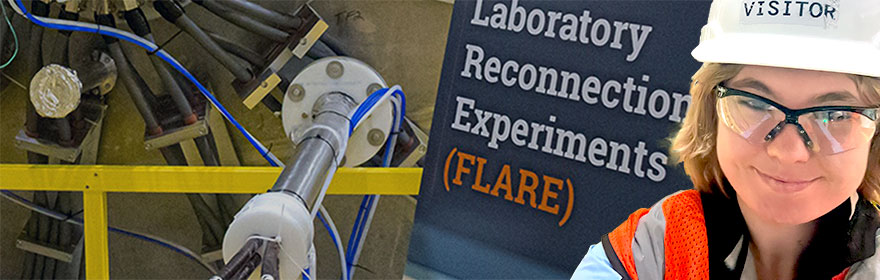
Alyssa Luby, BS physics '28, created her own co-op position at the Princeton Plasma Physics Lab to pursue her goal of using nuclear fusion to produce cleaner, more efficient energy sources. Full Story
Drexel’s Bachelor of Science in Physics degree program offers students a solid foundation that prepares them for graduate school or careers in science and technology. With an innovative curriculum that brings together classes and experts in the field, students explore subjects ranging from astrophysics and cosmology to molecular biophysics and subatomic particle physics. Undergraduate physics coursework extends our students’ abilities to manage real-world challenges using cutting-edge technology, critical thinking and analysis skills.
Physics majors will gain a comprehensive understanding of physical principles, problem-solving, mathematical and computational skills, and broad experimental training. Students also have countless opportunities to conduct research beginning as early as their first year, through Drexel’s renowned cooperative education program, in faculty-led research areas and as participants in global collaborations. In addition, our undergraduate physics program emphasizes proficiency in numerical techniques, parallel processing, and electronic communication, plus the essential software and computer languages relevant to physics research – giving our graduates a distinct advantage in any field they choose to pursue.
In addition, students in our program become proficient in numerical techniques, parallel processing, and electronic communication, plus the essential software and computer languages relevant to physics research – giving our graduates a distinct advantage in any field they choose to pursue.
Program Features
- Intimate learning settings, hands-on laboratories, an on-campus observatory and opportunities to engage in faculty-led research.
- A wide range of curriculum choices allows students to enhance their knowledge and extend their skills.
- Exposure to classical and modern physics right from the start as part of our freshman course sequence.
- Special elective biology sequences for physics majors who are interested in studying biophysics or medicine.
- Options to pursue advanced topics in atomic, nuclear, particle, solid-state or theoretical physics.
Visit Our Department
Quicklinks
Program Contact
Innovative Curriculum
Drexel offers students majoring in physics the opportunity to take as broad a selection of courses as possible by providing a wide range of choices in the curriculum. In addition, subject courses include scientific computing via Maple, a mathematical and analytical software package, and Python, a computer programming language used in theoretical and computational physics. High-performance computational physics exposes students to numerical techniques, parallel processing, electronic communication, primary computer languages and software relevant to advanced studies and physics research. The curriculum concludes with a capstone senior thesis project.
Drexel's undergraduate course offerings in physics are divided into three categories:
- Core Courses – Include 62 credits taken by all physics majors.
- Methods Courses – Focus on experimental, computational or mathematical physics techniques. Students complete 12 credits from the list; at least 6 credits must have a PHYS subject.
- Subject Courses – Involve intermediate or advanced physics courses intended to round out the student's undergraduate education – they are not considered essential for the Bachelor of Science in physics degree. Students complete 15 credits from the list. Courses at the 400 level and above will also be accepted, except for PHYS 480.
Please email David Goldberg, PhD, with any questions you may have at goldberg@drexel.edu.
Course Offerings
Electives and minors
Virtually every course in the Drexel physics major extends the student's ability to handle real-world problems solved by state-of-the-art techniques. An essential feature of the program is the large number of electives, which allow students to pursue particular topics of interest. There are numerous elective courses in areas as diverse as biophysics, cosmology, nanoscience and particle physics. Students can also choose electives to meet teacher certification requirements.
In addition, Drexel offers three physics minors:
Research Areas
Drexel University’s Department of Physics is recognized as a worldwide leader in physics research. Our department introduces undergraduate students to both traditional and novel areas of physics:
- Astrophysics and general relativity
- Atomic physics
- Biological physics
- Condensed-matter physics, including superconductivity and nanotechnology
- Laser physics and quantum optics
- Nonlinear physics and chaos
- Nuclear physics
- Nuclear astrophysics
- Particle and cosmic ray physics
In addition, our community of scholars is actively engaged in collaborative research around the globe, including the Sloan Digital Sky Survey in New Mexico, the Large Synoptic Survey Telescope in Chile and the Ice Cube Neutrino Observatory in Antarctica – to name a few.
Most of our students participate in research projects, several go on to co-author publications in peer-reviewed journals and others present their findings at national and international conferences.
Undergraduate courses extend our students’ ability to field real-world problems using state-of-the-art techniques. The Laboratory for High-Performance Computational Physics at Drexel is another venue for students to gain proficiency in numerical methods, parallel processing, electronic communication and the computer languages and software relevant to advanced physics research. Constructed in 1968, Drexel’s Joseph R. Lynch Observatory is home to one of the largest telescopes on the East Coast. Using our on-campus observatory, students in the observational astrophysics course gain hands-on skills through data analysis.
Students work side-by-side with faculty to explore research areas that include:
Diverse Community
The Department of Physics at Drexel comprises a diverse community of undergraduate and graduate scholars, dedicated faculty and professional staff focused on advancing each other’s personal, professional and academic growth. The department is committed to equity-centered and inclusive practices that allow each individual to excel and thrive. We promote access, opportunity, and justice by fostering a supportive environment built on mutual respect and a shared pursuit of knowledge.
Physics student organizations at Drexel include:
Co-operative Education Tracks
Drexel’s renowned co-operative education program encourages students to gain up to three six-month periods of full-time employment to explore career options, gain hands-on experience in their fields of interest, build their resume and foster a professional network.
Physics majors may choose from the following co-op tracks:
- Three Co-ops (five years)
- One Co-op (four years)
- No Co-op (four years)
Students who elect the No Co-op option are not required to pursue studies during summer terms. However, students in this track may elect to take one six-month period of co-op employment during the spring and summer terms of their junior year.
Career Outlook
Drexel students can look forward to countless applications for their degrees. Physics majors are valuable prospects for employment across a wide variety of industries as well as in research settings. With its emphasis on computational skills and coding, Drexel’s physics curriculum gives students a competitive edge as they enter the job market. According to the U.S. Bureau of Labor Statistics, jobs for physicists and astronomers are projected to grow 8 percent from 2021 to 2031, faster than the average for all occupations.
Recent graduates have gone on to successful careers such as:
- Computational Programmer, Princeton Plasma Physics Laboratory
- Project Manager, National Board of Medical Examiners
- Software Developer, Comcast
- Health Physicist, United States Army
- Graduate Researcher, University of California, Berkeley
Meet Our Students
Undergraduate Research Prepares Physics Major for Career in Sustainable Energy
Drexel physics major Alyssa Luby will present her research on the Beam Lifetime (BL3) Experiment at the upcoming Arts and Sciences Undergraduate Research Support (ASURS) symposium.
Read More
Science Meets Social Justice: Physics Major Dmitri LaBelle is Working Toward Equity
At Drexel, LaBelle has strived to excel academically in physics while contributing to diversity, equity and inclusion efforts in the field and even encouraging the next generation of scientists. They hope that more Drexel students will get involved in making their community a better place.
Read More
Research Co-op Leads to Innovative Breakthrough for Math and Physics Major Omesh Dhar Dwivedi
Drexel undergraduate Omesh Dhar Dwivedi was part of a team of researchers at the Princeton Plasma Physics Laboratory who have proposed a step-by-step chemical pathway to creating boron nitride nanotubes. The math and physics major from Lucknow, India, discusses the work he did during his co-op.
Read More
Two Physics Majors Receive Goldwater Scholarships
This year, physics majors James Minock and Johannes Wagner were Drexel’s sole recipients of the Goldwater Scholarship. Minock and Wagner were selected from a highly-competitive pool of 5,000 natural sciences, mathematics, and engineering college sophomores and juniors who were nominated by 443 academic institutions across the United States.
Read More
Physics Major Keziah Sheldon Receives Fulbright Award
Senior physics major Keziah Sheldon was one of three College of Arts and Sciences students and alumni to be awarded a Fulbright Study/Research award this year. The award supports nine months of full-time research sponsored by the Fulbright Program, the United States’ flagship international educational exchange program.
Read More