LIS Program Data 2024-2025
- Retention rate: One year retention for LIS who entered in 2024-2025 is 91%
- Average time to degree completion: LIS students who graduated in the most recent 4 quarters – Fall 2024–Summer 2025 – is 30 months
- Percentage of graduates holding positions relevant to the degree within 12 months of degree completion (may include further graduate study): For students who completed a LIS degree in 2023–2024 AY, 94% responded to post graduation surveys and 94% report full-time employment one year after graduation
LIS Program Assessment
In AY 2024–2025, the Department of Information Science faculty approved a revised set of Program Learning Objectives (PLOs) for the MSI–LIS program. These objectives were developed through a structured review process informed by stakeholder input, including alumni, employers, faculty, and current students. The revised PLOs articulate strengthened expectations around professional values, leadership, community engagement, and information stewardship, and are organized into four thematic domains:
Program Learning Objectives
1. Professional Values and Ethical Foundations
- 1. Analyze the social and technological contexts that shape the work of information professionals.
- 2. Demonstrate commitment to core professional values, including social justice, intellectual freedom, and privacy.
- 3. Evaluate and apply information policies, laws, and standards to support ethical technology use and equitable access to information and technology.
2. Organizational Leadership and Management
- 4. Lead and manage information organizations through equitable planning, budgeting, fundraising, and policy development.
- 5. Use research and data to demonstrate the value of libraries and information agencies and to inform information and technology strategies.
3. Community Engagement and Service Design
- 6. Assess the information needs of communities and design inclusive and accessible programs, resources, and services.
- 7. Develop and implement strategies to enhance information literacy for individuals and communities.
4. Information Stewardship and Digital Literacy
- 8. Guide users in creating and managing digital identities and materials effectively.
- 9. Sustainably appraise, organize, manage, and preserve digital and physical assets reflective of a diverse society, and support communities and individuals in preserving their identities and heritage.
Following approval of the revised PLOs, the LIS faculty conducted a comprehensive remapping of required core course assignments to ensure clear alignment between curriculum, learning objectives, and assessment practices. This remapping clarified how individual assignments contribute to multiple PLOs and strengthened the program’s evidence-based assessment framework.
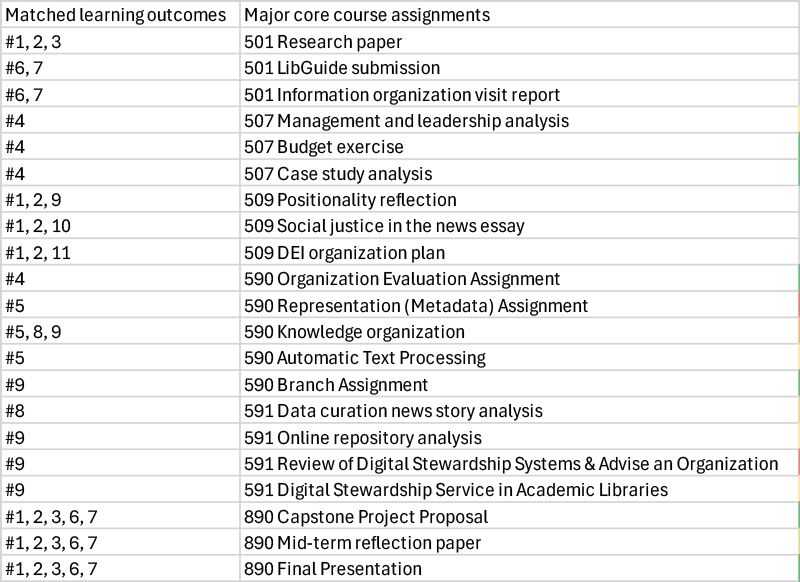
Analysis of Assessment Results (AY 2022–2023 to AY 2024–2025)
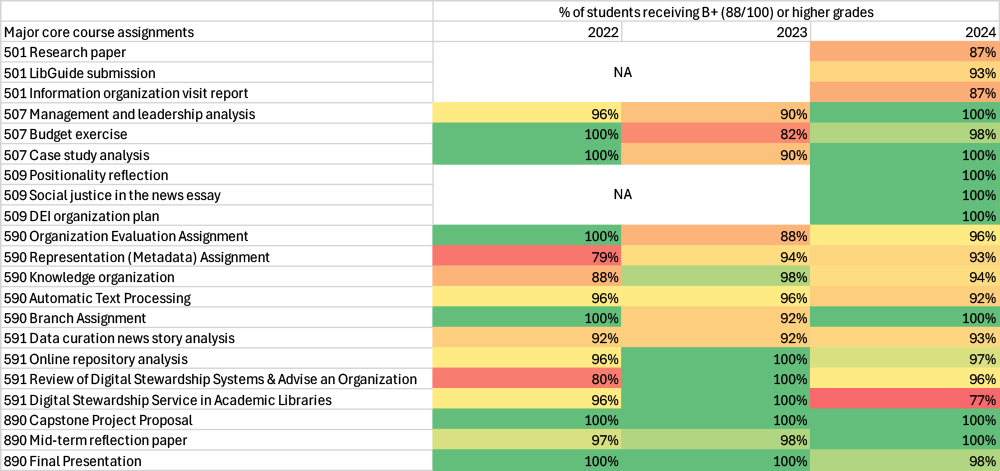
The table below reports the percentage of students earning grades of B+ (88/100) or higher on major core course assignments across three academic years. Overall, the results demonstrate consistently strong student achievement, with particularly notable gains following the implementation of the revised learning objectives and remapped assessments in AY 2024–2025.
1. Overall Performance Trends
- Across nearly all assignments and academic years, student performance meets or exceeds program benchmarks, with the majority of assignments showing 90% or higher of students earning B+ or above. In AY 2024–2025, most assignments achieved mid-to-high 90% performance, indicating that students are successfully meeting or exceeding faculty expectations across the revised PLO domains.
2. Impact of Revised Learning Objectives and Remapping
- Several assignments first assessed or newly aligned in AY 2024–2025 (e.g., INFO 501 and INFO 509 assignments) demonstrate strong initial results, with performance ranging from 87% to 100%. This suggests that the revised PLO framework and remapped assignments are both instructionally coherent and assessable, even in their first full year of implementation.
3. Leadership, Management, and Organizational Competencies
- Assignments in INFO 507 and INFO 590 mapped to leadership, management, and organizational analysis objectives (PLOs 4 and 5) show stable or improving performance over time.
4. Information Stewardship and Digital Competencies
- Assignments aligned with information stewardship, digital literacy, and preservation (PLOs 8 and 9), particularly in INFO 590 and INFO 591, show consistently high performance, with most results in the 90–100% range.
5. Capstone Integration and Program-Level Achievement
- The INFO 890 capstone assignments remain a clear strength of the program. Across all three years. The Capstone Project Proposal and Final Presentation consistently achieve 98–100% attainment. The Mid-term Reflection Paper shows steady improvement, reaching 100% in AY 2024–2025.
These outcomes provide strong evidence that students are able to integrate professional values, leadership skills, community engagement, and information stewardship in a culminating experience, thereby meeting the program’s comprehensive learning expectations.
View the 2023-24 LIS Program Assessment
View the 2020-21 LIS Program Assessment
View the 2019-20 LIS Program Assessment
View the 2018-19 LIS Program Assessment
View the 2017-18 LIS Program Assessment