Drexel Writing Center
University Writing Program
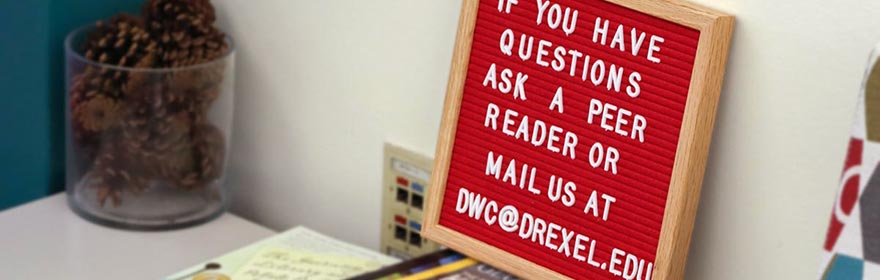
The Drexel Writing Center supports all members of our Drexel University community to develop as writers. We offer access to free, confidential consultations on writing projects, from interpreting assignments to planning to drafting and editing. We provide individualized support for any task –assignments, personal statements, scholarly articles for publication and personal projects– from brainstorming to final revision. In addition, the center helps to integrate writing and the teaching of writing into the curriculum.
The center, hosted within the University Writing Program, encourages students, faculty and staff to write and learn about writing by thinking through and developing various writing projects, primarily through one-on-one consultations with peer readers, graduate writing consultants and faculty readers.
The Drexel Writing Center is a proud member of the McGonigal ARC –Academic Resource Center– which offers an integrated hub of academic support services for all Drexel students.
We offer in-person and online appointments. Please contact the Operations Manager, with any questions about appointments by emailing dwc@drexel.edu or by calling 215.895.6633.
Faculty: We make class visits! We lead peer review sessions, workshops topics in writing, and more. Contact Liz Kimball at ek674@drexel.edu, for more information.

Location, Hours, Contact
Korman Center – Room 100
15 South 33rd Street
Philadelphia, PA 19104
Hours
Monday – Friday: 9 a.m. to 9 p.m.
Saturday and Sunday: Limited hours.
Contact
dwc@drexel.edu
215.895.6633
Our Approach
Statement of Anti-Racist Pedagogy
This statement is both an act of scholarship and an invitation. It was written collaboratively, over years of reading, writing, conversation, and thoughtful reflection on race and language. We see it as an invitation to you, the reader, a member of the Drexel community, to join us in antiracist work. We believe that, though talking about race can be difficult, it is necessary if we seek to create more equitable spaces.
We offer you a way of seeing how antiracist values and actions operate in the writing center. We invite you to converse with us about race, language, and anti-racist pedagogy. We see that conversation in the context of structural racism1 and are concerned with the policies and practices that create inequity which we all have a responsibility to address.
While we believe these issues have always been urgent, recent national events have shown that we all bear the responsibility to address systemic racism in the contexts in which we live. Please read the full statement to join us in doing so.
What We Know
At the Drexel Writing Center, we’ve spent years thinking about language and how it functions to create personal and professional identities. If we are going to help writers succeed, we find it essential to acknowledge that systemic racism persists and is insidious in norms that shape attitudes about language, in the systems, rules and expectations that make up our classes, schools, institutions and society. In writing center work, this is most clearly exemplified in the persistent practice of requiring that students use only Standard Academic English in their academic writing.
We join a chorus of scholars in Linguistics and Writing Studies that have clearly shown that there is no inherent standard of English, a living language that is constantly changing.
We affirm the decades of research in which linguists have shown that no dialect of English is superior to any other.
We uphold the linguistic truth that all dialects have an inherent grammar and can be used for effective communication.
These truths make it illogical to elevate Standard Academic English over other dialects, but more importantly, limiting students’ access to all of their linguistic resources also limits their learning and disproportionately impacts students of color. We believe it also devalues the dialects, languages, and identities of writers.
While we all live, learn, and work within the context of structural racism, we do not need to do so uncritically. Writing Studies and Linguistics teaches us that access to all of our linguistic resources facilitates learning. We see it as part of our job to make these linguistic truths central to our work, taking a more expansive and inclusive approach to the ways we use language to make meaning. This means that we may explicitly talk about institutional, systemic racism and its effect on our languages, identities and the choices we can make to work towards a more just world.
Our antiracist and social justice work can help all of the Drexel community.
With students, we will:
- Value all of your dialects and languages and help you to explore effective usage of them.We acknowledge the linguistic truth that no language or dialect of English is superior to another and we work with writing from that point of view.
- Help you to master Standard Academic English, not as a superior dialect, but as another tool to use with your already abundant linguistic resources.
- Learn new dialects and languages from and with you.
- Talk with you about the racist structures that privilege one dialect of one language, and consequently one race, over other equally valid dialects.
With faculty and staff, we will:
- Value all of your dialects and languages and help you to explore effective usage of them. We acknowledge the linguistic truth that no language or dialect of English is superior and we work with writing from that point of view.
- Upon request, give workshops to your department and classes about linguistic diversity, antiracist pedagogy and writing.
- Talk with you about the process of language acquisition and what that means for students who are still acquiring English as another language.
- Introduce you to equitable linguistic practices that give students greater access to all of their language skills and greater ability to succeed, to learn new material, and engage in critical thought, inquiry, and writing.
- Consult with you about how to incorporate practices—like codemeshing and translanguaging— that allow students access to all of their dialects and languages.
These practices can make learning new subject matter easier for students and allow them to do more with what they learn.
Peer Reader Program – For undergraduate students
Drexel undergraduate students from many majors staff the Peer Reader program. Through rigorous coursework and ongoing training, Drexel’s Peer Readers are highly skilled in helping their undergraduate peers to grow as writers. The Peer Reader approach focuses on collaborative learning and the social construction of knowledge. In addition, Peer Readers are trained in and focus on anti-racist pedagogy in their practice.
Peer Readers meet with students in one-to-one conferences that can take place in the Drexel Writing Center or online in synchronous appointments that utilize audio/video, chat functions and document editing capabilities.
Walk-ins are always welcome, but we encourage you to make an appointment to meet with a Peer Reader.
Meet Our Peer Readers
Faraaz Mohammad, BS/BA MIS and Business Analytics '27
Kianna Phosouvanh-Sythong, BA English '29
Anna Bokarev, BA English
Brent Mackesey, BA English '28
Sanjana Bandi, BS Biomedical Engineering '27
Teagan Hardiman, BA English '27
Eliana, BA Global Studies '28
Graduate Writing Consultants Program – For graduate students
Drexel graduate students from various areas of expertise help to staff the Graduate Writing Consultants program. Consultants are skilled in working with essential projects such as theses, dissertations and articles for submission to peer-reviewed journals. They are also adept at working through the difficulties graduate students often encounter as novices in their professional genres. As busy pre-professionals, consultants know graduate students' barriers and concerns, which allows them to provide informed support and feedback that helps students accomplish and often surpass their writing goals.
Graduate Writing Consultants meet with their peers in one-to-one conferences that take place in the Drexel Writing Center or online in synchronous appointments that utilize audio/video, chat functions and document editing capabilities.
While walk-ins are welcome, we encourage you to make an appointment since our Graduate Writing Consultants are in high demand.
Large Project Consulting Program
Have you got a large project like a term paper or dissertation?
Our Graduate Writing Consultants now offer free, long-term appointments for all Drexel graduate students working on large projects like dissertations. Get matched with a Graduate Writing Consultant who will work with you weekly, in-person or remotely, over an extended time to develop your long-term writing project.
The Drexel Writing Center will make your appointments, saving time and helping keep you on track. To get started or for more information, please email Dr. Llana Carroll, Coordinator of Graduate Writing Program, at lc3382@drexel.edu.
Meet Our Writing Consultants
Erik Billings '27
MFA Creative Writing student, College of Arts and Sciences
Marian Gasinu '26
MS Human-Computer Interaction and User Experience student, College of Computing and Informatics
Olivia Harriman '29
JD Law student, Kline School of Law
Bevyn Mannke '27
PhD Community Health and Prevention student, Dornsife School of Public Health
Nicole Marie '27
MS Psychology student, College of Arts and Sciences
Andrew Mirea '26
MS Material Science and Engineering student, College of Engineering
Julia Pines '29
PhD Clinical Psychology student, College of Arts and Sciences
Llana Carroll, PhD
PhD, English, Critical and Cultural Studies, University of Pittsburgh, 2009
Robert Zawatski, MFA
MFA, Creative Writing, Drexel University
Frequently Asked Questions
The Drexel Writing Center philosophy is rooted in the belief that all writers benefit from discussing their work. These conversations about writing are often collaborative and spur critical thinking. Writing center consultants are highly trained professionals who will provide a close and essential reading of your efforts and give you honest feedback based on their observations and your goals.
Our staff comprises undergraduate students, graduate students, faculty and professional tutors from diverse disciplines, which help to make the center a place where readers and writers from different backgrounds can learn from each other.
We believe that members of the Drexel community are hard-working and talented; we respect your right to make any final choices about your writing.
Do I need to have a finished draft to visit the center?
No, you don’t need to have a finished draft. The Drexel Writing Center will meet you wherever you are in the writing process—brainstorming, researching, outlining, drafting, revising, or copy editing. Just show up and work with us: we love writing at all stages.
Is an online appointment just as good as an in-person appointment?
Online appointments can utilize your computer’s microphone and camera during a session, similar to a Skype session. Meetings take place with the same readers who would conduct in-person sessions. In addition, you can use chat and both writer and reader can revise the document within the online module. They closely mimic the intimacy of face-to-face appointments and are most appropriate for students who cannot visit the main campus.
Can I make more than one appointment?
Undergraduate students can make up to two appointments per week. Graduate students may make one appointment per week. They can schedule appointments at any time that is most convenient for you.
Will my reader review my grammar?
Your reader will help you accomplish your goals for the project, including allowing you to recognize and correct errors in grammar and style. Readers may suggest that other aspects of your writing need more attention than your grammar, but the reader and writer will negotiate and agree upon goals. However, consultants will be more directive in correcting grammar errors with multilingual students still acquiring English as a written language. We acknowledge that English is a living language, so the “rules” are constantly changing. Therefore, we will help you improve your usage of academic English in your writing but will also honor other English as equally valid choices.
Do readers at the Writing Center copyedit papers?
We do not provide copy editing services. However, we will help you recognize and correct grammar and style errors. We will be more directive in correcting grammar errors with multilingual students still acquiring English as a written language. Copy editing is a valuable part of the writing process that polishes your ideas and can improve clarity in your writing. However, it is best tackled as the last step in your writing process after revising your ideas and organization. For this reason, your reader should suggest you work on those aspects of your project first or include improving grammar and style into work on developing your ideas and organization.
Do I need to be present while the reader goes over my paper?
Yes, appointments at the Writing Center are collaborative and conversational. Your reader will involve you to help advance their understanding of your writing through discussion. We expect you to work on your writing during the session.
Do you only review essays?
Many of our appointments focus on formal essays, but we’re happy to review any written work with you. Students often bring lab reports, presentations, resumes and cover letters, personal statements, and creative writing.
Will the Writing Center be able to help with papers like lab reports?
Tutors are adept at assisting all disciplines. Additionally, we employ students from many fields across the University, such as business and engineering. As a result, we have an extensive experience base to draw upon. If you want to work with someone from your discipline, you can select your reader according to your academic major using the drop-down box at the top of the schedule.
We're Hiring – Join Our Team
Undergraduate Peer Readers
Are you interested in your fellow students' ideas and learning to become a more critical reader and writer? Then the Peer Reader position in the Drexel Writing Center may be a good fit for you. The first step in becoming a Peer Reader is taking the training course WRIT 210: The Peer Reader in Context, offered in the fall, winter and spring terms. Taking WRIT 210 also fulfills a Writing Intensive course requirement. The course is intellectually challenging and focuses on your development as a reader and writer. We invite all students who complete WRIT 210 to interview for a position as a Peer Reader in the Drexel Writing Center.
If you have questions about this position, please email Janel McCloskey, Program Manager, Drexel Writing Center, at jfp48@drexel.edu.
Graduate Writing Consultants
The Graduate Writing Consultants program offers peer support in writing at the graduate level. If you are a graduate student and are interested in working with your peers on the higher level, challenging writing that graduate students engage in, please email Janel McCloskey, Program Manager, Drexel Writing Center, at jfp48@drexel.edu.
Operations Manager Co-Op
The Drexel Writing Center Operations Manager role is available as a co-op position. The position is responsible for day-to-day of the management of the center. In addition, the operations manager oversees larger projects for the Drexel Writing Center and the University Writing Program. If you are a Drexel student interested in this co-op position, we encourage you to apply through the Steinbright Career Development Center.