History
In founding Drexel University, Philadelphia financier and philanthropist Anthony J. Drexel launched a tradition of innovation.
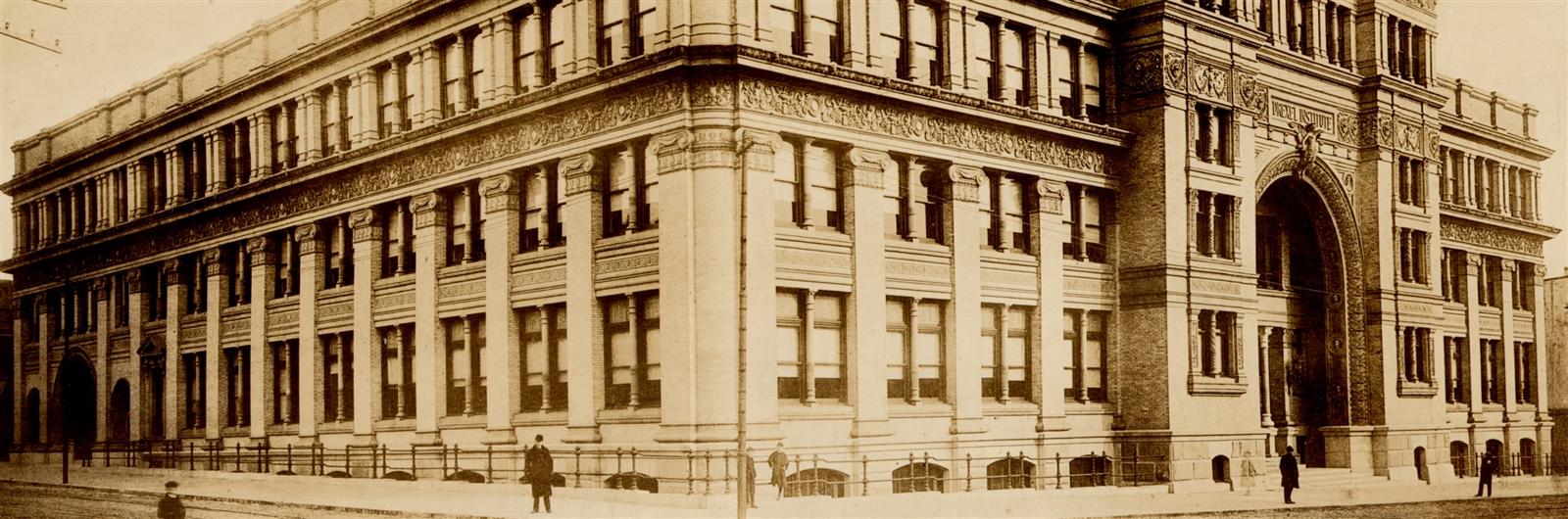
He envisioned an institution of higher learning uniquely suited to the needs of a rapidly growing industrial society and of the young men and women seeking their place in it — core values that continue to guide the University in its modern era. His vision was officially realized in 1891 with the establishment of the Drexel Institute of Art, Science and Industry.
The Growth of Drexel University
Originally a non-degree-granting institution, Drexel began conferring the Bachelor of Science degree in 1914, when its 18 departments were organized into four schools. In 1927, the Commonwealth of Pennsylvania granted Drexel the privilege to confer the Master of Science degree, and, in 1965, the Doctor of Philosophy degree.
The institution's curriculum and organization of its academic programs have evolved to include 15 colleges and schools. In accordance with this evolution, Drexel has undergone two changes in name, in 1936 becoming Drexel Institute of Technology, and, in 1970, Drexel University. The current title reflects the institution's commitment to research as well as the breadth of its programs. The University continues to expand, in 2006 becoming the first major research university to open a new law school in 25 years and one of just two universities operating a law school that follows a cooperative model of education. Drexel also established an affiliation with one of Philadelphia’s most storied institutions, The Academy of Natural Sciences, in 2011.
Central to Drexel’s experiential education philosophy is the co-op program. Through it, students mimic Anthony Drexel’s hands-on training, alternating periods of study with full-time professional employment. This creates an immense advantage when entering the workforce and provides additional context to supplement in-class education.
Innovation in Education
With innovation running through the heart of Drexel, it’s not surprising that the University has been at the forefront of higher education. In 1983, Drexel became the first university in the U.S. to require all undergraduates to adopt the microcomputer for use in coursework, with over 1,800 students being provided their own Macintosh 128Ks at a time when it was cutting-edge technology. This commitment to technology means that it was a natural fit for Drexel to become the first major university to operate a fully wireless campus in the year 2000.
Through all of the changes and evolution, Drexel's core mission has held constant. Since its founding, the institution has remained a privately controlled, nonsectarian, coeducational center of higher learning, distinguished by a commitment to preparing men and women for success in their chosen careers. Its greatly expanded enrollment, campuses, and curriculum reflect a history of responsiveness to societal and individual needs — just as Anthony Drexel wanted.

Born in 1826, Anthony J. Drexel was a financier and philanthropist whose actions helped shape the course of the United States as we know it — developing one of the world’s leading banks with his mentee John Pierpont Morgan, financing America’s railroads, underwriting the pay for the U.S. Army during the Civil War, and bailing out both the U.S. government and the New York Stock Exchange in 1895 and 1907, respectively. But perhaps his most lasting legacy is Drexel University, known at the time as the Drexel Institute of Art, Science and Industry.
Founder's Vision
As a teenager, Anthony Drexel went to work for his father’s small currency trading house, and the value of this real-world experience stayed with him as he advanced in his career. Meanwhile, the pace of technological change demanded new models of education in America. To fill this demand, Anthony Drexel dreamed of an educational facility that would produce graduates more experienced and more prepared for success than anywhere else. This was a guiding principle so prescient that Anthony Drexel invested more than $3 million of his own money (adjusted for inflation, about $78 million today) to answer the call. This focus on experiential education continues to drive the University more than 125 years later thanks to our unique cooperative education program, formalized in 1919.
A revolutionary idea at a time when college was reserved for upper-class men headed for ministry, law, or medicine, the Drexel Institute made no restrictions on religion, race, gender, or socioeconomic status. Drexel University maintains a commitment to this philosophy as well, developing a culture of inclusion that permeates all aspects of the University community.


